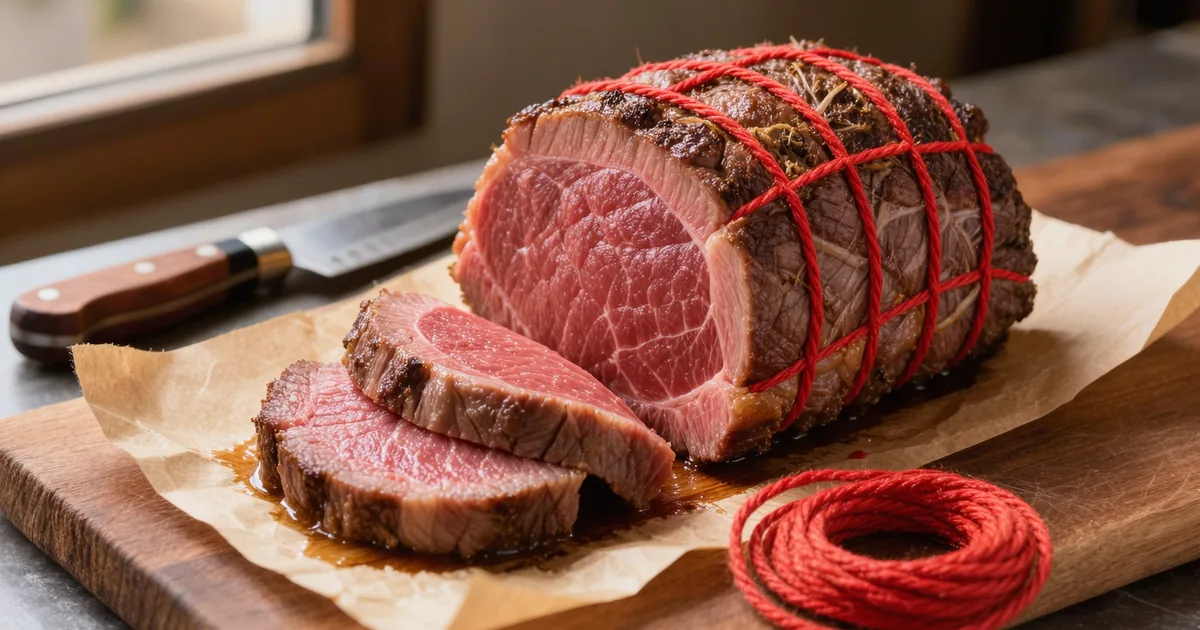
The number that ruins tenderloin math isn't the portion. It's what the butcher's paper weighs before you get home.
Every other roast here behaves: you buy a weight, cook it, lose some to the fire. Tenderloin adds a step nobody warns you about. Between the meat case and the oven, a third of what you paid for comes off on the cutting board — silverskin, chain, fat. Size your order off a per-person chart without counting that, and a five-pound plan roasts into a three-and-a-half-pound dinner.
So this page runs two numbers: what your guests eat, and what you buy to end up with it. The calculator keeps both on screen, along with the hour the roast goes in.
How much beef tenderloin per person: half a pound, trimmed
Half a pound of trimmed tenderloin per adult. That's the party figure, and exactly half what bone-in prime rib asks for — a full pound a head — because tenderloin carries no bone and barely any shrink. Ten adults, five pounds of roast. Clean arithmetic, once the meat is actually trimmed.
Now the honest part. The per-person figure is a real 4-to-8-ounce split, not somebody's error. The beef industry's chart is built on a 3-ounce cooked serving — roughly 4 to 6 ounces raw. Caterers plan 8. Both describe real meals, just different ones: 3 ounces cooked is a nutrition-panel serving on a plate with two sides and a starter. Eight is what a person takes when the tenderloin is the reason they came.
We use the party figure, and I'll say why plainly: I have never once been thanked for a smaller portion of tenderloin. If your menu is genuinely loaded, slide the leftovers control toward none and step down.
How many pounds of beef tenderloin per person once you add the trim back
Buy a whole tenderloin and the answer changes shape. A whole PSMO — trade shorthand for "peeled, side muscle on" — trims to about 65% usable roast meat. The rest is silverskin, the chain muscle running along the side, and fat. So the shopping rule for ten people isn't five pounds. It's 7.5 to 8 pounds of PSMO, which trims to the five you were planning on.
That 65% isn't a number I'd ask you to take on faith. One documented trim test, weighed piece by piece: a cook started with a tenderloin at 5 lb 9 oz and got 3 lb 6 oz of steaks and roast — 60.7% — plus small usable bits, plus 1½ lb of genuine scrap, about 27%. That 60.7% is the showpiece yield; our 65% assumes you also count the odds and ends, which any working kitchen does. The honest band is 55% to 75%, depending on how ruthless the person with the knife feels.
| Guests | Trimmed roast | Whole PSMO to buy | Cooked (82% yield) |
|---|---|---|---|
| 8 | 4 lb | 6.5 lb | 3.3 lb |
| 10 | 5 lb | 8 lb | 4.1 lb |
| 12 | 6 lb | 9.5 lb | 4.9 lb |
| 16 | 8 lb | 12.5 lb | 6.6 lb |
| 20 | 10 lb | 15.5 lb | 8.2 lb |
Computed by the Party Portions engine — party-portions.com
Buying an already-trimmed roast? The middle column is your shopping list — the calculator's toggle switches between the two.
How many people does a whole tenderloin feed?
Eight to ten. One whole tenderloin, trimmed, at the party portion — which is why a single roast handles most holiday tables without anybody doing arithmetic. Above ten guests you're buying a second, and I'd rather you know that in November than at the counter on the 23rd. Two smaller ones also roast more evenly, and give you two center cuts.
Buy the PSMO and trim it yourself. Yes, you're paying tenderloin prices for 35% you'll cut off — but that trim isn't garbage. The chain is the best stroganoff meat in the store. The tail makes stir-fry. The scraps make stock. Meanwhile the pre-trimmed roast charges you for fifteen minutes of the butcher's time, billed at the price of the thing he trimmed. A boning knife and one video is all it takes — I've taught it to crew on their first weekend. If you truly don't have twenty minutes on Christmas Eve, buy trimmed and don't apologize. Just make it a time decision, not one someone talked you into.
PSMO, trimmed, and the sizes that actually exist
USDA writes the spec sheet for these. The IMPS catalog — Institutional Meat Purchase Specifications, the language the meat trade orders in — lists a PSMO tenderloin as item 189A at 3 to 6+ pounds, the trade's sweet spot at 5 to 7. A fully trimmed tenderloin is item 190, at 2 to 4+ pounds. Which means when a recipe airily says "buy a 6- to 8-pound tenderloin," it's describing a big one, not a typical one.
Order by the number you need — "a PSMO around seven pounds, please" — and if the case only has fives, two of them is a normal answer, not a failure. Order early. Whole tenderloin is the first thing a meat counter runs out of in the third week of December.
Cook shrink is 18% — the leanest big roast you can buy
Tenderloin loses 18% in the oven. USDA measured it: a roasted tenderloin yields 82% of what went in, and no big roast on this site does better. That's the flip side of the trim tax — you pay ruthlessly on the cutting board, then almost nothing to the fire. Five pounds of trimmed roast comes out around 4.1 lb. A brisket surrenders half.
Timing runs off the trimmed weight, never the PSMO weight. In a 425°F oven: 20 to 25 minutes per pound of trimmed roast, pull at 135°F, rest 15 minutes tented — five pounds is roughly an hour and fifty minutes. That's the schedule the calculator assumes when you give it a dinner hour, working backward to the moment the roast goes in. Prefer to reverse-sear? Legitimate route, and the one the prime rib calculator is built around; this timeline is the straight hot-oven roast. Tie the roast and fold the tail under, or it cooks like what it is: a thick piece, a medium piece, and a thin one gray early.
145°F, 135°F, and which number is yours
Two temperatures. I'll give you both.
USDA FSIS calls whole beef cuts safe at 145°F with at least a 3-minute rest (USDA FSIS). That's the food-safety standard, backed by an agency that studies this for a living.
The steakhouse pull is 135°F, and every restaurant serving you medium-rare tenderloin works near it. USDA does not endorse that. It's a personal-risk choice — small for a healthy adult eating a whole-muscle cut, real for anyone pregnant, elderly, very young, or immune-compromised. Both numbers are true statements about different things. Decide which is yours before the roast goes in.
Once it's carved, the ordinary clocks apply: don't leave it out past 2 hours — 1 hour above 90°F (USDA FSIS). Leftovers keep 3 to 4 days refrigerated or 3 to 4 months frozen, reheated to 165°F (USDA FSIS). Though reheating tenderloin is a small tragedy. Leave it cold, slice it thin, put it on bread.
Christmas for 10: the worked example
A client dinner, ten adults, carving at 6 PM. The order: 8 lb of PSMO, trimmed to about 5 lb of roast — half a pound a head, exactly the plan. The engine put the oven at 3:52 PM: an hour and fifty minutes at 425°F, pulled at 135°F, fifteen minutes tented while the potatoes finished. Carved at six. The chain became a stroganoff two days later, and the family still brings it up more than the roast.
Load that Christmas plan. Ten adults, whole PSMO, dinner at six — change any of it and the timeline recalculates.
Load Christmas for 10About cost: I won't publish a per-dollar comparison against prime rib. Retail beef prices swing by week and region, and I couldn't verify a ratio to two sources I'd stand behind — so I'm not inventing one. Here's the part that doesn't move: you buy half the weight per guest. Ten adults want 10 lb of bone-in prime rib — five ribs — where the same ten take 5 lb of trimmed tenderloin (size the prime rib side by side). Price both at your own store and compare plates instead of stickers.
Then feed the rest of the table. Ten guests take 5 lb of mashed potatoes — run the numbers — and ten cooked cups of rice from 3.3 dry (rice per person calculator). If half the table would rather have their own steak, ten standard appetites take seven 12-ounce ribeyes (steak per person calculator). Or start from the guest list and plan the whole menu at once.
Frequently Asked Questions
Beef tenderloin for 10 people: how much should I buy?
Five pounds of trimmed roast — half a pound per adult. Buying a whole PSMO tenderloin? That's 7.5 to 8 pounds on the receipt, because trimming takes about 35% off as silverskin, chain, and fat. The calculator rounds to 8 lb, which trims to roughly 5. Buying trimmed, order 5 lb and you're done. Either way, ten adults sits inside what one whole tenderloin handles, since a trimmed one feeds 8 to 10. Cooked, that 5 lb serves out at about 4.1 lb of beef, because tenderloin only loses 18% in the oven. If two of your ten are big eaters, the calculator counts them at one and a half.
Is half a pound of tenderloin per person too much?
It depends which chart you trust — and this is a real 4-to-8-ounce split, not a mistake. The beef industry's chart is built on a 3-ounce cooked serving, roughly 4 to 6 ounces raw. Caterers plan 8 ounces. We use the caterer's figure, because a holiday tenderloin is the reason people came to the table, not a nutrition panel. If your menu is heavy — a starter, soup, four sides — plan closer to 6 ounces a head and nobody will notice. What I wouldn't do is plan 4 ounces and hope. Tenderloin is the one roast where a thin slice gets remembered.
What is a PSMO tenderloin, and should I buy one?
PSMO stands for peeled, side muscle on — a whole tenderloin with its fat peeled but the chain muscle and silverskin still attached. USDA's IMPS catalog lists it as item 189A, 3 to 6+ pounds, with the trade's sweet spot at 5 to 7. A fully trimmed tenderloin is item 190, 2 to 4+ pounds. Buy the PSMO if you have fifteen minutes and a boning knife: the trim isn't waste — the chain makes exceptional stroganoff, the tail makes stir-fry, the scraps make stock. Buy trimmed if you'd rather spend Christmas Eve doing anything else. Just don't pay the premium believing the job is difficult.
What temperature should beef tenderloin be cooked to?
USDA FSIS calls whole beef cuts safe at 145°F with at least a 3-minute rest (USDA FSIS). That's the standard, and the number I give you first. The steakhouse pull for medium-rare tenderloin is 135°F, and USDA does not endorse it — that's a personal-risk choice, and a different one depending on who's eating. For anyone pregnant, elderly, very young, or immune-compromised, take the 145°F line seriously. Both numbers describe something true. Pick yours before the roast goes in, and pull 5 to 10 degrees early either way, because carryover heat keeps cooking a roast that's out of the oven.
When does the tenderloin go in the oven for a 6 PM dinner?
For a 6 PM dinner with 5 lb of trimmed roast, the oven goes on about 3:52 PM. The math: 20 to 25 minutes per pound at 425°F puts five pounds near an hour and fifty minutes, plus a 15-minute tented rest before carving. Time it off the trimmed weight, never the PSMO weight — that mistake overshoots by half an hour. Give the calculator your dinner hour and it works backward for your exact roast. Then use a probe thermometer, not the clock: ovens lie and tenderloins taper.
How long do beef tenderloin leftovers keep?
Three to four days refrigerated, or 3 to 4 months frozen, reheated to 165°F (USDA FSIS). Get it in the fridge within 2 hours of carving — 1 hour if the room is above 90°F (USDA FSIS). But here's my real advice: don't reheat it. Tenderloin is lean enough that a second trip through heat takes it from medium-rare to gray with nothing in between. Keep the roast in one piece rather than pre-sliced so it holds moisture, then slice it cold and thin the next day for sandwiches with horseradish. Cold roast beef is the quiet best meal of the holiday.