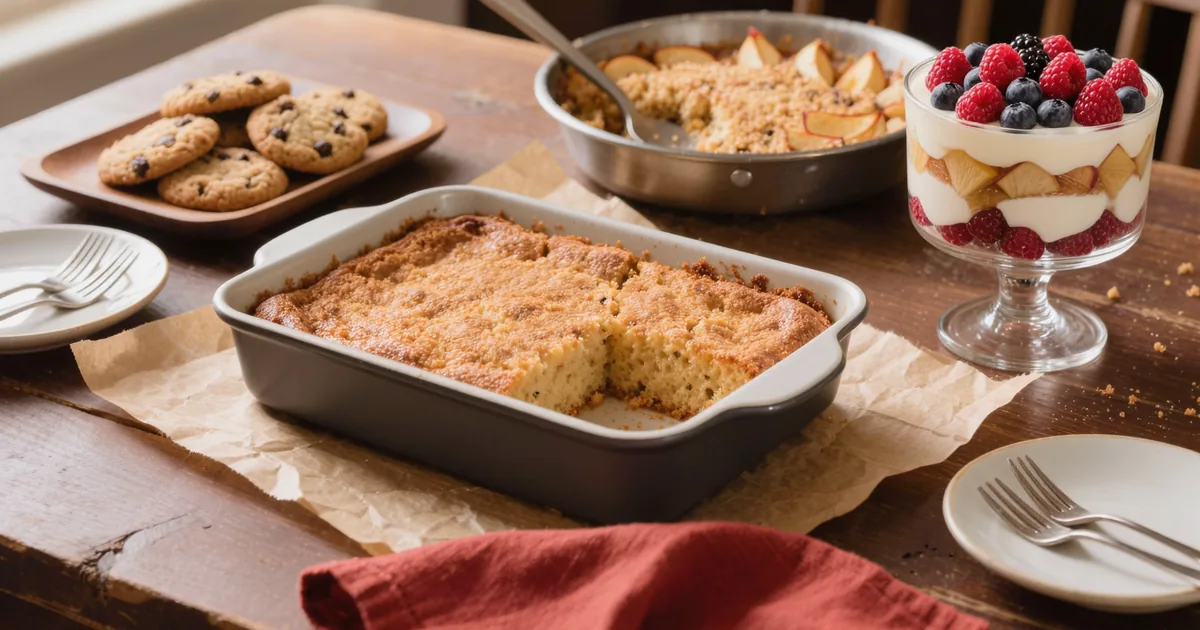
Nobody has ever asked me for a dessert. They ask me for a pan. "Will one pan do it?" — that's the actual question at every event I've ever worked, and it's a geometry question wearing an apron.
So let's do the geometry first. The honest definition of a dessert for a crowd is a thing you can cut, not a thing you assemble. Once you accept that, the whole problem collapses into one number: how many real squares come out of the rectangle in your cabinet.
Pan math: what a 9×13 actually cuts
A 9×13 gives you about 20 real squares. Not 29. Twenty.
Published guidance for a single-layer 9×13 runs 12 to 29 servings, and that spread is not a rounding difference — it's a 2.4x argument about what a serving is. The high end is a finger slice. The low end is a piece a grown adult recognizes as dessert. Here's the rule I cut by, and it's the only formula on this page:
Real squares ≈ pan area in square inches ÷ 6.
Run it and watch what happens:
| Pan (single layer, ~2") | Area | Real squares (÷6) | Published band |
|---|---|---|---|
| 9×13 | 117 sq in | ~20 | 12–29 |
| 12×18 (half sheet) | 216 sq in | ~36 | 36–54 |
| 18×24 (full sheet) | 432 sq in | ~72 | 72–108 |
Every one of those lands exactly on the bottom of the published band. That's the finding worth taking away: the low end of every chart is the real-world number, and the top end is what you get if you cut like a wedding caterer trying to make one cake reach a hundred and forty people. A Wilton wedding slice is 1×2×4 inches — eight cubic inches, roughly two bites. A party slice is 1.5×2×4, twelve cubic inches. Both are official; they differ by 50%; nobody tells you which one the chart used.
One more warning about the vocabulary. There is no industry standard for "quarter sheet", "half sheet", or "full sheet" — the words mean different rectangles at different bakeries. Always quote inches. If you order a half sheet over the phone and they hand you a 13×18 when you planned on 12×18, you'll live. If you planned on 18×24, you're 36 squares short.
Desserts for a crowd: the quantity spine
Two numbers run everything, and which one you use depends on a single decision you've probably already made without noticing.
- Cake is the whole dessert: one slice per guest. 20 guests, 20 slices. No cleverness required.
- You're setting out a dessert table: cake for only about 70% of the room, plus 3–4 small pieces per person of everything else.
That 70% is the number hosts fight me on and it's the one I'm surest about. When there are seven things on a table, roughly three people in ten walk past the cake entirely — they came for the lemon bars, or they're carrying a toddler, or they took two cookies and called it. Cut 50 slices for 50 guests at a dessert table and you will throw away 15 slices of cake. I have watched it happen at more receptions than I can count.
The full sheet-and-round math — which round feeds how many, what happens across every guest count, and why an 8" round is somewhere between 8 and 24 servings depending purely on the knife — lives on its own page. A dessert table serving 50 wants 35 slices, not 50 — run the dessert table numbers.
Skip the individual portions. Verrines, mason jars, little cups with a spoon bridged across the top — they look like effort and they taste like a compromise, because every one of them is a dessert that had to survive being built four hours early in a container that fits in a fridge. One great sheet cake cut at the table beats fifty little plastic cups you spent Saturday filling. Nobody has ever left a party talking about the ramekin. They talk about the corner piece.
Easy desserts for a crowd: the quantities for 20 and 40
The two sizes most parties land on, with the pan that gets you there:
| Dessert plan | For 20 | For 40 |
|---|---|---|
| Cake as the only dessert (1 slice each) | 20 slices | 40 slices |
| Cake on a dessert table (~70% take one) | 14 slices | 28 slices |
| Small pieces on a dessert table | 70 | 140 |
| Cupcakes (1 each) | 20 | 40 |
| Pans to get there (real squares) | one 9×13 | one 12×18 |
| Coffee, morning (grounds) | 0.4 lb | 0.8 lb |
Computed by the Party Portions engine — party-portions.com
Read the middle two rows together, because that's the whole trick: a dessert table for forty needs 28 slices of cake and 140 small pieces. The cake shrinks and the little things multiply. If you want one easy dessert for a crowd and nothing else on the table, go back to row one and cut 40 — the moment you add a second dessert, row two takes over. Same logic runs every tool here, so you can plan the whole menu off one guest count, kids at half and big eaters at one and a half.
How many desserts do you need for 40 people?
For 40 people with a full dessert table, plan 28 slices of cake — about 70% of the room — plus 3–4 small pieces each, which is 140 small pieces. If you're making one dessert and nothing else, two 9×13 pans give you about 40 real squares and cover the party. It depends on which of those two parties you're throwing.
10 that travel, scale, and cut clean
1. Sheet-Pan Brownies
The baseline. A 9×13 is 20 squares, it travels in the pan it baked in, it needs no plate and no fork, and it improves on day two once the edges settle — if I could bring one thing to a party this is it, and I've never brought home more than three. What breaks them is cutting warm: you get a pan of torn brown rubble instead of squares. Bake the day before, leave them uncut overnight, cut cold with a long knife wiped between rows.
Quantities For 20: one 9×13 (20 squares) · For 40: one 12×18 (~36) or two 9×13
2. Texas Sheet Cake
I'm required by geography to put this first among the cakes, but it earns it on the math: it's the thinnest cake anyone makes on purpose, so one 12×18 covers a room, and the icing goes on while the cake is still hot and sets itself — no frosting a cooled cake, no crumbs in the buttercream. Because it's thin, people take two, so plan on that instead of being surprised by it. A 12×18 is about 36 squares, which is a party of 20 with honest seconds, not a party of 36.
Quantities For 20: one 12×18 (~36 squares — it's thin, they take two) · For 40: two 12×18
3. Apple Crisp in a Hotel Pan
The most forgiving dessert here. It doesn't have to look like anything — it's supposed to look like rubble — so it can be scooped by a teenager with an ice cream disher and still read as generous, and it holds hot for hours, which almost nothing else on this list does. What breaks it is a lid: cover it warm and the topping goes soft and stays soft. Bake it the morning of, leave it uncovered on the counter, warm it back through right before you serve.
Quantities For 20: one 9×13 (20 scoops) · For 40: one 12×20 hotel pan (~40)
4. Banana Pudding
In this part of Texas you don't throw a party without it, and I've stopped arguing. It's assembled, not baked, so it costs you no oven — which on a day when a brisket owns the smoker and the oven has four other jobs is the entire reason it's here. What breaks it is making it too far ahead: the wafers go from cake-soft to sludge somewhere past the 24-hour mark. Build it the night before, not two nights before, and keep it cold until the last minute.
Quantities For 20: one 9×13 (20 scoops) · For 40: two 9×13 — build the night before, not sooner
5. Lemon Bars
Every dessert table needs one thing that isn't brown and isn't chocolate, and this is the one taken by the people who told you they weren't having dessert. They also cut cleaner than anything else here — the curd sets firm, so the squares stay square on a tray. What breaks them is powdered sugar dusted early: it dissolves into a damp film within the hour and the top goes grey and weeping. Dust them on the table, right before people arrive.
Quantities For 20: one 9×13 (20 squares) · For 40: one 12×18 (~36) or two 9×13
6. Pecan Pie Bars
Pecan pie's sensible cousin — all of the filling, none of the crimping, and it cuts into squares instead of collapsing into wedges. The Texas pecan harvest lands in October and November, which is exactly when you want these, and a bar holds its structure on a tray for hours where a slice of pie surrenders. What breaks them is underbaking the base: a pale bottom crust turns to paste under the filling. Get real color on the shortbread before the filling goes on, and cut them fully cold.
Quantities For 20: one 9×13 (20 squares) · For 40: one 12×18 (~36) — richest thing on the table, cut smaller
7. No-Bake Cheesecake Cups
Here's where I walk back what I said about individual portions, and only here. Cups earn their keep at exactly one kind of party: no table, everyone standing, nowhere to set a plate down — the same one-hand rule that governs appetizers, where a plate in one hand and a drink in the other leaves no third hand for a fork. If there is a table, make it in a 9×13 and cut it: you'll save two hours, and it tastes better cold from a pan than warm from a cup you filled at noon.
Quantities For 20: 20 cups · For 40: 40 cups — one each, and only if there's nowhere to sit
8. A Cookie Platter
The load-bearing dessert nobody credits. Cookies are the only thing here finished a month early, frozen as dough, and baked while guests are in the driveway — so the house smells right and you did nothing that morning. Two a head is the planning rate when it's one of several small items on the table. Don't make five kinds; make two, in quantity — the variety argument loses here for the same reason it loses on the appetizer table.
Quantities For 20: 40 cookies · For 40: 80 — 2 a head, inside the 70 small pieces for 20
9. A Layered Trifle
The only dessert here that photographs better than it cuts, which is precisely why it belongs in one big glass bowl and not twelve small ones. It's also the great rescuer: a cake that came out dry, or broke leaving the pan, becomes a trifle and nobody is any the wiser — I've saved three weddings this way. What breaks it is assembling early: the cake drinks the cream and the layers go to mud past about six hours. Build it the morning of, not the night before.
Quantities For 20: one large bowl (~20 scoops) · For 40: two bowls — assemble the morning of
10. Peach Cobbler
An honest regional note: Hill Country peaches out of Stonewall and Fredericksburg are a May-to-August thing, so the rest of the year this is a summer dessert wearing a fall costume. In September I switch to apples and stop pretending — a cobbler built on hard supermarket peaches in November is just a warm disappointment. In season, though, nothing here beats it, and it scales without complaint: cobbler is a rubble dessert like the crisp, so it scoops and it forgives.
Quantities For 20: one 9×13 (20 scoops) · For 40: one 12×20 hotel pan (~40) — May to August only
Fall desserts for a crowd, honestly
Pumpkin bars, apple crisp, pecan pie bars. That's the list, and all three are 9×13 dishes, which is not a coincidence — fall baking is bar baking.
But I have to be straight about the season, because I live here. Autumn in the Hill Country is not a sweater. Early October runs 85°F and it is not unusual to be setting out a dessert table in shorts while the phrase "fall festival" appears on the invitation. That matters for two reasons, and neither shows up in the fall dessert lists written in Vermont.
First, the safety clock tightens. The 2-hour rule becomes a 1-hour rule above 90°F (USDA FSIS), and an outdoor October party in Texas can absolutely clear 90. Anything with dairy or eggs in it — the cheesecake, the banana pudding, the trifle, a cream cheese frosting — is on the short clock, outdoors, in the fall. Plan the swap, don't discover it.
Second, the actual harvest doesn't match the aesthetic. Texas pecans come in through October and November, so pecan pie bars are genuinely seasonal here. Peaches are gone by September no matter what the sign at the store says. The three fall desserts that hold up in real Hill Country autumn heat are the two bars and the crisp — all of them shelf-stable or forgiving, none of them dependent on staying cold on a table at 87 degrees.
What freezes, what weeps, and what you assemble at the table
Sort every dessert into one of three bins and the schedule writes itself.
- Freezes clean (a month out): cookie dough, unfrosted brownies, unfrosted cake layers, pecan pie bars. Wrap hard, thaw in the wrapper so condensation lands on the plastic and not the crumb.
- Bakes ahead, holds 1–2 days: lemon bars, pumpkin bars, Texas sheet cake, frosted brownies. These want to be cut cold and left in the pan.
- Weeps — build it the same day: trifle, banana pudding, anything with whipped cream or fresh fruit. Meringue is the worst offender. Six hours is the ceiling and the morning of is the plan.
And a fourth bin nobody mentions: things you finish at the table. Powdered sugar, the honey drizzle, the whipped cream, the ice cream on the crisp. Every one of those takes ninety seconds in front of guests and looks like more work than the eleven hours you actually spent. Cake also wants coffee, and that's the piece people forget until 8 p.m. — 50 guests takes 1 lb of grounds and one 60-cup urn — size the coffee.
What is the easiest dessert to make for a crowd?
Sheet-pan brownies — one 9×13 cuts about 20 real squares, so a single pan feeds a party of 20 and two pans cover 40. They bake the day before, travel in the pan they baked in, and improve overnight; the only rule is cutting them cold, with a long knife wiped between rows.
A 50th-anniversary party, worked out
Last October, 50 guests, a dessert table instead of a cake — the couple wanted the table their kids remembered. The engine's numbers: 35 slices, not 50, because only about 70% take cake when there are seven other things in front of them. Plus 175 small pieces, which is 3½ each.
That built out as one 12×18 sheet cut into 35 honest squares, two 9×13s of lemon bars, a 9×13 of pecan pie bars, 100 cookies, and a trifle assembled at ten that morning. Nine slices of cake came home. Every lemon bar was gone by eight-thirty, which is the fourth time that's happened and the reason I now make two pans. Before all of it there were appetizers for the same 50 — 500 pieces across six kinds.
See that dessert table in one tap. This link loads 50 guests straight into the dessert table calculator, cake and small pieces both.
Load the 50-guest dessert tableFrequently Asked Questions
How many desserts do I need for a dessert table?
Cake for about 70% of the room, plus 3 to 4 small pieces per person of everything else. For 50 guests that is 35 slices and 175 small pieces — not 50 slices, because when there are seven things on a table roughly three people in ten walk past the cake entirely. Cut one slice per guest and you will bin fifteen of them. The small pieces are where the volume actually goes: 175 sounds enormous until you split it across cookies, bars, and one more thing, at which point it is two of each per person. If cake is the only dessert you are serving, ignore all of this and cut one slice per guest.
How many servings does a 9x13 pan really make?
About 20 real squares, and that is the number I would plan on. You will see 12 to 29 published for a single-layer 9x13, which is a 2.4x spread masquerading as a range — the top of it assumes a finger slice, roughly two bites. My rule is pan area divided by 6: a 9x13 is 117 square inches, so about 20. A 12x18 half sheet is 216 square inches, so about 36. An 18x24 full sheet is 432, so about 72. Every one of those lands on the bottom of the published band, which tells you something. Also worth knowing: quarter, half, and full sheet have no standard meaning between bakeries. Always order in inches.
What desserts can I make ahead and freeze?
Cookie dough, unfrosted brownies, unfrosted cake layers, and pecan pie bars all freeze clean for about a month — wrap them tightly and thaw them still wrapped, so the condensation lands on the plastic instead of the crumb. Lemon bars, pumpkin bars, and sheet cake do not need the freezer at all; they bake a day or two ahead and are better for the wait, cut cold, left in the pan. What you cannot make ahead is anything that weeps: trifle, banana pudding, whipped cream, fresh fruit, and meringue above all. Those get built the morning of, with about six hours as the honest ceiling before the layers go to mud.
What are the best fall desserts for a crowd?
Pumpkin bars, apple crisp, and pecan pie bars — all three are 9x13 dishes, because fall baking is bar baking. Texas pecans actually come in during October and November, so pecan pie bars are genuinely seasonal here rather than just seasonally themed. One regional warning the lists written up north never give you: autumn in the Texas Hill Country is not a sweater. Early October runs 85°F, which tightens the safety clock from 2 hours to 1 hour above 90°F (USDA FSIS). That puts cheesecake, banana pudding, trifle, and cream cheese frosting on a short leash at an outdoor fall party. The two bars and the crisp hold up. The dairy does not.
Do I still need a cake if I am setting out a dessert table?
No, and this is the cheapest cut you can make. If you have six or seven other things on the table, the cake is decoration that costs you the most money and the most work of anything there — and 30% of the room walks past it anyway. Cutting it entirely and adding a second pan of bars is nearly always the better party. The exception is an event where the cake is ceremonial and people are going to watch someone cut it: an anniversary, a wedding, a milestone birthday. Then you need the cake, but you still only need it for about 70% of the room, so buy it in inches accordingly.
Is it fine to serve dessert straight from the pan?
Yes, and it usually beats the alternative. A pan set on the table with a knife and a stack of small plates tells guests the food is theirs, and it stays fresher than anything pre-cut and pre-plated an hour early. Brownies, bars, sheet cake, crisp, and cobbler are all better served from the pan they baked in — the crisp especially, since a topping that sits under a lid goes soft. The only thing worth staging is the finishing: dust the powdered sugar, drizzle the honey, scoop the ice cream in front of people. Ninety seconds of work at the table reads as more effort than the eleven hours you actually spent.