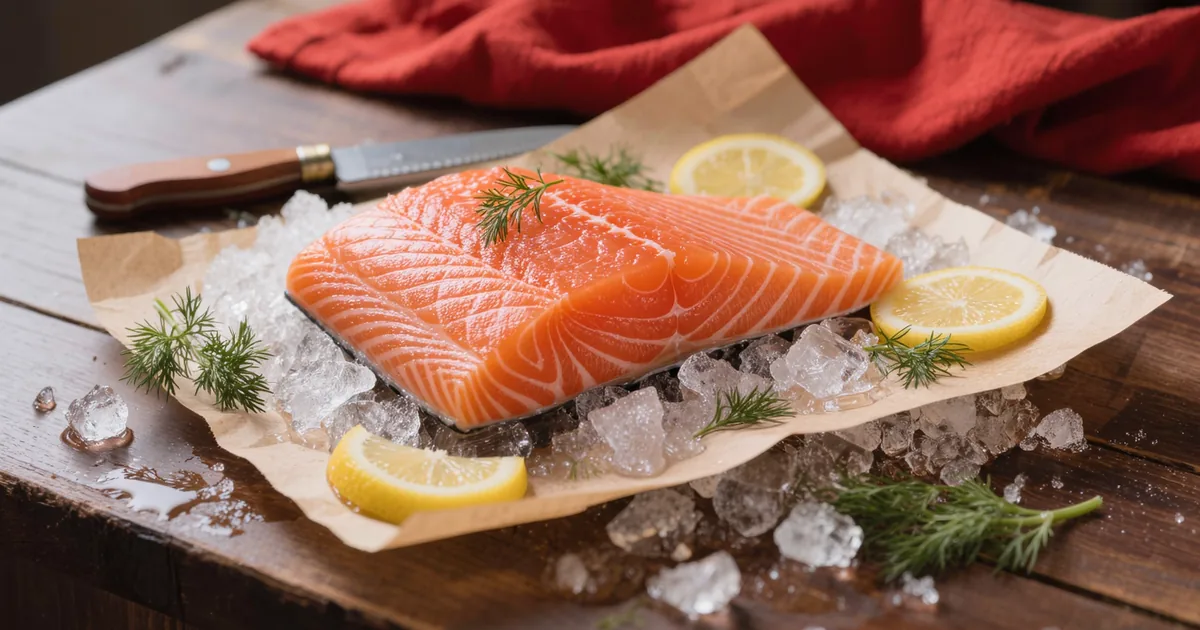
Two summers ago I catered a rehearsal dinner for thirty, and the mother of the bride told me, relieved, that the fish was handled — she'd ordered "a salmon." One salmon. A single three-pound side, which feeds six to eight adults as a main course, standing in for a party of thirty. I tripled the order that afternoon without mentioning it, and when the kid count firmed up, I added a fourth side. Nobody at that dinner ever knew there was a problem, which is the entire catering business in one sentence.
The arithmetic that saved her is short: 6 to 8 ounces of raw salmon per adult for a main course — 7 is the midpoint this calculator uses — and about 3 ounces a head when it's an appetizer. Everything else on this page is that number, multiplied carefully.
How much salmon per person for dinner: the fillet math
Dinner service means 6 to 8 ounces of raw fillet per adult. Use 6 when the menu is thick with sides and a starch, 8 when salmon is the whole show or the crowd skews hungry. The engine defaults to 7 because midpoints keep you honest. Kids count as half portions; big eaters count as one and a half. That's the whole model, and after 1,500 events I haven't found a fish that breaks it.
Appetizer service is its own mode: about 3 ounces per person when the salmon shares a table with other passed plates. Cured, skewered, or flaked over toasts, 3 ounces reads generous precisely because nobody's building a dinner out of it. Flip the calculator to appetizer mode and it swaps the math for you.
How much salmon per person in grams?
About 170 to 225 grams of raw fillet per adult for a main course, and roughly 85 grams for an appetizer portion. If you shop metric, flip the calculator's unit toggle to grams and kilograms and the whole order converts. And for anyone who typed salmon portion per person grams into a search bar at the fish counter: 200 g raw per adult, main course, is the working answer. In kilograms, that's 0.2 kg per person — so a 1-kg fillet is dinner for five, and a 2-kg order covers ten.
Salmon for 10 to 100 guests: the quick table
Adults only, main-course fillets at the 7-ounce midpoint, no leftover padding — here's what to buy.
| Guests (adults) | Raw salmon to buy |
|---|---|
| 10 | 4.5 lb |
| 20 | 8.8 lb |
| 30 | 13.3 lb |
| 50 | 22 lb |
| 100 | 43.8 lb |
Computed by the Party Portions engine — party-portions.com
Those are raw, skin-on weights. At 20 guests, that's three 3-pound sides — nine pounds against an 8.8-pound target, which is exactly the small margin I like to carry. Fish counters don't sell 8.8 pounds; round toward whole sides.
How much salmon for 3, 4, or 5 people?
Small dinners run on the same 7-ounce midpoint, and the counter math is friendlier than the big-party version. For 3 people, buy about 1.3 lb (600 g). Four people want 1.75 lb (800 g). Five adults is 2.2 lb — almost exactly a 1-kg piece, which is why the kilo fillet is my favorite dinner-party cut. Six people, 2.6 lb; eight, 3.5 lb, at which point a single 3-lb side plus one fillet does it. Below ten guests I buy individual fillets or one uncut piece and portion after cooking — it carves cleaner than it divides raw.
One number, multiplied carefully. The calculator handles kids, big eaters, appetizer mode, and metric — no napkin math at the counter.
Size my orderFillets, a whole side, or a whole fish?
Individual fillets are the easy button: even thickness, even cooking, zero knife work, and the counter does the portioning. You'll pay a little more per pound for that labor. For dinners under ten, I think it's worth every cent.
A side is half a fish — skin on, pin-boned, right around three pounds. It's the caterer's default because it cooks as one piece, serves like a platter, and costs less per pound than portioned fillets.
How many people does a side of salmon feed?
Six to eight as a main course. A 3-pound side is 48 ounces, divided by 6-to-8-ounce portions. Party of twelve? Two sides. Thirty? Four. The mother of the bride from my rehearsal-dinner story was twenty-some portions short with one — a side looks enormous on the counter and modest on a buffet.
Buying a whole fish? Fillet yield runs about 65 percent, so a 10-pound whole salmon hands you roughly 6.5 pounds of usable fillet. Whole fish is often the cheapest route per pound of actual dinner — but only if you'll roast the frames for stock, or your fishmonger fillets it free. Otherwise the savings are mostly theater.
One buying note: every weight on this page is skin-on, because that's how fillet is sold. Don't try to subtract for the skin — at party scale it's a rounding error.
The skin isn't waste — it's the built-in spatula. Buy skin-on even for a table of committed skin-haters. It holds the fillet together on the grill and under the broiler, survives the trip from pan to platter, and then peels off in one clean motion at the table, like it was designed for the job. Skinless fillets flake apart the moment a spatula looks at them sideways. Serve the haters their portion skinless if you must — just don't cook it that way.
How much fish per person: converting salmon math to any fish
The salmon rule travels — you just adjust for density and richness. Here's the conversion I hand new crew members.
| Fish | Raw per person (main) | Why |
|---|---|---|
| Salmon and other rich fillets | 6–8 oz | Rich and filling; 7 oz is the safe midpoint |
| White flaky fish (cod, haddock, tilapia) | 6 oz | Flakier and lighter eating, usually sauced |
| Dense fish (swordfish) | 6–7 oz | Steak-like density; eats heavier per ounce |
| Shellfish | By count, not weight | Portion in pieces per person |
Shellfish is a counting game, not a weighing one. Shrimp cocktail served next to other appetizers runs 4 pieces of 16/20 shrimp per adult — about 2.3 pounds for ten people — and the shrimp per person calculator handles counts, boils, and shell-on math on its own page.
Doneness, shrink, and the leftover window
USDA FSIS puts fish at 145°F — opaque flesh that flakes with a fork (USDA FSIS). That's the food-safety standard. Plenty of restaurant kitchens pull salmon at 125°F for a medium, silkier center; that's a texture preference USDA doesn't endorse, and both facts belong on the table. I cook client salmon to the standard, and my own dinner a little under. Make the call honestly, and if any guests are pregnant or immune-compromised, the 145°F number isn't negotiable.
Cooking costs you about 20 percent of the raw weight in moisture. A 7-ounce raw portion lands near 5.5 ounces cooked — which is exactly why the buying rule is written in raw ounces. Don't re-pad the order for shrink; it's already in the math.
Cooked salmon runs on the same clock as everything else on a buffet: 2 hours out, 1 hour if it's above 90°F (USDA FSIS). Leftovers keep 3 to 4 days in the fridge or 3 to 4 months frozen, and reheat to 165°F (USDA FSIS). Cold flaked salmon over a grain salad is the rare leftover that tastes intentional.
Thirty guests, four sides: the worked example
Back to that rehearsal dinner: 24 adults and 6 kids. Kids count half, so the engine sees 27 effective adults. At the 7-ounce midpoint that's 189 ounces — 11.8 pounds of raw salmon — and since sides run about 3 pounds each, the order is four whole sides: an even dozen pounds with a sliver of margin. That's the quiet tripling from the story, plus one for the kids.
Here's that dinner, preloaded — swap in your own guest list and the order rewrites itself.
Salmon wants a starch that behaves. Salmon for 12 wants 4 cups of dry rice — one cooked cup per guest, and rice triples from dry. Feeding the full thirty, mashed potatoes run 15 pounds (potatoes per person calculator). And once the fish is settled, plan the whole menu from one screen, so the starch, the appetizers, and the fish all agree with each other.
Frequently Asked Questions
A whole side of salmon feeds how many people?
Six to eight adults as a main course. A whole side weighs about 3 pounds — 48 ounces — and dinner portions run 6 to 8 ounces of raw fillet, so the division lands at six to eight people. As an appetizer at 3 ounces a head, the same side stretches to about sixteen. This is the number that catches hosts out: 'a salmon' sounds like it should feed a party, and it's dinner for eight. Thirty guests want about four sides. Run your exact count through the calculator before you order.
How much salmon should I buy for 20 adults?
About 8.8 pounds of raw fillet at the 7-ounce midpoint — call it three 3-pound sides, nine pounds with a whisper of margin. If several of your twenty are kids, count each as half a portion and watch the number drop. If salmon is the only protein and the crowd came hungry, run the math at 8 ounces instead and you'll land near ten pounds. Buy skin-on, and if the counter is out of sides, twenty individual 6-to-8-ounce fillets do the same job.
Skin-on or skinless for a party?
Skin-on, always — even if every guest peels it off. The skin holds the fillet together through grilling, broiling, and the trip from pan to platter, then releases in one clean motion once it's cooked. It also shields the flesh from drying out on the hot side of the grill. Skinless fillets are for weeknight portions, not party sides. If someone truly objects, slide their portion off its skin as you plate it; by then the skin has already done its job.
Can I use frozen salmon for a dinner party?
Yes — for parties it's often the smarter buy, since well-handled frozen salmon holds its quality. Thaw it in the refrigerator at 40°F or below; the working rate is about 24 hours per 4 to 5 pounds, so flat packs of fillets thaw overnight (USDA FSIS). In a rush, use cold water: 30 minutes per pound, change the water every 30 minutes, and cook immediately afterward (USDA FSIS). Never thaw on the counter — the 2-hour rule doesn't pause for frozen fish.
What internal temperature is salmon done at?
145°F, says USDA FSIS — the flesh turns opaque and flakes with a fork (USDA FSIS). That's the food-safety standard and the right call for a mixed crowd. Many restaurant kitchens pull salmon at 125°F for a medium, silkier center; that's a texture preference, not a safety figure, and USDA doesn't endorse it. I cook client fish to the standard and my own a touch under. If any guests are pregnant or immune-compromised, stay with 145°F and don't revisit the question.
How long do salmon leftovers keep?
Three to four days in the refrigerator, 3 to 4 months in the freezer, and reheat leftovers to 165°F (USDA FSIS). Get cooked salmon into the fridge within 2 hours of service — 1 hour if it's been sitting out above 90°F (USDA FSIS). And consider skipping the reheat entirely: cold salmon flaked over grains or salad is the rare leftover that reads as a planned second meal instead of a rerun. Label the container with the day it went in — party fridges fill up fast, and day four sneaks up on everyone.