Two good sources disagree about this, out loud, and sorting out why is worth more to you than either answer on its own.
Iowa State Extension says 1.5 sandwiches per person. Panera, Jimmy John's, Subway and McAlister's — four companies that sell sandwiches to crowds for a living and eat the cost of getting it wrong — all plan somewhere between 0.7 and 1.0. That is not a small gap. On a 50-person order it is 25 extra sandwiches.
Neither of them is wrong. Iowa State is describing a graduation open house: sandwiches are the meal, there is no seating, and guests drift through for four hours picking at things. The caterers are describing one sandwich, on one desk, at noon, next to a laptop. Order Iowa State's number for a desk lunch and you over-buy by half. Order the caterers' number for an open house and you are driving to the store at 2 p.m.
The event type is the answer. Everything below follows from it.
How many sandwiches per person?
One per person at an office lunch. About 1.2 at a reception, where people are standing and talking and a sandwich is a prop as much as a meal. And 1.5 at an open-house party, where the sandwiches are dinner and the afternoon is long.
That office figure is the correction most charts still need. One sandwich — not the 1.5 that gets copied around from party-planning advice into office-catering advice, where it does not belong. People at a desk eat one sandwich. Some eat half. The person who eats two is real, and they are cancelled out by the two people who skipped lunch for a call.
Count kids as half a portion and big eaters at one and a half, the same guest-mix math behind every tool here. Twelve adults and four kids is 14 effective adults, not 16.
How much deli meat per sandwich?
Three to four ounces of pre-sliced deli meat, plus about an ounce of cheese — one slice. The calculator runs 3.5 oz, the middle of that range, which is a sandwich that looks generous without falling apart when someone picks it up.
Then there is the line from Ellen's Kitchen that carries more weight than anything else on this page: hand-sliced roasted meats use up to twice as much as pre-sliced deli meat. Twice. Not a little more.
The reason is geometry, not appetite. A deli slicer shaves meat thin enough to drape, and drape piles high — four ounces of shaved turkey mounds up over the bread like it is trying to escape. Your knife, on a roast you cooked yourself, produces slabs. Slabs lie flat. To make a hand-sliced sandwich look like the same sandwich, you keep adding slabs, and you are at seven ounces before you have noticed. That is what the hand-sliced toggle on the calculator is — that factor, applied honestly, before you shop instead of after you run out.
How much lunch meat per person, in pounds
Sandwich counts are what you order; pounds are what you buy. Here is how much lunch meat per person turns into weight at the counter, by event type.
| Guests | Office: sandwiches / meat | Party: sandwiches / meat | Hand-sliced (office) |
|---|---|---|---|
| 10 | 10 / 2.2 lb | 15 / 3.3 lb | 4.4 lb |
| 20 | 20 / 4.4 lb | 30 / 6.6 lb | 8.8 lb |
| 30 | 30 / 6.6 lb | 45 / 9.8 lb | 13.1 lb |
| 50 | 50 / 10.9 lb | 75 / 16.4 lb | 21.9 lb |
| 100 | 100 / 21.9 lb | 150 / 32.8 lb | 43.8 lb |
Computed by the Party Portions engine — party-portions.com
Read the first and last columns together for a minute. Same 30 people, same one sandwich each — 6.6 lb from the deli case, or 13.1 lb if you are slicing a roast at home. That is the entire disagreement between a catering menu and a church cookbook, and it has nothing to do with how hungry anyone is.
How much deli meat for 100 sandwiches?
About 22 pounds of pre-sliced deli meat — 100 sandwiches at 3.5 oz each — plus 6.25 lb of sliced cheese, one slice per sandwich. Split the meat across three kinds or the platter reads as monotone; my standard break is 9 lb turkey, 7 lb ham, 6 lb roast beef, because that's roughly the order a mixed American crowd empties them in. Halve everything for 50 sandwiches: 11 lb of meat, 3 lb of cheese. Quarter it for 25.
Note what the question is and isn't: 100 sandwiches feeds 100 people at a desk lunch, but only about 67 at an open house where sandwiches are the meal. Decide the event first, get the sandwich count from the calculator, then buy 3.5 oz per sandwich — and if you're hand-slicing your own roasts instead of buying shaved, the number doubles, per the section above.
Sandwich platter for 20 people: what the caterers actually build
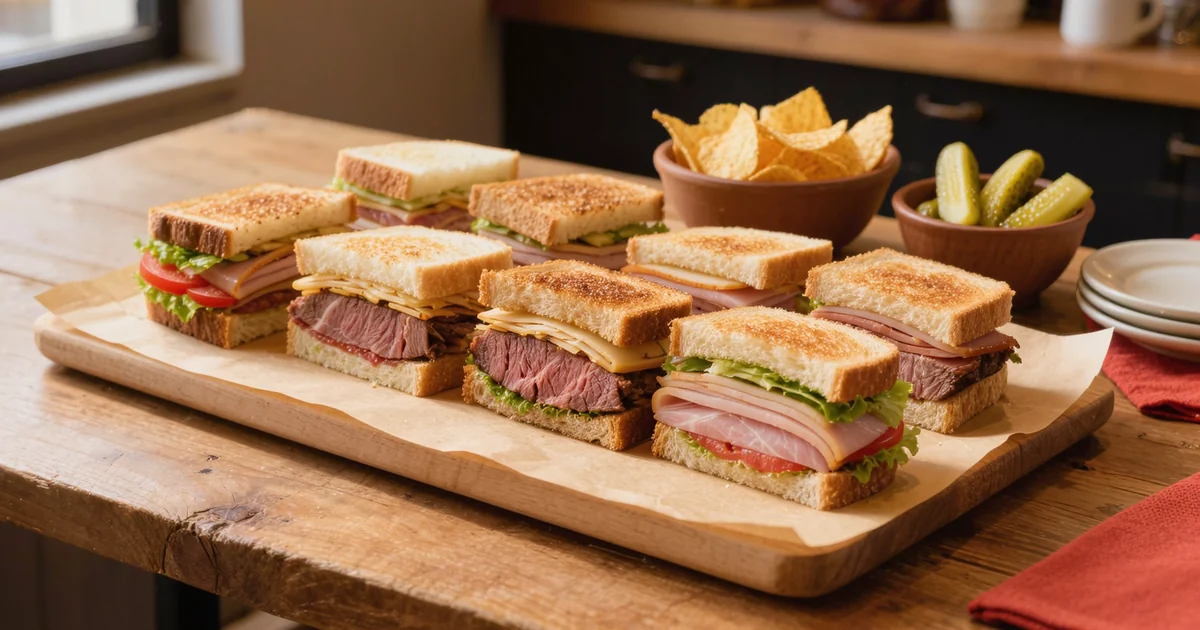
Order a sandwich platter for 20 people from Jimmy John's, Panera, McAlister's or Subway and you get roughly the same thing: about 20 whole sandwiches, cut into ~40 halves. One whole per head, presented as two pieces. Four companies, four menus, one answer — which tells you the number is real and not a marketing decision.
The bundles get creative around the edges. Jimmy John's "serves up to 20" box, for instance, is 30 pieces plus 12 half wraps and 2 sides — read past the headline and that is still about one sandwich's worth of food per person, with the count inflated by cutting things smaller. Which, as it happens, is the right instinct, and it is the whole point of the next section.
So: 20 people at a desk lunch, 20 sandwiches, 4.4 lb of deli meat, 1.3 lb of cheese. If those 20 are drifting through an open house instead, it is 30 sandwiches and 6.6 lb. Same guests. Different afternoon.
The rest of the platter
Bread first, because it is the thing people forget until the counter closes. Plan about 1.2 rolls or bread portions per person at an office lunch, 1.6 at an open-house party, and an even 1 at a reception — the buffer covers the roll that tears and the one that hits the floor.
Lettuce runs about 8 heads per 100 guests. Tomatoes, 2 oz a person, which is more than it sounds — 100 people is 12.5 lb of tomatoes and a genuinely long afternoon with a knife. Mayo at 0.8 oz and mustard at 0.5 oz per person, sliced onion at about 1.1 oz for the half of the room that wants it.
A platter is rarely the whole menu, either. Sides for the same 20 run 2.3 lb of green salad, 6 lb of mac and cheese and 3.9 lb of slaw (size the sides), and an office lunch means coffee — 30 people in the morning is 23 drinkers and 0.6 lb of grounds (work out the urn). If a grazing board is doing the opening, 20 guests want 2.5 lb of meat and 2.5 lb of cheese (build the board). One guest list, every dish — plan the whole menu from the same numbers.
Order halves, not wholes
Put out halves and you will throw away a third less bread. Everyone takes one whole sandwich, because it is there and because taking a whole one is what you do. Then they eat two-thirds of it and abandon the rest next to a laptop. Put out halves and the same crowd eats what it actually wants — a half, or a half and a half of something else, or two halves if they are hungry. People take seconds when they mean it. Nobody has ever felt rude taking a second half. They feel rude leaving a third of a whole, so they take the whole and leave the third anyway.
Iowa State's other quiet line belongs here too: an open house should plan for about 60% of the people invited. Invite 100, buy for 60. That number scares hosts and it has never once been wrong on my events.
Halves also fix variety without fixing anything else. A person who takes one whole sandwich makes one choice and tries one thing. A person taking two halves tries turkey and roast beef, which makes a three-kind platter feel like six, and costs you nothing.
Make-ahead without the sog
You can build sandwiches the night before. You cannot dress them the night before. That distinction is the whole game.
Meat, cheese, bread — assemble those, wrap the tray tight, and refrigerate. Lettuce, tomato and condiments go on at the table, not in the fridge. Mayonnaise on bread twelve hours ahead is a wick; sliced tomato on bread is a small, patient flood. Both turn the bottom slice to paste by mid-morning, and there is no rescuing it.
Set out the lettuce, tomato and pickles in bowls beside the platter and let people finish their own. It looks like a nicer spread than it is, it saves you an hour of the worst prep work in catering, and it means the last sandwich on the tray is as good as the first. Cut the wraps and sandwiches at the last reasonable moment, and keep the tray covered until the room fills.
The clock on a conference-table platter
Deli meat is ready-to-eat, and that fools people into thinking a platter is shelf-stable. It isn't. The 2-hour rule governs a sandwich platter exactly like it governs anything else: never out more than 2 hours, or 1 hour above 90°F (USDA FSIS). A conference room with a sunny wall and fifteen laptops in it is a warm room — if it's uncomfortable in there, you are on the one-hour clock, not the two-hour one.
The practical version, for a lunch that runs long: put half the platter out and hold the rest in the fridge. Swap at the hour. That covers the people who wander in at 1:15 without leaving the turkey to sit through two meetings. What comes back goes into the fridge inside that window and keeps 3–4 days (USDA FSIS). The tray that sat out through an all-afternoon meeting does not go home with anyone. It goes in the bin, and that is cheaper than what happens otherwise.
A law-firm lunch for 30, worked out
A firm in Austin books me for the same working lunch four times a year: 30 people, noon, a conference room, and a hard stop at one o'clock because they bill by the hour and mean it. Office tier, straight off the chart — 30 sandwiches and 6.6 lb of deli meat. Three kinds: turkey, roast beef, ham. Plus 1.9 lb of sliced cheese, 36 rolls, 3 heads of lettuce, 3.8 lb of tomatoes, 24 oz of mayo, 15 oz of mustard.
All 60 halves go out. Cut, never whole — I switched that firm to halves in 2019 after watching a partner leave a third of a roast beef on a legal pad two visits running. What comes back now is four or five halves and one very lucky paralegal. Before the switch, I was carrying out most of a garbage bag of good bread every quarter.
Load that law-firm order in one tap. This link drops 30 adults and the office-lunch tier straight into the calculator.
Load the lunch for 30Frequently Asked Questions
How much lunch meat do I need per person?
Three to four ounces of pre-sliced deli meat per sandwich, plus about an ounce of cheese. Since an office lunch runs about one sandwich a person, that is also your per-person number: 3 to 4 oz, or roughly 4.4 lb of meat for 20 people. An open-house party runs 1.5 sandwiches a head, which is 6.6 lb for the same 20 guests. The one thing that moves this number hard is hand-slicing: if you are carving a roast at home instead of buying it shaved at the deli counter, plan on close to twice as much meat, because slabs lie flat where shaved meat piles high.
What is in a sandwich platter for 20 people?
For an office lunch, a sandwich platter for 20 people means about 20 whole sandwiches, cut into 40 halves — that is what Jimmy John's, Panera, McAlister's and Subway all build, and four independent caterers agreeing is as close to a standard as this subject gets. In groceries: 4.4 lb of deli meat across two or three kinds, 1.3 lb of sliced cheese, and about 24 rolls. If those 20 people are drifting through an open house where sandwiches are the meal rather than sitting at a desk at noon, order 30 sandwiches and 6.6 lb of meat instead.
How many sandwiches should I plan per person?
It depends entirely on the event, and that is the real answer rather than a dodge. One sandwich per person at an office lunch. About 1.2 at a reception. And 1.5 at an open-house party where the sandwiches are dinner and people graze for four hours. Iowa State Extension gives 1.5 and four national caterers plan 0.7 to 1.0 — both are right, because they are describing different afternoons. Use Iowa State's number for a graduation open house and the caterers' number for a desk lunch. Getting this one input right matters more than any other choice you make.
Does hand-sliced meat really use twice as much?
Up to twice as much as pre-sliced deli meat, which is the single most expensive surprise on this page. Ellen's Kitchen has been saying it for years and it holds up every time I test it. The cause is geometry: a deli slicer shaves meat thin enough to drape, and draped meat mounds up over the bread. A knife on a home-roasted turkey gives you slabs, and slabs lie flat, so you keep adding them to make the sandwich look right. Four ounces becomes seven before you notice. The calculator has a hand-sliced toggle that applies the factor before you shop.
Can I make sandwiches the night before a party?
Assemble the night before, but dress at the table. Meat, cheese and bread can be built, wrapped tight, and refrigerated overnight with no loss at all. Lettuce, tomato and condiments cannot — mayonnaise on bread is a wick and sliced tomato is a slow flood, and twelve hours turns the bottom slice to paste. Put the lettuce, tomato and pickles in bowls beside the platter and let guests finish their own sandwiches. It looks like a more generous spread, it saves the worst hour of prep in catering, and the last sandwich on the tray tastes like the first one did.
How long can a sandwich platter sit out?
Two hours, and one hour if the room is above 90°F (USDA FSIS). Deli meat is ready-to-eat, which fools people into treating a platter as shelf-stable, but the 2-hour rule governs it exactly like anything else — and a sunny conference room with fifteen laptops in it counts as a warm room. For a lunch that runs long, put half the platter out and hold the rest cold, then swap at the hour mark. Leftovers that went back promptly keep 3 to 4 days in the refrigerator (USDA FSIS). A tray that sat through an entire afternoon of meetings gets thrown out, not wrapped up.