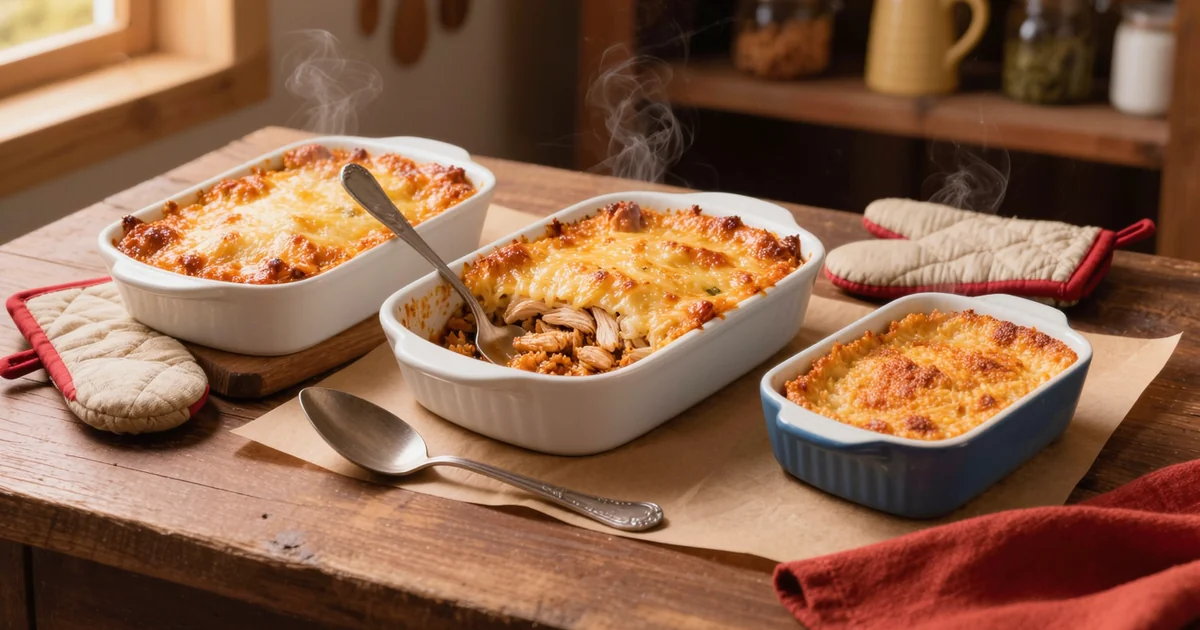
Casserole for a crowd: the pan math
One number runs this entire page. A standard 9x13 feeds 8 as a main and 12 as a side. Everything after that is multiplication, and if you learn nothing else here, learn that.
Twenty people, casserole as the main event: 20 divided by 8 is 2.5, so three pans. Forty people: five pans. Thirty: four. You round up, always, because half a pan doesn't exist and the person at the end of the line is a real person with a real plate. If the casserole is a side — the hash browns next to a ham, the mac and cheese at a barbecue — the same pan stretches to 12, so 20 guests need two and 40 need four.
Scale past a home kitchen and the unit changes but the logic doesn't. A full hotel pan, the deep steam-table kind, holds about two and a half 9x13s — call it 20 mains or 30 sides. That's the pan a rental company hands you, and it's why caterers think in pans instead of recipes. I have never once written a party order in servings. I write it in pans, because pans are what fit in the oven, what fit in the chafer, and what fit in the back of the van.
So count pans, not recipes. A card that says "serves 8-10" is a stranger's guess about your guests; a 9x13 is a physical object with a known volume. When somebody asks me how many casseroles for a crowd of 30, I don't reach for a multiplier or a rule of thumb. I do 30 ÷ 8, round up, and say four.
The thing I'd tattoo on a host's hand: stop scaling the recipe and start counting pans. Tripling a casserole into one enormous roasting pan looks efficient — one dish, one bake, less washing up. What you get is a casserole scorched at the edges and cold in the middle at the exact moment forty people are standing there holding plates. Depth is the enemy. Heat moves through a two-inch casserole in a way it simply cannot move through a five-inch one, and no temperature adjustment fixes it; lower and slower just burns the edges more slowly. Three 9x13s. Every time. They bake evenly, they hold in a chafer, they cool inside the safe window, and if one is a disaster you still have two.
How many 9x13 pans do I need for 30 people?
Four pans as a main, three as a side. A 9x13 holds 8 main-course servings, so 30 ÷ 8 comes to 3.75 and you buy the fourth pan — half pans don't exist. Serving it beside a ham instead? The pan stretches to 12, and 30 ÷ 12 rounds up to three.
Two pans do not bake like one
Here's what the pan math doesn't tell you, and it wrecks more church suppers than any bad recipe ever has: two 9x13s in one oven do not bake like one 9x13 in one oven. They bake like two, and your oven only has so much air.
What's actually happening is simple. Each pan is a cold mass absorbing heat, so two pans pull the oven temperature down further and hold it down longer. They also block airflow. Put two side by side on one rack and the facing edges — the ones with a pan next to them instead of hot air — cook noticeably slower than the outside edges. Put them on two racks and the top pan browns while the bottom pan stays pale. Neither arrangement is wrong. Both need managing.
So rotate. Halfway through, swap the pans top-to-bottom and turn each one 180 degrees. It takes eight seconds and it's the whole difference between even and embarrassing. Add ten minutes to your total for two pans and more for four. Leave a couple of inches around each one, too — a pan touching the oven wall has a side that's radiating rather than baking.
Then the one that catches everybody. A pan straight from the fridge needs 15 to 20 minutes more than the same pan at room temperature, and the center is what pays for it. A make-ahead casserole is a cold brick, and the time on the card was written for a pan assembled and baked in the same hour. Pull your pans out 30 minutes before they go in, then probe the middle rather than trusting any clock. I have watched a beautiful, browned, bubbling casserole come out of an oven with a cold raw center. It looked perfect. It was not done, and the only reason I knew was the thermometer.
Can you bake two casseroles at the same time?
Yes — two casseroles bake together fine if you manage them: add ten minutes to the total, and halfway through, swap the pans top-to-bottom and turn each one 180 degrees. Leave a couple of inches of air around every pan, because an edge against the oven wall radiates instead of bakes.
Ten casseroles worth making, counted in pans
1. King ranch chicken
The Texas potluck standard and the best casserole here for a crowd, because it's better assembled a day ahead and it doesn't mind a chafer. Chicken, tortillas, chiles, cheese. Rotisserie chicken isn't a shortcut in this one, it's an improvement — poached breast goes stringy over a long bake. Poultry to 165°F (USDA FSIS). What breaks it: a sauce that's too thin. It should set into something you can cut, not something you ladle.
Quantities For 20: 3 pans (9x13) · For 40: 5 pans — about 9.5 lb of boneless breast for 20
2. Baked ziti
The one I'd hand a first-timer. It assembles cold, it bakes forgivingly, it holds at 140°F (USDA FSIS) for two hours, and one pan can quietly be meatless without anybody registering it as a concession. Undercook the pasta by two minutes — it keeps cooking in the sauce, and mushy ziti is a solved problem you don't need to solve again. What breaks it: baking it uncovered the whole way. Foil on for most of it, off for the last fifteen minutes.
Quantities For 20: 3 pans (9x13), about 5 boxes of pasta · For 40: 5 pans, 10 boxes
3. Hash brown casserole
Every funeral, every brunch, every Christmas morning in this part of Texas. It's a side, so a 9x13 goes twelve ways, and it's the cheapest thing on this list. Frozen shredded potatoes, and I mean that as advice rather than a confession — they're already blanched and already shredded. What breaks it: assembling it wet. Thaw the bag overnight, squeeze it out in a clean towel, then build. Skip that step and you bake a soup with a crust on it.
Quantities For 20: 2 pans (9x13) · For 40: 4 pans — a side portion, 12 to a pan
4. Green bean casserole
I'm not going to be snobby about this one. It's a side, it's expected at certain tables, and it takes eleven minutes to put together. It also has the shortest hold time here: the fried onions go soft about twenty minutes into a warmer, which is why they belong on at the end rather than at the start. What breaks it: onions baked in from the beginning. Bake the casserole, add the onions for the last five minutes, serve it.
Quantities For 20: 2 pans (9x13) · For 40: 4 pans — a side, and there's usually some left
5. Chicken and rice
One pan, a whole dinner. Bone-in thighs on top so the fat bastes the rice underneath; boneless breast if you want it lighter. It's the casserole that most rewards not touching it — the rice is cooking in steam it can't spare, so every time you lift the foil to check, you're taking dinner away from yourself. Poultry to 165°F (USDA FSIS). What breaks it: brown rice on a white rice timer. That's a different bake entirely.
Quantities For 20: 3 pans (9x13), 9.5 lb boneless breast or 13 lb bone-in · For 40: 5 pans, 19 lb or 26 lb
6. Enchilada casserole
Rolling enchiladas for 40 is a wrist injury. A layered enchilada casserole is the same flavors in a fifth of the time, and in twenty years nobody at a party has ever asked me why they were stacked instead of rolled. Corn tortillas, not flour — flour dissolves into paste. What breaks it: building it too far ahead. The tortillas keep drinking sauce, so by tomorrow it's mush. This is the one casserole here I assemble the same day.
Quantities For 20: 3 pans (9x13) · For 40: 5 pans — a main portion, 8 to a pan
7. Overnight breakfast casserole
The single most useful pan in this business. Bread, eggs, sausage, cheese, assembled the night before so the bread drinks the custard — the soak is the entire point, which is why this one has to be made ahead rather than merely can be. Eggs to 160°F (USDA FSIS), measured in the center of the pan. What breaks it: the fridge-cold bake. Add 15 to 20 minutes and probe the middle, because the edge set a long time ago and it'll lie to you.
Quantities For 20: 3 pans (9x13) · For 40: 5 pans — a main portion, 8 to a pan
8. Mac and cheese
A side that thinks it's a main, and people will treat it as both, so buy accordingly. Our engine puts it at 5.3 oz per adult as one side among several — the USDA adult portion — so mac and cheese for 20 comes to 6 lb. What breaks it: a sauce built on pre-shredded cheese. The anti-caking starch makes it grainy. Shred your own, and pull the sauce a little loose; it firms up in the bake whether you want it to or not.
Quantities For 20: 2 pans (9x13), about 6 lb · For 40: 4 pans, about 12 lb
9. Shepherd's pie
The most underrated party casserole there is. It's a whole dinner in one pan — meat, vegetables and a potato lid — which makes it the only dish here that doesn't really need a side next to it. Ground meat to 160°F (USDA FSIS). Rough the potato top up with a fork so it browns properly. What breaks it: a filling that's too loose. It has to be thick enough to hold the potato up, or the mash sinks and you've made a strange soup with a crust.
Quantities For 20: 3 pans (9x13), about 10 lb of potatoes for the top · For 40: 5 pans, 20 lb
10. Tuna noodle
Include it or don't, but know why it's here: it's the cheapest casserole on the page, it's shelf-stable except for the dairy, and at a certain kind of gathering — a reunion, a funeral, a fishing camp — it's the dish people are quietly hoping for. What breaks it: freezing it. Dairy-heavy sauces split when they thaw and you get a grainy, weeping pan. This one gets made and eaten, same day, no plans.
Quantities For 20: 3 pans (9x13) · For 40: 5 pans — a main portion, 8 to a pan
Breakfast casserole for a crowd
A breakfast casserole for a crowd is the same pan arithmetic with one extra rule attached: it has to sit overnight, and that isn't a convenience, it's the method. The bread needs hours to absorb the custard. Assemble it and bake it in the same hour and you get a wetter, looser thing with dry bread swimming in it. Assemble at 8 PM, bake at 8 AM, and it slices.
The count is the count: a 9x13 feeds 8 as the main event, so 20 people is three pans and 40 is five. What's different is the temperature — egg dishes cook to 160°F (USDA FSIS), and you probe the center, because the edge set twenty minutes ago. The fridge-cold penalty bites hardest here too: 15 to 20 extra minutes for a pan straight out of the refrigerator, with the middle as the part that's underdone while the top looks glorious.
Breakfast is also where the pan-counting habit pays off most, because breakfast is a scheduling problem more than a cooking one — one oven, six dishes, everything landing at the same minute. Breakfast for 20 is three casserole pans, 3 lb of bacon and 40 biscuits, with a run sheet for what goes in when.
Casseroles for a crowd: what goes inside the pans
Pan math tells you how many pans. It says nothing about what to buy to fill them, and that's the other half of the problem — the half where our engine earns its keep. These are the same numbers the calculators run, at the two headcounts that come up most.
| What's in the pan | For 20 | For 40 |
|---|---|---|
| Chicken, boneless breast (king ranch, chicken and rice) | 9.5 lb | 19 lb |
| Pasta, as the main (baked ziti) | 5 boxes | 10 boxes |
| Rice, dry (chicken and rice) | 6.7 cups | 13.3 cups |
| Potatoes, mashed (shepherd's pie topping) | 10 lb | 20 lb |
| Sides: salad + mac + slaw together | 13.5 lb | 27 lb |
Computed by the Party Portions engine — party-portions.com
Read the top row against the pan count and the whole system clicks. Forty people is five pans of king ranch and 19 lb of boneless breast: the pans tell you how much oven you need, the pounds tell you what's on the shopping list, and neither number is any use on its own.
A church supper in Wimberley last November made that point better than I can. Forty guests, one kitchen, two ovens, king ranch as the main — five pans, 19 lb of boneless breast, and because the pans came out of a walk-in at 38°F, an extra twenty minutes apiece that the volunteer running the kitchen had not planned for. We rotated at the halfway mark and ran the ovens in two waves, three pans and then two, with the first wave tented under foil while the second baked. Everything hit the line above 165°F (USDA FSIS) within ten minutes of each other. The lesson wasn't the recipe. It was that five pans and two ovens is a schedule, not a bake.
Load that supper in one click. Forty adults, boneless breast, roasted — swap in your own headcount from there.
Load the 40-guest king ranchOne caveat on that chicken figure, and it's the kind of thing that only shows up at scale: the cut moves the weight more than the portion does. Boneless breast for 20 is 9.5 lb. The same twenty people eating bone-in thighs need 13 lb, and a whole roasting bird takes 20 — chicken for 20 runs 9.5 lb boneless or 13 lb bone-in, depending entirely on what you put in the cart. Get that wrong and no amount of pan-counting saves you.
What freezes, what doesn't
Freezing is where casseroles either save your week or waste your money, and the sorting rule is about fat and starch rather than difficulty.
Freezes raw, beautifully: anything tomato-based or stock-based. Baked ziti, lasagna, enchilada casserole, shepherd's pie. Build them in foil pans, wrap twice, freeze flat, and bake from frozen with an extra 45 minutes to an hour — or thaw overnight in the fridge and add the usual 15 to 20. I build lasagna two weeks out on nights I happen to have time, and it's the single best trick in this business.
Freezes baked, acceptably: king ranch, chicken and rice, hash brown casserole. They lose a little texture — rice goes softer, potatoes go slightly grainy — but they come back as something people are glad to eat. Cool them first, and cool them fast. A hot pan in a freezer is a food-safety problem for everything sitting around it.
Never freezes: dairy-heavy sauces. Mac and cheese, tuna noodle, anything built on cream or sour cream. They break on thawing — the fat separates and you get a grainy, weeping pan that no amount of stirring puts back together. Green bean casserole is a near-miss for the same reason, and the onions go to mush besides. Those get made and eaten. That's the deal, and it's not negotiable.
Underneath all of it, the unglamorous rule: cooked casseroles keep 3–4 days in the refrigerator or 3–4 months in the freezer, reheated to 165°F (USDA FSIS). Label the pan with what it is and the date you built it. You will not remember. I have thawed a great many mystery bricks.
The temperatures a casserole lives or dies by
Four numbers, and a casserole hides all four. That's exactly why they matter — you cannot see the middle of a pan.
Egg-based casseroles cook to 160°F (USDA FSIS): the breakfast casserole and anything custard-bound. Casseroles with poultry go to 165°F (USDA FSIS) — king ranch, chicken and rice, every shredded-chicken pan on the list. Probe the center, not the edge; the edge finished a while ago and it's lying to you. Then hot holding at 140°F or above (USDA FSIS), which is what a chafing dish exists to do and what a half-empty chafer with one tired fuel can underneath does not do.
The clock is the fourth number. Perishable food shouldn't sit out over 2 hours, or 1 hour above 90°F (USDA FSIS). Here's where the pan-counting habit quietly pays off one more time: three pans means you put out one and hold two, swapping at the hour, so nothing on the table is ever old. One giant pan means the entire dinner is riding the same clock, and by hour three you're scraping most of it into a bag. Leftovers go into the fridge inside the window, keep 3–4 days, and reheat to 165°F.
Casseroles are rarely the whole party, which is the last thing worth saying about them. They're the reliable pan in the middle of a bigger arithmetic problem, and the party food calculator runs your guest list through the rest of it at once. If the casserole is the main event, sides for 20 is 13.5 lb across salad, mac and slaw. If it's one of several mains, ten big-batch mains that scale to 40 sorts the dishes that double from the ones that collapse — a pot of chili at 4× is still chili.
Frequently Asked Questions
How many casseroles do I need for 30 people?
Four pans if the casserole is the main event, three if it's a side. A standard 9x13 feeds 8 as a main and 12 as a side, so 30 divided by 8 is 3.75 — round up to four, because half a pan doesn't exist and the person at the end of the line is a real person. As a side, 30 divided by 12 is 2.5, so three. Don't bake all four in one oven at once: two pans on a rack is comfortable, four is a compromise where the top browns and the bottom stays pale. Bake in waves of two, tent the first wave in foil, and everything lands within twenty minutes of each other and above 140°F (USDA FSIS).
Can I double a casserole recipe into one big pan?
No, and this is the mistake I'd most like to talk you out of. Depth is the problem. Heat moves through a two-inch casserole in a way it cannot move through a five-inch one, and no oven adjustment fixes it — lower and slower just burns the edges more slowly while the center stays cold. You get a pan that looks perfect, browned and bubbling, with a raw middle, and you find that out in front of forty people. Bake two 9x13s instead. They cook evenly, they hold in a chafer, they cool inside the safe window, and if one goes wrong you still have the other. Two pans want about ten extra minutes and a rotation halfway through.
How much longer do you bake a casserole straight from the fridge?
Fifteen to twenty minutes longer, and the center is what needs it. This is the most common failure with a make-ahead casserole: the time on the card was written for a pan assembled and baked in the same hour, and yours has been sitting at 40°F all night. It's a cold brick. Pull the pan out 30 minutes before it goes in — that alone claws back most of the difference — then stop trusting the clock and probe the middle. Egg-based casseroles want 160°F, anything with poultry wants 165°F (USDA FSIS). A frozen casserole is a bigger version of the same problem: add 45 minutes to an hour, or thaw it in the fridge overnight first.
What casseroles can you make ahead and freeze?
Tomato-based and stock-based ones freeze raw and beautifully: baked ziti, lasagna, enchilada casserole, shepherd's pie. Build them in foil pans, wrap twice, freeze flat, and bake from frozen with an extra 45 to 60 minutes. King ranch, chicken and rice and hash brown casserole freeze acceptably once baked — they lose a little texture but they come back fine. What never freezes is anything dairy-heavy: mac and cheese, tuna noodle, and anything built on a cream or sour-cream sauce. The fat separates on thawing and you get a grainy, weeping pan that no amount of stirring fixes. Frozen casseroles keep 3-4 months, refrigerated ones 3-4 days, and everything reheats to 165°F (USDA FSIS).
How do you keep casseroles warm for a party?
Hold at 140°F or above (USDA FSIS) — that's the whole rule, and a chafing dish is the tool for it. Fresh fuel cans, water in the bottom pan, and a full food pan rather than a half-empty one, because a half-empty chafer loses the fight. Foil pans help here: they go straight from the oven into the chafer without a transfer that dumps heat all over your kitchen. Tenting a pan in foil on the counter buys you 20 to 30 minutes and not a minute more. Then respect the clock — perishable food can't sit out over 2 hours, or 1 hour above 90°F (USDA FSIS). With three pans you put one out and hold two, swapping at the hour, so nothing on the table is ever old.
What size casserole dish do I need for a crowd?
Stay with 9x13s and buy more of them. That's the honest answer and it's not the one people want. The 9x13 is the only pan whose behavior everybody already knows: 8 mains, 12 sides, about two inches deep, and it bakes evenly. Scale up to a full hotel pan, the deep steam-table kind, and you get roughly two and a half 9x13s' worth — call it 20 mains or 30 sides. Those are worth renting past about 50 guests, as long as you know a deep hotel pan bakes slower and less evenly than a shallow one. Roasting pans are the real trap: the depth that makes them perfect for a turkey is exactly what makes a casserole scorch at the edges and stay cold in the middle.