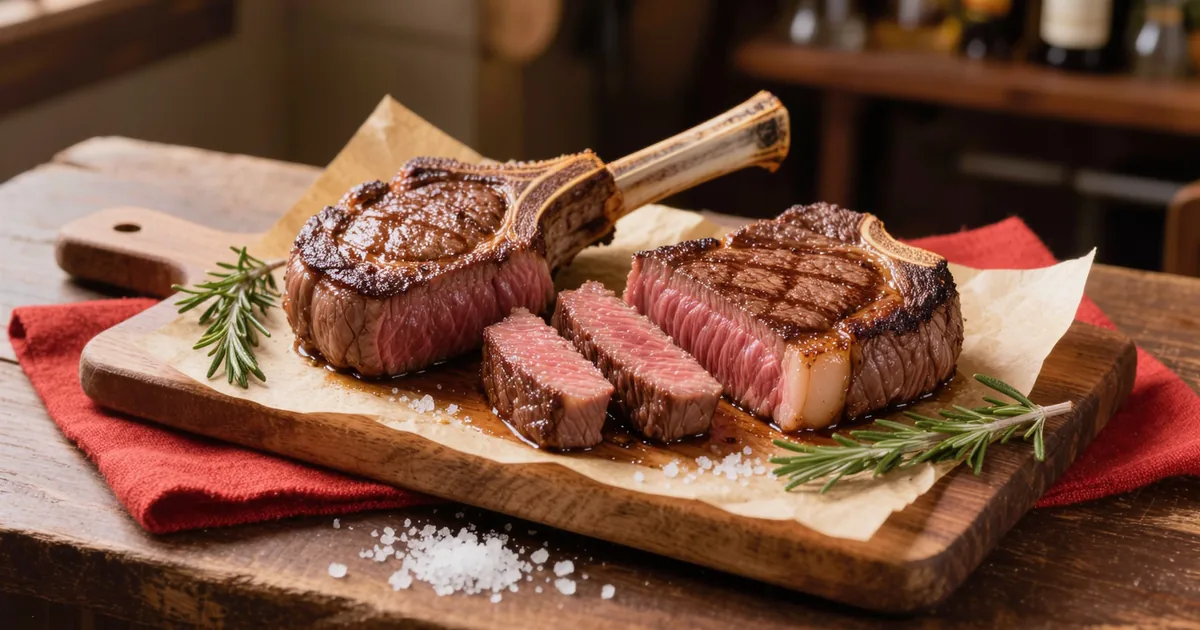
How much steak per person: appetite honesty first
Start with the honest number, because everything else on this page hangs off it: 8 oz of steak feeds most adults. Not "light eaters." Most adults, at a real dinner with a potato and a vegetable on the plate. Ask how much steak per person for dinner and 8 oz is the answer that survives contact with actual plates coming back to my kitchen.
Twelve ounces is a choice, not a serving size. It's a fine choice — I make it myself a couple times a year — but be clear about when it applies: steak is the entire event, sides are a garnish, appetites are large, and nobody's saving room for dessert. Restaurant menus have drifted so big that 8 oz now reads small on paper. That's merchandising, not metabolism.
The calculator above makes you pick between the two on purpose. I labeled the buttons the way I'd say it across the counter: 8 oz feeds most; 12 oz is a choice. Metric cooks, hit the kg / g toggle under the results and every figure converts — no arithmetic with 28.35 required.
8 oz vs 12 oz steak per person
Here's what the 4-oz difference costs at scale. Ten guests at 8 oz need 80 oz of steak — seven 12-oz ribeyes. The same ten at 12 oz need 120 oz — ten ribeyes. That's three extra steaks, 2.25 lb of premium beef, for the same headcount. At fifty guests the gap widens to about 8 lb. Nobody at the party will report being underfed at 8 oz; plenty will quietly leave a third of a 12-oz steak on the plate, and that third goes in my compost bucket, not a doggy bag.
My honest sorting rule after twenty years: couples' dinners and steak-club nights earn 12 oz. Parties, showers, anniversaries, anything with appetizers or a dessert table — 8 oz, no exceptions, and cut a few steaks in half after resting so the platter offers a smaller piece to whoever wants one.
Steak sizes by cut — and how many to buy
Steaks are sold by the piece, so the real shopping question is a count, not a weight. Typical single-steak sizes as they come out of the case:
| Cut | Typical steak | One steak covers |
|---|---|---|
| Ribeye | 12 oz | 1.5 standard appetites, or 1 hearty |
| NY strip | 10 oz | 1¼ standard appetites |
| Filet mignon | 7 oz | just under 1 standard appetite |
| Top sirloin | 8 oz | exactly 1 standard appetite |
Computed by the Party Portions engine — party-portions.com
Buy to ounces, not to heads. Multiply guests by 8 oz, divide by the steak size, round up. So if you're wondering how many steaks for 10 people: seven ribeyes, not ten. Rest them, slice or halve a few, and the platter feeds everyone with a spare. Scaled up at the standard appetite:
| Guests (adults) | 12-oz ribeyes to buy | Total weight |
|---|---|---|
| 10 | 7 | 5.3 lb |
| 20 | 14 | 10.5 lb |
| 30 | 20 | 15 lb |
| 50 | 34 | 25.5 lb |
| 100 | 67 | 50.3 lb |
Computed by the Party Portions engine — party-portions.com
Two notes on the table. First, the filet exception: at 7 oz each, filets really are one per person, so the count equals the headcount and the ceiling math stops saving you money. Second, 100 guests eating individual ribeyes is 67 steaks on a grill — a timing problem before it's a shopping problem, which is exactly why the next section exists.
One steak each, or one big cut sliced?
Somewhere around 10 guests, I stop buying individual steaks and start buying big cuts to slice — flank, tri-tip, sometimes a whole sirloin. Plan a half pound raw per adult, cook to a single target temperature, rest properly, slice against the grain, fan it on a platter.
You gain three real things. Doneness control: two large pieces with two thermometers instead of fourteen individual timers, and the end cuts quietly serve the well-done crowd without a special order. Grill time: roughly half, because you're managing two pieces of meat instead of a shingled crowd of steaks. And budget: sliced cuts cost meaningfully less per pound than middle-meats, and a fanned platter of pink tri-tip looks more generous than the same weight served as slabs.
Skip the filet for a crowd. It's the most expensive way to serve the least flavor — tenderloin is tender because that muscle does nothing, and doing nothing doesn't taste like much. A sliced tri-tip at half the price gets emptier platters. I've run both at back-to-back events: the tri-tip tray needed a refill by 7:15, and the filet tray needed a ride home.
Shared-cut math is the same half-pound-raw-per-person arithmetic as any boneless cut, so the meat per person calculator covers it in pounds if you'd rather skip steak counts entirely. And if the occasion wants a roast with real theater, prime rib runs 1 lb bone-in per adult with one rib feeding two — the prime rib calculator does ribs and pounds together.
Doneness, rest, and what USDA actually says
The federal line is unambiguous: whole cuts of beef are safe at 145°F internal with at least a 3-minute rest (USDA FSIS). That lands at a rosy medium. Steakhouse medium-rare — 130 to 135°F — is below that line, and I'll say both things plainly: it's what most steak lovers order every week of their lives, and it's a personal-risk choice the USDA does not endorse. Know which side of that line you're serving and who's at the table; I hold to 145°F for buffets, pregnant guests, and anyone immune-compromised, no debate.
Whatever your target, pull steaks about 5°F early and rest them under loose foil — carryover finishes the cooking while the juices settle back into the meat instead of onto the cutting board. The 2-hour rule applies to steak like everything else: never out over 2 hours, or 1 hour above 90°F (USDA FSIS). Leftover steak keeps 3–4 days refrigerated or 3–4 months frozen, and reheats to 165°F (USDA FSIS) — sliced thin into tacos or a sandwich, it's the rare leftover that might beat the original.
The worked example: an anniversary dinner for 12
This spring I cooked a 25th-anniversary dinner for 12 in a backyard outside Dripping Springs. Ribeyes, standard appetite — with a cheese board first and a cake after, 12 oz steaks would have been a donation to the compost pile.
The math: 12 adults × 8 oz = 96 oz of steak. Divided by 12-oz ribeyes, that's exactly eight steaks — 6 lb total. Eight beautiful ribeyes fed twelve people, because after resting I halved four of them and built a platter of whole and half steaks. Everyone chose their size. Nothing came back.
Load that dinner into the calculator and swap in your own guest list from there.
Sides were doing quiet work that night too. Mashed potatoes for 10 take 5 lb of russets — for 12 I round to 6 — and the potatoes calculator converts that for roasted, baked, or salad. A rice side for 10 is just 3.3 dry cups, which the rice calculator scales — and rice is the single dish I watch hosts overbuy at literally every party, so trust the small number. For everything else on the table, plan the whole menu in one pass.
Buying steaks this week? Pick your cut and appetite, and get a count instead of a guess.
Get my steak countFrequently Asked Questions
How much steak for 10 people?
For 10 people at the standard 8-oz appetite you need 80 oz of steak. Ribeyes run 12 oz, so that's seven ribeyes — about 5.3 lb — not ten steaks. Buy to ounces, not heads: rest the steaks, halve a few, and the platter serves everyone with a spare. Buying 7-oz filets instead, the same 80 oz needs 12 of them, since each filet is just under one portion. If your ten are hearty eaters and steak is the whole event, move to 12 oz each and the ribeye count becomes ten. The calculator above runs this ceiling math for any cut and any headcount.
Is 8 oz of steak per person enough?
Yes — with a potato, a vegetable, and bread on the table, an 8-oz steak satisfies most adults, and plenty of guests leave a few bites even then. Restaurant menus have drifted so large that 8 oz reads small; that's marketing, not appetite. Reserve 12 oz for dinners where steak is the entire point: one light side, big appetites, no dessert course. The difference is real money at scale — moving 10 guests from 8 to 12 oz adds three ribeyes for the same headcount. In twenty years of catering, the plates that come back cleanest are the 8-oz ones.
How much steak per person in grams?
About 225 g per adult as the standard portion, or 340 g when steak is the main event and appetites run big. By cut: a typical 12-oz ribeye is 340 g, a 10-oz New York strip is about 285 g, a 7-oz filet is 200 g, and an 8-oz sirloin is 225 g. If a butcher or caterer asks for the steak portion per person grams figure, 225 is the number to give. The calculator has a kg / g toggle — switch it once and every result converts, totals included, so metric shoppers never touch the ounce arithmetic.
When is a shared cut better than individual steaks?
Above roughly 10 guests, one big cut sliced beats a steak apiece. Plan a half pound of raw flank or tri-tip per adult, cook the whole piece to a single target temperature, rest it, and slice against the grain. You gain doneness control — two thermometers instead of fourteen timers, with end cuts for the well-done crowd — about half the grill time, and a lower price per pound than middle-meat steaks. A fanned platter also looks more generous than the same weight in slabs. Individual steaks still win under 10 guests, where the ceremony of a whole steak is part of the gift.
What temperature should steak be cooked to?
USDA FSIS says whole cuts of beef are safe at 145°F internal plus at least a 3-minute rest — that lands at medium. Steakhouse medium-rare is 130–135°F, and both things are true at once: it's what most steak lovers order, and it's a personal-risk choice the USDA doesn't endorse. Choose knowingly, and hold to 145°F for buffets, pregnant guests, and anyone immune-compromised. Whichever target you pick, pull the steaks about 5°F early and rest them under loose foil — carryover finishes the job while the juices settle back into the meat. A thermometer beats the thumb-poke test every service.
How long does leftover steak keep?
Refrigerate leftover steak within 2 hours of cooking — 1 hour if you're eating outside above 90°F — and it keeps 3–4 days in the fridge or 3–4 months in the freezer; reheat to 165°F (USDA FSIS). Slice it before you store it and next-day steak becomes an asset: steak tacos, a sandwich, a salad that outranks the original dinner. That safety net is why over-ordering ribeyes stings less than over-ordering seafood — the extras have a plan. Even so, buy to the count math on this page and let seconds absorb the surplus, not the trash can.