Bone-in chicken needs 50% more than boneless. You'll find that rule on nearly every party-planning page on the internet, and it's true — of exactly one cut.
The multiplier that turns boneless weight into bone-in weight isn't one number. USDA's Agriculture Handbook 102 measured it cut by cut, and the cuts disagree: breast 1.54, thigh 1.69, drumstick 1.82, whole bird 2.13. The famous 1.5 is the breast's figure, promoted to a law it never earned. Plan drumsticks on it and you're 20% short. Plan a whole bird on it and you're short by a third.
So this page doesn't have a chicken rule. It has four, one per cut, plus a second correction almost nobody applies for the way you're cooking. The calculator above carries all of it, and it's one tool in our party food calculator family.
How much chicken per person, cut by cut
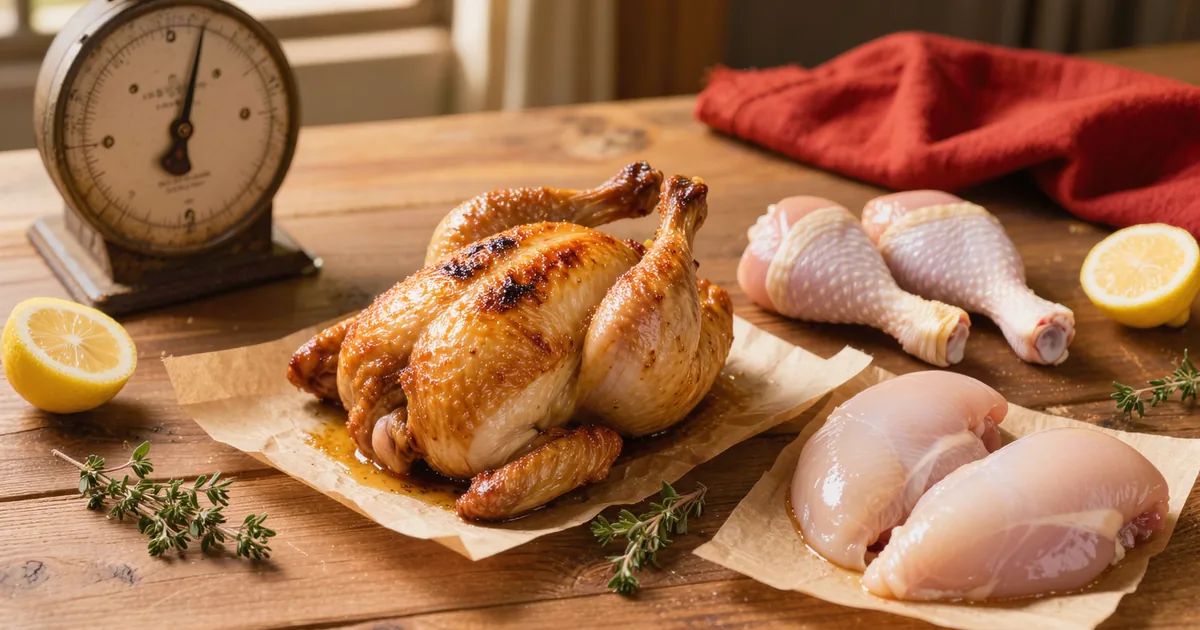
The whole answer, before the reasoning. A whole roasting bird runs a pound per adult. Leg and breast quarters, nine-tenths of a pound. Bone-in thighs or drumsticks, 0.65 lb — two pieces a head. Boneless skinless breast, 0.47 lb, which is one 7- to 8-ounce breast. Those are raw weights: what you carry out of the store, not what lands on the plate.
| Cut | Raw per adult | What that looks like |
|---|---|---|
| Whole roasting bird | 1 lb | a 4-pounder feeds about 4 |
| Leg / breast quarters | 0.9 lb | one quarter per adult |
| Bone-in thighs or drumsticks | 0.65 lb | 2 pieces per adult |
| Boneless skinless breast | 0.47 lb | one 7–8 oz breast |
Computed by the Party Portions engine — party-portions.com
Now the part other pages skip: nobody official publishes those per-person figures. I went looking for a party portion from a university extension service or the National Chicken Council, and there isn't one. The NCC has industry statistics and a 3.5-ounce nutrition serving — a label figure, not a plan for feeding thirty people in a backyard. So call these what they are: catering convention, checked against USDA's yield measurements. That's a different authority than a federal standard, and you should know which one you're holding.
How many pounds of chicken per person: the multiplier nobody uses
If you want one number, multiply. Ten adults on bone-in thighs need 6.5 lb; twenty on boneless breast need 9.5 lb. The interesting part is what happens when you switch columns — that's where the 1.5 rule falls apart.
AH-102 doesn't guess at bone weight. It reports what's left after somebody boned the bird out and weighed the parts. Run those figures into a multiplier and you get four answers:
| Cut | Bone-in factor (USDA AH-102) | What a flat 1.5× does to you |
|---|---|---|
| Breast | 1.54× | close enough — this is where the rule came from |
| Thigh | 1.69× | about 11% short |
| Drumstick | 1.82× | about 20% short |
| Whole bird | 2.13× | short by roughly a third |
Here's why I trust those factors enough to build an engine on them. AH-102 is primary measurement — a lab, a scale, a boned-out chicken. Ellen's Kitchen has published independent quantity-cooking charts for caterers for decades, built from service data rather than USDA. For breast, the caterers land on 1.56 against USDA's 1.54. Two points apart, neither citing the other. When a lab number and a working caterer's number converge like that without collusion, you can plan a party on it.
How many chicken thighs per person?
Two — 0.65 lb of bone-in thighs or drumsticks per adult. Count pieces at the butcher counter, not pounds: thighs vary in size and your scale doesn't argue. Twenty guests, forty pieces, 13 lb. One thigh reads as a portion plated next to rice and a vegetable. On a buffet line, where nobody's watching, two is what disappears.
| Guests | Whole bird (1 lb) | Quarters (0.9) | Bone-in pieces (0.65) | Boneless breast (0.47) |
|---|---|---|---|---|
| 10 | 10 lb | 9 lb | 6.5 lb (20 pcs) | 5 lb |
| 20 | 20 lb | 18 lb | 13 lb (40 pcs) | 9.5 lb |
| 30 | 30 lb | 27 lb | 19.5 lb (60 pcs) | 14.5 lb |
| 50 | 50 lb | 45 lb | 32.5 lb (100 pcs) | 23.5 lb |
| 100 | 100 lb | 90 lb | 65 lb (200 pcs) | 47 lb |
Computed by the Party Portions engine — party-portions.com
Adults only, no leftover plan. Kids count as half, big eaters as one and a half. If chicken is sharing the table with a second meat, don't buy a full portion of each — nobody eats two mains — and the meat per person calculator splits a mixed spread properly. Same crowd wanting wings instead? Twenty guests take 11 lb as an appetizer, and the wings per person calculator counts the pieces.
Your cooking method moves the number more than the cut does
Same breast. Six ways to cook it. Six different amounts of meat at the end, with a nineteen-point spread between best and worst. USDA AH-102 measured these on breast:
| Method | Cooked yield (USDA AH-102, breast) |
|---|---|
| Simmered | 77% |
| Roasted | 72% |
| Braised | 71% |
| Pan-fried | 68% |
| Broiled or grilled | 63% |
| Deep-fried | 58% |
Read that as a warning to grillers. Every portion chart on the internet was written at the roasting yield, because roasting is what test kitchens do. Take that chart to a hot grill and you land 10–15% under — at a party of thirty, four or five people looking at an empty pan. It's the most common way I've watched a host miss. Not the portion. The method. That's why the calculator asks how you're cooking before it tells you what to buy.
One correction on that 72%, because it's quoted everywhere and explained wrong nearly everywhere. The famous "USDA says chicken breast yields 72%" is a bone-in, skin-on cooking yield. It sits in AH-102's cooking-data section, not its boning section, and AH-102 has no boneless-skinless row there at all. The number survives — 72% is a real roasted bone-in figure — but the reasoning usually cited for it doesn't. The right boneless figure comes from a different book: USDA's Food Buying Guide, whose row reads 1 lb as purchased = 0.73 lb cooked chicken meat. That 0.73 is what this engine uses.
Thighs beat breasts for a crowd, and it isn't close. They cost less at every counter I buy from. They hold on a buffet without turning to chalk, because the fat is a buffer against time — and time is the enemy at every party I've worked. On a grill, where breast gives up 63% of its weight, dark meat simply doesn't dry the same way. Thirty minutes into service, that's the difference between chicken and jerky. The only reason breasts dominate party menus is that nobody asked the guests. I've put both off the same grill at the same event more times than I can count. The thigh pan empties first, every time.
165°F, and the clock that starts when the food hits the table
One temperature for all of it: chicken is done at 165°F — whole birds, breasts, thighs, ground, all of it (USDA FSIS). No separate dark-meat number to memorize, though thighs are more pleasant at 175°F, where the connective tissue finally lets go. Cooking dark meat past the safety line costs you nothing.
Then the harder clock. Perishable food shouldn't sit out more than 2 hours — 1 hour above 90°F (USDA FSIS), which describes most of my summer. Chicken is stricter than brisket in practice, because there's no fat cap doing you favors. Hold it at 140°F or above if it's staying out (USDA FSIS), and put half the platter out at a time.
Leftovers go in the fridge inside that window and keep 3–4 days, or 3–4 months frozen, reheated to 165°F (USDA FSIS). Day-two chicken beats day-one chicken in exactly one application: shredded, into something with a sauce. Twenty guests take 6.7 dry cups of rice as a side — far less than the stockpot most hosts commit to, so check the rice math first. I have never once watched a party run out of rice.
A worked example: twenty grads, one grill, 9.5 pounds of breast
A graduation lunch in Dripping Springs last May. Twenty guests, and the family had already decided: grilled boneless breast, because that's what the kid asked for. Twenty adults at 0.47 lb is 9.4, and the engine rounds up to 9.5 lb raw. That's the easy half.
The half that matters is what 9.5 lb becomes. Grilled, at 63%, it cooks down to about 6 lb of meat on the platter. Had I ordered off a roasting chart at 72%, I'd have planned for 6.8 lb of cooked meat and served 6 — and the last four people through the line would have found out. Same weight on the receipt, different party. The method picker is that correction, and it's the reason this page exists.
Reproduce that order in one click. This link loads the graduation's exact inputs — swap in your own headcount from there.
Load the 20-guest grill orderChicken is also the honest fallback when a holiday bird looks like too much bird. Ten guests take a 10-lb turkey with no leftovers, or 12.5 lb for sandwich week (turkey size calculator). The same ten eat perfectly well off two 5-lb roasting chickens that fit one oven and cook in ninety minutes. Nobody has ever complained. A few have asked why we don't do it every year.
Frequently Asked Questions
How much chicken for 20 people?
Boneless skinless breast: 9.5 lb. Bone-in thighs or drumsticks: 13 lb, which is 40 pieces at two per adult. Roasting whole birds instead? Buy 20 lb — five 4-pounders — and for leg or breast quarters it's 18 lb. Those are raw weights for twenty adults with no leftover plan. Kids count as half an adult and big eaters as one and a half, so a real twenty is rarely a flat twenty; put your actual mix in the calculator and it re-runs everything. And if you're grilling that breast, read the method section above before you shop — a grill costs you about 10% of the meat a roasting chart promised.
How many chicken thighs per person should I plan?
Two — that's 0.65 lb of bone-in thighs per adult, and the same figure covers drumsticks. Twenty guests need 40 pieces, or 13 lb. Count pieces rather than pounds at the counter, because thighs vary in size and two per person is what actually leaves the buffet. One thigh reads as a portion on a plate next to rice and a vegetable, but on a line where guests serve themselves, plan two and you won't be refilling. Thighs are also my recommendation for any party running longer than an hour: the fat keeps them edible while breast meat goes dry and tight in the pan.
Is bone-in chicken really 1.5x boneless?
Only for breast. USDA's Agriculture Handbook 102 measured bone-removal yield cut by cut, and the multipliers land at breast 1.54, thigh 1.69, drumstick 1.82, and whole bird 2.13. The famous 1.5 is the breast's number, quietly applied to everything else, and it costs you: drumsticks planned on a flat 1.5 come up about 20% short, and a whole bird by roughly a third. Use the per-cut figure instead — a pound of whole bird per adult, 0.9 lb of quarters, 0.65 lb of bone-in thighs or drumsticks, 0.47 lb of boneless breast. Independent caterers' charts land within two points of the USDA breast figure, which is why I'll defend these.
Does grilling change how much chicken I should buy?
Yes — by 10 to 15%, and it's the mistake I see most. USDA AH-102 measured chicken breast yields by method: simmered 77%, roasted 72%, braised 71%, pan-fried 68%, broiled or grilled 63%, deep-fried 58%. Nearly every portion chart online was written at the roasting yield, because test kitchens roast. Grill the same weight and you lose nine more points to the fire. On a 20-person order of boneless breast that's about a pound of cooked meat that never shows up — four servings. The fix isn't buying blindly extra; it's telling the calculator how you're cooking, so the correction happens before you shop instead of after.
What size whole chicken feeds 4 people?
A 4-pound bird feeds about four adults. The rule is a pound of whole raw bird per person, and it holds because roughly half a chicken's raw weight is bone, skin, and what the oven takes. If your store's birds run 5 lb, that's four adults with some comfort, or four adults and a couple of kids counting as half portions. For eight to ten people, buy two smaller birds rather than one big roaster: they fit in one oven, cook in about ninety minutes, and you double the drumsticks, which are the pieces that vanish first. Roasters over 7 lb cook unevenly — the breast is dry before the thighs are ready.
How long does leftover chicken keep?
Three to four days refrigerated, or 3 to 4 months frozen, reheated to 165°F (USDA FSIS). Get it in the fridge within 2 hours of serving — 1 hour if the party is running above 90°F (USDA FSIS). Two habits make the difference. Pull the meat off the bone before it goes in the container, because bones hold heat and slow the cooling that keeps it safe. And store it with whatever liquid you have, even a splash of broth: reheated in its own moisture to 165°F, day-three chicken shreds into tacos or soup and nobody guesses. Dry leftover breast is a storage problem, not a cooking one.