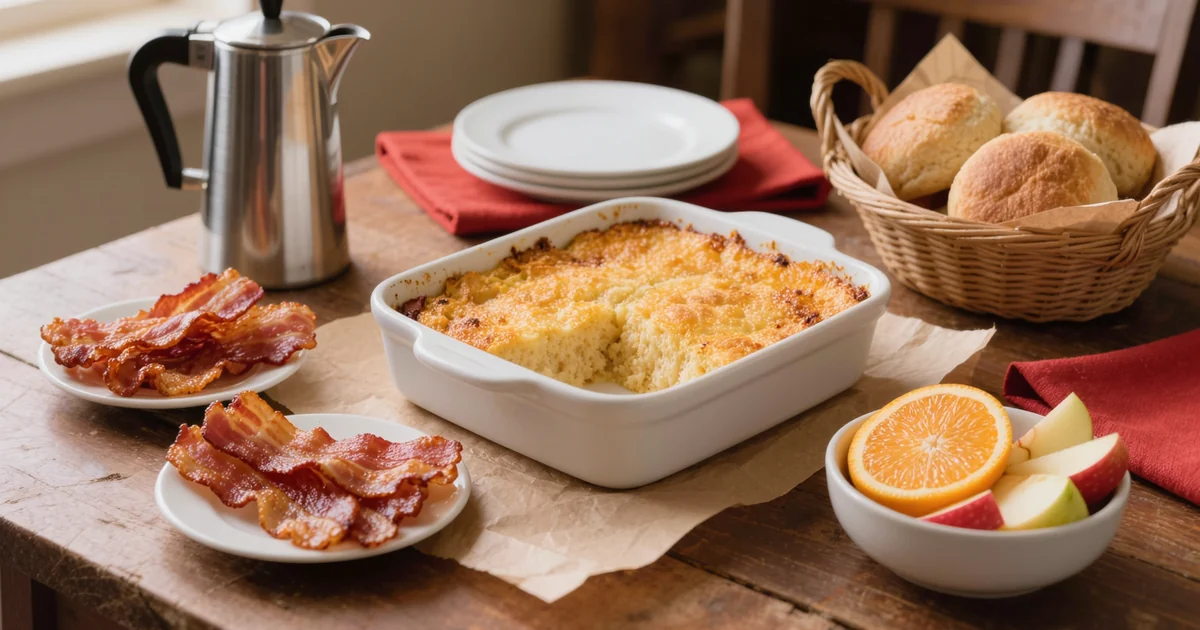
Easy breakfast for a crowd starts the night before
Breakfast is the only meal where every dish wants to be served at the same moment, and almost every dish wants a burner. That's the whole problem. My kitchen at home has four burners. The church hall I work in Dripping Springs has six, and one of them sulks. You cannot cook eggs, bacon, potatoes and pancakes for thirty people on six burners in the same forty minutes — nobody can — so an easy breakfast for a crowd isn't a cooking problem at all. It's a scheduling problem, and you solve it the night before.
The rule I give my crew: if it can't go into a pan the day before and into the oven in the morning, it doesn't go on the menu. That one filter kills the pancake griddle, the omelet station and the skillet of scrambled eggs, and it saves the morning. What's left is casseroles, sheet pans, and things that were already finished yesterday. Assemble at 8 PM. Sleep. Bake at 8 AM.
Oven capacity is the second half of the same problem. A home oven takes two 9x13 pans on one rack without much complaint and four across two racks with a lot of complaint. Past that you're batching, and batching means the first pan is cold by the time the last one's done. So I count pans before I count people. Thirty guests, three casseroles, one oven — fine. Thirty guests, six casseroles, one oven — that's two seatings and a lot of apologizing.
The part nobody wants to hear: scrambled eggs do not scale. They're the single worst dish you can choose for twenty people. They go rubbery and weep water in about ten minutes on a warmer, and the fix isn't technique — it's a casserole. Every caterer I know already knows this. Every host I work for tries anyway, and every one of them ends up spooning grey eggs into a chafing dish at 9:15 while apologizing to a line. Eggs want to be eaten within ninety seconds of leaving the pan. A crowd cannot do that. Put the eggs in a pan, bake them to 160°F (USDA FSIS), cut them into squares, and go talk to your guests.
The lineup: 10 dishes that hold
1. Overnight breakfast casserole
The dish the whole morning hangs on. Bread, eggs, sausage, cheese, assembled the night before and left in the fridge so the bread drinks the custard — that soak is why it bakes into one sliceable thing instead of a wet mess. It holds on a warmer for two hours without turning. What breaks it: baking it cold from the fridge on the timer you used last time. A cold 9x13 needs 15 to 20 extra minutes, and the center is what pays. Probe the middle to 160°F (USDA FSIS), not the edge.
Quantities For 20: 3 pans (9x13) · For 40: 5 pans — a 9x13 feeds 8 as the main event
2. A sheet pan of bacon
Oven, not skillet. That's the whole trick, and it's the biggest time-saver on this list. Strips on a rimmed sheet pan, 400°F, no flipping, no spatter, nobody chained to the stove. Two sheet pans go in together and come out together — try getting that from a skillet. Drain on paper and do it in the last twenty minutes so it's still crisp; bacon cooked early and held goes limp and sad. What breaks it: crowding. Overlap the strips and they steam instead of crisping.
Quantities For 20: 3 lb · For 40: 6 lb — about 2 strips a head
3. Migas or breakfast tacos
I'm a Hill Country caterer, so this has been on every breakfast I've ever put out. Migas — eggs, tortilla chips, cheese, chiles — is the one egg dish that survives a warmer, because the fried tortilla holds the eggs together and keeps the texture honest. Breakfast tacos are the assembly-line version: bake the eggs, warm the tortillas in a covered pan, let people build. Salsa in bowls, not on the tacos. What breaks it: pre-assembled tacos wrapped in foil for an hour. Fine for a truck. Not fine for a buffet.
Quantities For 20: 40 tacos (about 3 dozen eggs) · For 40: 80 tacos — 2 a head
4. Buttermilk biscuits
The one thing here I'll let you make fresh that morning, because it takes twelve minutes and no burners. Cut them the night before, freeze them raw on the sheet pan, bake straight from frozen — they rise better cold, and you've moved all the work to yesterday. What breaks it: baking them at 6 AM to get them out of the way. A biscuit's window is about forty minutes wide. Time them to the moment people sit down, not to your convenience.
Quantities For 20: 40 biscuits · For 40: 80 biscuits — 2 a head, and they'll all go
5. Sausage gravy
The cheapest way to make a breakfast feel like an event, and the most forgiving thing on this page. A stockpot of gravy holds all morning on the lowest burner you own, and unlike eggs it improves while it sits. Make it the day before. It'll set up like concrete in the fridge — that's correct, that's what it's supposed to do — and you thin it with milk while it reheats. What breaks it: reheating it hard and fast, which splits it. Low, whisk, walk away.
Quantities For 20: 2.5 qt · For 40: 5 qt — about 4 oz a head over biscuits
6. Baked oatmeal
The dish that makes the vegetarians and the 7 AM crowd happy, and it costs almost nothing. Assemble the night before and bake it in the morning alongside the casserole at the same temperature — that's the real reason it's on the list. It shares oven space instead of fighting for it. Serve it warm with a pitcher of cream and a bowl of brown sugar. What breaks it: honestly, nothing. It's the most durable thing here. It's still good at eleven.
Quantities For 20: 2 pans (9x13) · For 40: 4 pans — 12 servings a pan alongside other dishes
7. Fruit salad
Zero oven, zero burners, and it's the plate's only relief from a table of beige. That is not a small thing at 9 AM. Cut everything the day before except the bananas and apples, which go brown and take the bowl down with them. Melon, pineapple, grapes and berries hold overnight fine; dress it with a little lime and honey an hour out. What breaks it: cutting it small. Big pieces hold. A fine dice weeps into a slush by hour two.
Quantities For 20: 5 lb prepped · For 40: 10 lb — about 4 oz a head
8. Cinnamon rolls
People will take one no matter how much else is on the table, so plan for it rather than pretending otherwise. Roll and cut them the night before, park the pan in the fridge for a slow overnight rise, then bake from cold with 15 to 20 extra minutes. Ice them warm, not hot, or the icing runs off into the pan. What breaks it: a warmer. Twenty minutes in a chafer and the outside turns to leather. These go out at the end, once, and get eaten.
Quantities For 20: 24 rolls (2 pans) · For 40: 48 rolls (4 pans) — 12 to a 9x13
9. A frittata
The casserole's lighter cousin, and what I reach for when somebody's gluten-free. No bread means nothing to soak, so unlike the overnight casserole this one gets assembled and baked the same morning. Bake it in a 9x13 and cut it into squares — a round skillet frittata is a photograph, not a service plan. Same 160°F target as any egg dish (USDA FSIS). What breaks it: overbaking. It goes from set to rubber in about four minutes, and it keeps cooking on the counter.
Quantities For 20: 2 pans (9x13) · For 40: 4 pans — 12 squares a pan
10. Hash brown casserole
Potatoes without a single burner. Frozen shredded hash browns, dairy, cheese, into a 9x13 — and yes, I said frozen, because the bag is already shredded, already blanched, and I have forty people coming. Thaw the bag overnight in the fridge or the middle of the pan stays icy. What breaks it: assembling it wet. Squeeze the thawed potatoes out in a clean towel first, or you will bake a casserole soup and nobody will tell you why they didn't take seconds.
Quantities For 20: 2 pans (9x13) · For 40: 4 pans — a side portion, 12 to a pan
Brunch ideas for a crowd: the later, boozier version
Brunch is breakfast that starts at eleven with a bar, and the shift changes three things. People eat more, because they skipped breakfast to be hungry for this. They graze across two hours instead of inhaling in forty minutes. And somebody has to pour.
The food barely changes — every dish in the lineup above works at 11 AM. What changes is that you add one thing people can chew on for two hours: a grazing board, chicken and waffles, a pastry table. And you add the bar, which has arithmetic of its own and isn't gentle about it. My rule comes straight off the wedding math: two drinks in the first hour, one an hour after that. Fifty drinking guests across a four-hour brunch is 250 drinks — mimosas included, and mimosas are still drinks even though the orange juice makes everyone feel like they aren't. Run the 250-drink bar math before you buy the sparkling. The case count surprises people every time.
The one brunch trick worth stealing: build the mimosa bar and step away from it. Bottles of sparkling in an ice tub, three juices in pitchers, flutes on a tray, a small sign. You are not a bartender, and you are also cooking. Self-serve for brunch drinks, always — same logic as the make-ahead spine. Anything you're personally doing at 11:15 is a thing that will go wrong at 11:15.
Breakfast for a crowd: what to buy for 20 and for 40
The lineup tells you what to make. This table is what our engine says about everything else on the table — the parts of a morning that already have hard numbers behind them. Same figures the calculators run, at the two headcounts that come up most.
| Item | For 20 | For 40 |
|---|---|---|
| Coffee, morning pour | 0.4 lb grounds | 0.8 lb grounds |
| Potatoes, roasted or mashed | 10 lb | 20 lb |
| Grazing board (app portions) | 5 lb | 10 lb |
| Chicken, boneless breast (chicken and waffles) | 9.5 lb | 19 lb |
| Cake or pastry table | 14 slices | 28 slices |
Computed by the Party Portions engine — party-portions.com
Most breakfast ideas for a crowd you'll find online stop at the dish and never say how much, which is the gap this whole site exists to close. Two of those rows deserve a note. The potato number is the same whether you roast them or mash them — 10 lb for 20 people either way, which surprises hosts who assume roasting shrinks more (the potato math is here). And the pastry row is a dessert-table portion, not a cake-only portion: when there's a spread, people take about 70% of a full slice each, which is why 20 guests need 14 slices and not 20.
What goes in when — the timing sheet
Everything lands at once or nothing does. So I don't plan forward from when I wake up. I plan backward from when the doors open, and this is what a 9 AM breakfast for thirty looks like on paper.
| Clock | What happens |
|---|---|
| 8:00 PM, night before | Assemble the casserole, hash browns, oatmeal and cinnamon rolls. Cut the fruit. Make the gravy. Cut and freeze the biscuits raw. |
| 7:30 AM | Casseroles out of the fridge onto the counter. This is the step everyone skips. |
| 7:45 AM | Oven to 350°F. Gravy onto the lowest burner you own. |
| 8:00 AM | Breakfast casserole and baked oatmeal go in together — same temperature, which is exactly why they're both on the list. |
| 8:20 AM | Hash brown casserole in. |
| 8:35 AM | Casseroles out and tented in foil. They rest, and they keep cooking. Oven to 400°F, bacon sheet pans in. |
| 8:45 AM | Biscuits in from frozen. Cinnamon rolls after them, arriving late on purpose. |
| 8:55 AM | Bacon out and drained. Fruit out of the fridge. |
| 9:00 AM | Doors open. Everything is within ten minutes of its best. |
My run sheet, not the engine's — move the clock, keep the order.
Two things in there do the heavy lifting. The 7:30 AM counter step, which nobody does and which is worth 15 to 20 minutes of bake time. And the 8:35 tent, which is where most hosts panic — the casserole looks done, it comes out, and then it sits for twenty-five minutes while the bacon goes. That's not a delay. That's the rest, and it's why the squares cut clean.
What time should you start cooking breakfast for a crowd?
For a 9 AM breakfast, the first pans go in at 8:00 AM — casserole and baked oatmeal together at 350°F — with the oven preheating from 7:45. The real start is 8:00 PM the night before, when everything gets assembled. Pull casseroles onto the counter at 7:30 AM; a fridge-cold pan costs 15 to 20 extra minutes.
Coffee is the other thing you'll underbuy
Coffee has arithmetic of its own, and it's the number I'd bet money most hosts get wrong — in both directions. Not everybody drinks it. At a morning event, about three in four do.
Last March I ran a 50-guest volunteer breakfast up in Kerrville, 8 AM start. Fifty people does not mean fifty cups. At a morning event roughly 75% take one, so the engine saw 38 drinkers, 38 cups, 2.4 gallons of water and about a pound of grounds. One 60-cup urn covered it with room to spare. I brought a second urn anyway and filled it with decaf, because about one in five coffee drinkers takes decaf and the ones who do will ask you personally.
Load that morning in one click. Fifty guests, morning pour — swap in your own headcount from there.
Run the 50-guest coffeeThe take rate is the part nobody accounts for. Morning is 75%; by afternoon it's 60%, by evening 50%. The same fifty people need noticeably less coffee at 4 PM than at 8 AM, so buying for fifty cups at a morning event isn't generous — it's just wrong, and the grounds you didn't need are grounds you paid for. Fifty guests at a morning event is 38 cups and about a pound of grounds; the calculator sizes the urn too, which matters more than it sounds. An urn brews once and then you're waiting on it, so a too-small urn means a queue at exactly the wrong moment.
Hot, safe, and still good at 10 AM
Four numbers run a breakfast buffet, and I've never worked an event where all four weren't in play.
Egg dishes cook to 160°F (USDA FSIS) — the casserole, the frittata, the migas. Probe the center of the pan, never the edge, because the edge was done twenty minutes ago and it will lie to you. Anything with poultry in it goes to 165°F (USDA FSIS), which catches the chicken and waffles and any casserole built on chicken sausage. Once it's out, hot food holds at 140°F or above (USDA FSIS). That is the chafing dish's entire job, and a chafer with one tired fuel can under a full pan does not do it. Test before you trust it.
Then the clock. Perishable food shouldn't sit out more than 2 hours, or 1 hour above 90°F (USDA FSIS). A brunch that opens at eleven and drifts to two has already lost that argument, which is why I swap pans instead of letting one pan ride all morning. Put out half, hold half, replace at the hour — the last person through the line gets the same breakfast as the first, and the leftovers are actually safe to keep. Those go in the fridge inside the window, last 3–4 days, and reheat to 165°F (USDA FSIS). Breakfast casserole reheats better than almost anything else on this page. Cut squares, cover, 350°F, and it's genuinely good on Tuesday.
How do you keep breakfast warm for a crowd?
Hold hot dishes at 140°F or above (USDA FSIS) — covered pans in a low oven do it at home, no chafer required. Tent the pans in foil so the tops don't dry out, and watch the clock on everything else: nothing perishable sits out past 2 hours, 1 hour above 90°F (USDA FSIS).
If breakfast is one meal of a whole weekend you're feeding — a wedding block, a reunion, a hunting camp — do the arithmetic once instead of three times. The party food calculator runs the same guest list through every dish at the site. For the dinner end of that weekend, ten big-batch mains that scale to 40 sorts what doubles from what collapses, and the pan math this page leans on — a 9x13 feeds 8 as a main, 12 as a side — is spelled out in full in the casserole guide.
Frequently Asked Questions
What is the easiest breakfast to make for 30 people?
One overnight breakfast casserole per eight guests — so four pans for 30 — plus a sheet pan of bacon and a bowl of cut fruit. That's the whole menu, and it's the one I'd hand a nervous host. Everything is assembled the night before, everything bakes at 350°F, and nothing needs a burner or a person standing over it. Four 9x13 pans won't fit one home oven at once, so bake two, tent them in foil, and bake the second pair — the first two hold fine for the twenty minutes that takes. Add biscuits if you want a third dish. Do not add eggs to order, a pancake griddle, or an omelet station. Those are the three things that turn a calm morning into a queue.
Can I make breakfast casserole the night before?
Yes, and you should — the overnight rest is the method, not a shortcut. The bread needs hours to drink the custard, and a casserole assembled and baked in the same hour comes out wetter and looser than one that sat. Assemble at 8 PM, cover, refrigerate. The thing that catches people: a pan going into the oven at fridge temperature needs 15 to 20 minutes longer than the same pan at room temperature, and the center is what's underdone. Pull it out 30 minutes before it bakes, then probe the middle to 160°F (USDA FSIS) instead of trusting the timer. Baked and tented in foil, it holds at 140°F or above on a warmer for a good two hours.
How do I keep breakfast hot for a crowd without ruining it?
Hold at 140°F or above (USDA FSIS), and hold the right things. Casseroles, hash browns, baked oatmeal and gravy all survive a chafing dish for two hours. Bacon, biscuits and cinnamon rolls do not — bacon goes limp, biscuits go stale, and a cinnamon roll in a chafer turns to leather in about twenty minutes. Those three come out last and go out once. The other habit that saves a buffet is swapping pans instead of topping them up: a fresh pan every 45 minutes keeps everything inside the 2-hour rule (1 hour above 90°F), and the last person through the line gets the same breakfast as the first. Half-full chafers with one weak fuel can underneath don't reach 140°F. Check with a thermometer, not with your hand.
How much bacon do I need for 20 people?
About 3 pounds — two strips a head — cooked on sheet pans in a 400°F oven rather than in a skillet. That's my number for a breakfast where bacon is one item among five or six. If bacon is the only protein on the table, go to four strips a head and buy 5 pounds. Two rimmed sheet pans hold roughly a pound and a half each without crowding, and crowding is the whole failure mode: overlapping strips steam instead of crisping. No flipping needed. Cook it in the last twenty minutes before service and drain it on paper — bacon cooked early and held goes soft, and nobody wants soft bacon at any hour of the day.
Do I need a coffee urn, or will drip pots work?
Depends on the headcount and the hour. Fifty guests at a morning event works out to 38 drinkers, 38 cups and about a pound of grounds, and one 60-cup urn covers that comfortably. Twenty guests need 15 cups, and a 30-cup urn or a couple of dedicated drip pots will do it. The reason I default to an urn past about thirty people isn't capacity, it's queueing: an urn brews once and pours all morning, while a 12-cup drip pot means somebody is refilling it every eight minutes during the exact window you're plating food. Bring a second urn for decaf if you can. Roughly one in five coffee drinkers takes decaf, and they will ask.
What should I not cook for a big breakfast?
Scrambled eggs, pancakes, omelets, and anything fried to order. All four fail for the same reason: they have a service window measured in seconds and a crowd measured in minutes. Scrambled eggs weep and go rubbery about ten minutes into a warmer. Pancakes turn to sponge under foil. An omelet station is one person standing at a burner for ninety minutes while the rest of the breakfast goes cold. Waffles are the exception I'll allow, and only because a waffle holds in a low oven on a rack better than any of the others — even then it's a compromise. Bake the eggs into a casserole to 160°F (USDA FSIS), cut them into squares, and spend the morning with your guests instead.