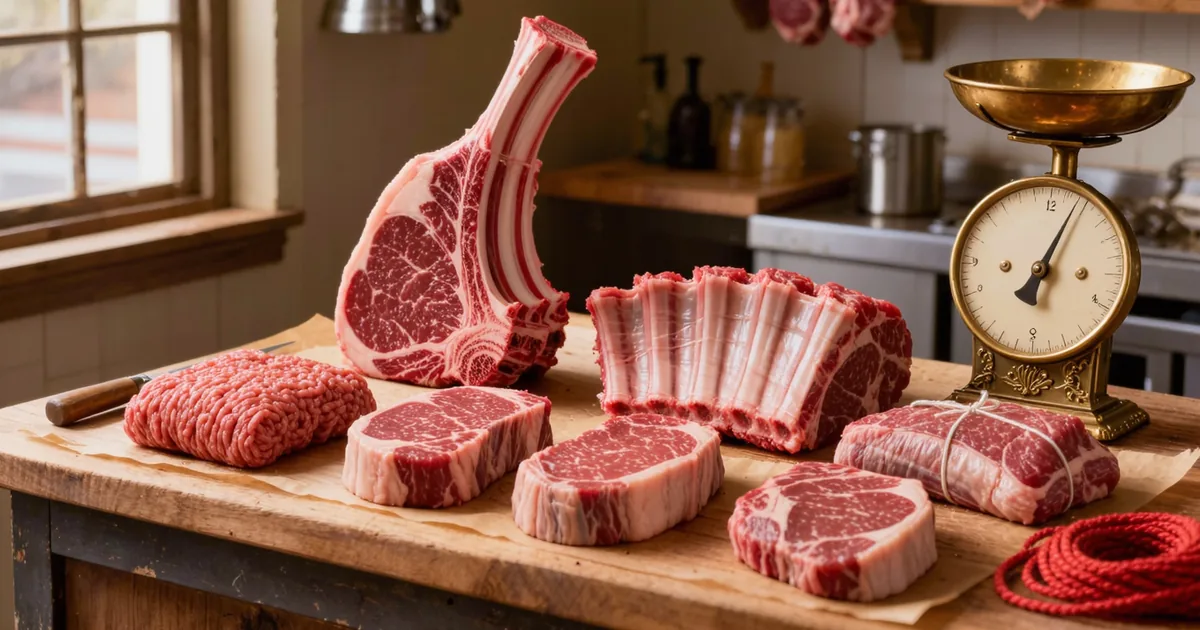
How many pounds of meat per person: the master table
I'm giving you the table first because it's what you came for. Every row assumes an adult eating a main-course portion with one or two sides. The cooked number barely changes from cut to cut — appetites don't care about bones. The raw number changes a lot, and raw is what the store sells you.
| Cut | Cooked per adult | Raw to buy per adult | Why |
|---|---|---|---|
| Boneless roast (chuck, loin, round) | ½ lb | ⅔ lb | ~75% yield after trim and shrink |
| Bone-in roast or ribs | ½ lb | 1 lb | ~50% yield — the bone never reaches a plate |
| Ground beef (burgers) | 2 quarter-pound patties | ½ lb | 4 patties per raw pound; 1.5–2 patties per adult |
| Mixed BBQ spread (2–3 meats) | ½ lb | ~0.9 lb | 55% blended yield across the spread |
Computed by the Party Portions engine — party-portions.com
Scaled up for a headcount, with 1–2 sides and no planned leftovers, the raw pounds to buy look like this:
| Adults | Boneless roast | Bone-in / ribs | Ground (burgers) | Mixed BBQ |
|---|---|---|---|---|
| 10 | 6.7 lb | 10 lb | 5 lb | 9.1 lb |
| 20 | 13.3 lb | 20 lb | 10 lb | 18.2 lb |
| 30 | 20 lb | 30 lb | 15 lb | 27.3 lb |
| 50 | 33.3 lb | 50 lb | 25 lb | 45.5 lb |
| 100 | 66.7 lb | 100 lb | 50 lb | 90.9 lb |
Computed by the Party Portions engine — party-portions.com
The pounds of meat per person calculator at the top of this page runs the identical math against your actual guest list — kids, big eaters, side count, leftovers slider and all. The tables are the fixed answer; the tool is the fitted one.
"One pound per person" is the butcher counter's favorite sentence, and it's only true for bone-in cuts. Nod along while you're buying a standing rib roast. Nod along for spare ribs. But repeat it over a boneless chuck roast and you've bought dinner for half the neighborhood — a 50% overbuy, every single time. Ask what the bone weighs before you agree with anybody's rule of thumb.
How much meat per person: what moves the number
Every serious estimate you'll find lives between a third of a pound and a full pound per person, and the spread isn't sloppiness. Four levers move it.
Cooked versus raw. This is the big one, and it's why the internet contradicts itself. A half pound cooked and a half pound raw are different dinners. Meat loses water and fat in the cooker, and bone-in cuts surrender the bone on top of that. When two sites disagree, check which weight they're quoting.
The rest of the table. The master numbers assume 1–2 sides. Put out three real sides and the calculator trims the meat about 15%. A full buffet spread — beans, mac, two salads, rolls, banana pudding — takes it down to a third of a pound cooked per adult. Twenty years of scraping plates says sides cut into meat more than hosts believe.
Who's actually coming. Kids count as half an adult appetite, big eaters as one and a half. Ten adults, four kids, and two big eaters isn't 16 portions — it's 15 effective adults. A party food calculator that ignores the guest mix will overfeed a birthday party and starve a rugby team.
Whether you want leftovers. Wanting them is legitimate — plan them with the slider instead of "rounding up" three separate times and calling it caution.
One boundary worth naming: if every guest gets an individual cut, you've left pounds-per-person territory and entered count math. Ten guests need 7 ribeyes, not 10 — the steak per person page handles that arithmetic.
Boneless vs bone-in meat per person: which needs more?
The convention: bone-in needs roughly 50% more raw weight than boneless — 1 pound per adult instead of two-thirds. I'd call that a butcher's convention rather than a law of nature, because the bone fraction swings by cut. A bone-in pork shoulder runs close to the convention. A rack of ribs carries more freight.
And bone-in chicken can run a full 100% more — a leg quarter is startlingly little meat once the frame is gone. When in doubt, price the cut both ways: the bone-in sticker is lower, but you're paying it on weight you'll never serve.
How much ground beef per person?
Plan a half pound of raw ground beef per adult — 5 lb for ten, 25 lb for fifty. A pound of 80/20 makes four quarter-pound patties, and most adults eat 1.5 to 2 patties at a cookout. Buy the second patty's worth even if you doubt it; a naked grill at 6:30 costs more goodwill than a pound of chuck.
Chili and tacos run leaner, because tortillas, beans, and toppings do half the feeding. A taco bar plans just 2 oz of cooked meat per taco, three tacos per adult — 10 adults need only 5 lb of raw ground beef there. If that's your party, the taco bar calculator does the meat, shells, and toppings in one pass.
How much BBQ per person: the spread math nobody publishes
Single-meat math is everywhere. Spread math — two or three meats on the same table — is where the internet goes quiet, because it's genuinely awkward: guests don't pick one meat. They take some of each.
Here's how I buy it, roughly 1,500 events in. Total appetite doesn't grow much when there are choices — half a pound cooked per adult still holds. What changes is the blended yield: packers and bone-in butts give up 50%, sausage and chicken give up less, and a real spread lands near 55%. Call it 0.9 lb of raw meat per adult across the whole table.
Then the split, which is where most hosts go wrong. Divide the total by your number of meats — then multiply each meat's share by 1.2. That's the variety factor. Every meat gets forked by far more plates than an even split predicts, and the headliner goes first. Yes, the shares now add to 120% of the base. The overage is deliberate, it's a few pounds per meat, and it's the difference between "we ran out of brisket at 7:40" and leftovers with a plan.
Take the classic search — how much meat for 20 people bbq — and run it: about 18 lb raw total for a two-meat spread. On paper that's 9 lb each. In my truck it's 11 lb of brisket and 9 of pork, with the cushion riding on whichever meat your crowd fights over. For comparison, single-meat parties for the same 20 guests: brisket alone is 20 lb raw — two 10-lb packers — while pulled pork sandwiches take 15 lb of bone-in butt, two 7.5-lb butts.
And if you got here by typing how much bbq per person calculator into a search bar: the tool above is that. Set the cut to Mixed BBQ spread, tell it how many sides you're running, and it does the blended-yield math before your group chat finishes arguing about sauce.
How many people does a pound of BBQ feed?
One cooked pound of BBQ feeds two adults at the half-pound convention, or three when a big side spread pulls portions down to a third of a pound each. And because brisket and pork butt give up about 50% in the smoker, that cooked pound started life as roughly 2 lb of raw meat.
A church picnic for 80: the worked example
Last month I catered a church picnic outside Wimberley — 80 people on the list, which sorted into 64 adults and 16 kids. Kids count half, so that's 72 effective adults. Two meats off my smokers — they're named after my aunts, and they earn it — plus a proper three-side spread from the congregation's casserole brigade.
The math: 72 × ½ lb cooked, trimmed 15% for the sides, is about 30.6 lb of cooked meat. At the 55% blended yield, that's just under 56 lb raw. An even split says 28 lb per meat; the 1.2 factor put the cushion on the headliner, so I bought 33 lb of packer brisket and let the pork butts ride at 28 — pulled pork stretches, brisket vanishes. Nothing ran out, and the pastor took a brisket sandwich home for Tuesday.
Load the picnic into the calculator and you'll see the same numbers — then swap in your own headcount.
The sides did their share of the feeding, which is the point of trimming the meat. Scale references from my tables: rice for 50 is 6.8 lb dry — and I have never once watched a party run out of rice, so run the rice numbers instead of guessing — and potato salad for 50 runs 19 lb of potatoes, which the potatoes calculator converts for mashed, roasted, or baked as well.
Feeding a crowd this weekend? Put your real guest list into the calculator and get raw pounds for your exact cut in ten seconds.
Run your numbersSafe temperatures, the 2-hour rule, and leftovers
Buy the right amount, then don't lose any of it to the danger zone. These are the numbers I hold my own crew to, and they come straight from federal food-safety guidance (USDA FSIS):
| Meat | Safe internal temperature |
|---|---|
| Ground meats (burgers, meatloaf) | 160°F |
| Whole cuts of beef, pork, lamb | 145°F + at least 3 minutes rest |
| Poultry (whole, parts, ground) | 165°F |
| Hot holding on a buffet | 140°F or above |
Perishable food never sits out over 2 hours — 1 hour when it's above 90°F, which in a Texas July is every daylight hour (USDA FSIS). Leftovers go in the refrigerator for 3–4 days or the freezer for 3–4 months, and reheat to 165°F (USDA FSIS). Planned leftovers are a win only if they're still safe on Tuesday, so box early and chill fast.
Frequently Asked Questions
How much meat per person do I need for a party?
Plan half a pound of cooked meat per adult when you're serving one or two sides — that single figure covers nearly every cut. What changes is the raw weight you buy: boneless cuts need about two-thirds of a pound raw at a 75% yield, bone-in cuts need a full pound at 50%, and a mixed BBQ spread lands near 0.9 lb raw at a 55% blended yield. Count kids as half an adult portion and big eaters as one and a half. A bigger side spread lets you trim the meat 15–33%. The appetite stays constant; only the packaging around it changes.
How much meat per person for BBQ with multiple meats?
For a barbecue spread with two or three meats, plan about 0.9 lb of raw meat per adult — half a pound cooked, at the 55% blended yield a mixed spread actually delivers. Then split with intent: divide the total by your number of meats and multiply each share by 1.2, the variety factor, because everyone takes some of each and the headliner disappears first. For 20 adults that's roughly 18 lb of raw meat total — call it 11 lb of brisket and 9 lb of pork butt rather than 9 and 9. A heavy side spread lets you trim the whole number by 15% or more.
How many pounds of ground beef do I need for burgers?
A pound of 80/20 makes four quarter-pound patties, and most adults eat 1.5 to 2 of them at a cookout, so the ground beef pounds per person figure is about half a pound raw. For 20 adults that's 10 lb of ground beef — 40 patties. Chili and tacos run leaner because beans, tortillas, and toppings do half the feeding: a taco bar plans just 2 oz of cooked meat per taco, three tacos per adult, so 10 adults need only 5 lb raw. Whatever the dish, cook ground beef to 160°F (USDA FSIS) — color is not a doneness test.
Do kids and big eaters change the math?
Count each kid as half an adult appetite and each big eater as one and a half — that's the guest-mix rule the calculator uses. So 10 adults, 4 kids, and 2 big eaters isn't 16 portions; it's 15 effective adults (10 + 2 + 3). On a plated brisket menu, that's 7.5 lb cooked and 15 lb raw. The mix matters more than hosts expect: a graduation party heavy on teenage boys eats like a roster of big eaters, while a church picnic with a long kids' table runs light. Set those two counters honestly before you trust any headline number.
How long can cooked meat sit out at a party?
Two hours, then it goes in the fridge — one hour when it's above 90°F outside (USDA FSIS). Hot food held for a buffet needs to stay at 140°F or above. Leftovers keep 3–4 days refrigerated or 3–4 months frozen, and reheat to 165°F. At events I run, we start boxing meat at the 90-minute mark, which doubles as the best overbuying insurance there is: the extra half packer only counts as a win if it's still safe to eat on Tuesday. A cheap cooler of ice next to the serving table pays for itself the first hot afternoon.
Is bone-in or boneless meat cheaper for a crowd?
Compare cost per cooked pound, not per sticker pound. Bone-in usually posts the lower shelf price, but at a 50% yield you're buying a full raw pound per adult versus two-thirds of a pound for 75%-yield boneless. Multiply the bone-in price by 2 and the boneless price by 1.33 — those are the real quotes, and boneless wins that comparison more often than the stickers suggest. Bone-in still earns its keep where it belongs: slow smokes that want the flavor and connective tissue, and platters that should look like an occasion. For burgers and chili, boneless every time.