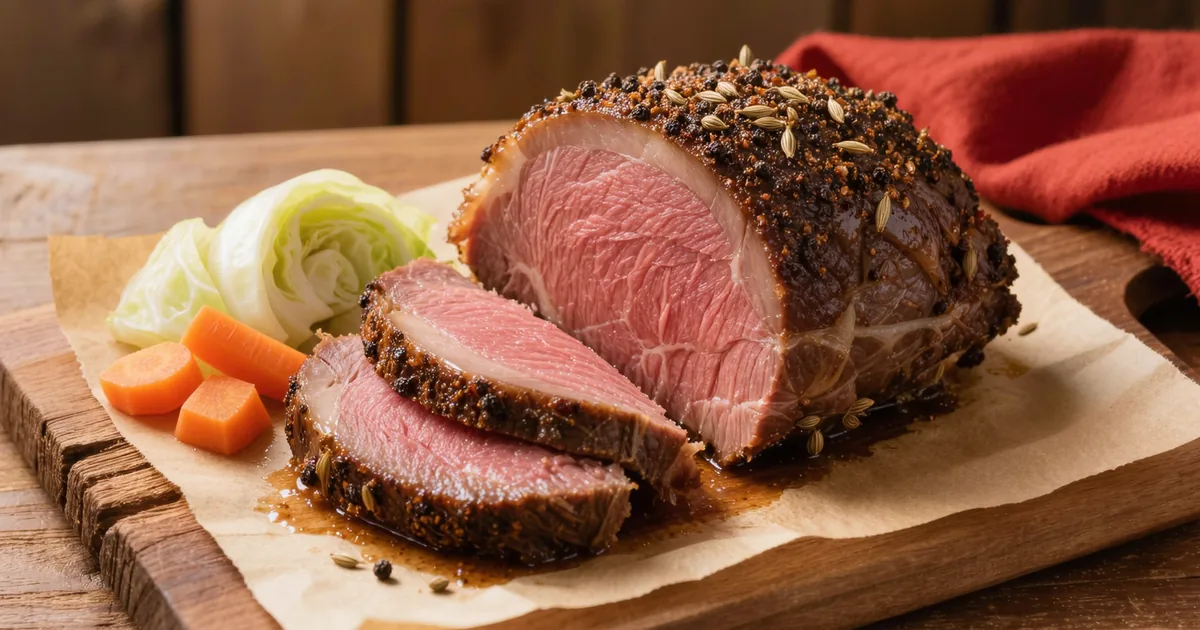
How much corned beef per person — the correction that comes first
Ask the internet how much corned beef per person you need and you'll get a wall of pages repeating that it loses 40 to 50 percent of its weight in the pot, so buy a pound a head. That number has been wrong for years, and it keeps getting copied anyway. USDA's own raw-to-cooked figure puts a pound of raw corned beef at 320 grams once it comes out of the water. Do the division. That's about 70 percent — a 30 percent shrink, not half.
The shopping list moves with it. At roughly 70 percent yield, three quarters of a pound raw per adult lands the half pound cooked a centerpiece portion wants. The pound-a-head rule assumes a 50 percent yield corned beef doesn't have. It isn't protecting you from running out — it's buying you leftovers you didn't plan. On March 17 that's no tragedy. But it should be a decision you made, not a rounding error you inherited.
Two numbers do the work here, and they have different pedigrees. The yield is USDA's. The half pound cooked per adult is a catering convention — mine, and every caterer I've worked beside. No .edu extension office and no USDA publication prints a corned beef party portion; nobody has studied how much of it a person eats at a party. What I have is twenty years of reading what comes back on the pan. Convention, clearly labeled; the yield underneath it is federal.
How many pounds of corned beef per person: the quick table
Adults, corned beef as the centerpiece, no leftover plan. Column one is what reaches the plate; column two is what you carry out of the store. Column three is the one nobody else prints — what to buy when the label admits the brisket carries more than 20 percent solution.
| Guests (adults) | Cooked | Raw lb to buy | Heavily pumped (>20% solution) |
|---|---|---|---|
| 10 | 5 lb | 7.3 lb | 8.5 lb |
| 20 | 10 lb | 14.5 lb | 16.8 lb |
| 30 | 15 lb | 21.5 lb | 25 lb |
| 50 | 25 lb | 35.8 lb | 41.8 lb |
| 100 | 50 lb | 71.5 lb | 83.5 lb |
Computed by the Party Portions engine — party-portions.com
Read row one and you have the page in miniature. Ten guests, 5 pounds cooked, 7.3 pounds raw — 8.5 if the label confesses. That 1.2-pound gap between the last two columns isn't a safety margin. It's water. Here's where it comes from.
Where the weight went: the brine you already paid for
Corned beef is the only brisket that arrives at your kitchen already full of someone else's water. It shows up cured, and the cure is mostly liquid — which is why its shrink number is a range instead of a fact.
Federal rule 9 CFR 319.101 is the mechanism. It lets the cure add up to 20 percent water over the fresh weight of the brisket, and more than that if the label declares it. Labels do declare it. Mouse Print documented briskets pumped with 35 percent brine, sold exactly that way, entirely legally. You carry that water home. You pay beef prices for it by the pound. Then you put it in a pot for a few hours and it leaves.
So the honest yield band is 60 to 75 percent, and the width has little to do with your cooking. A lightly cured brisket from a butcher who corns his own lands near 25 percent shrink. A heavily pumped supermarket one approaches 40. Same cut, same pot — different starting water. That spread is decided at the meat case, not the stove. The calculator's over 20% solution checkbox is that range: tick it and the engine drops to the bottom of the band.
Read the label, not the price tag. Two corned beef briskets at the same price per pound are not the same deal. The one pumped to 135% of its fresh weight is selling you brine at beef prices — and it'll shrink to prove it, on your holiday. Turn the package over. The solution percentage is printed there because federal law makes it be. It's the most useful number in the case, and I've never seen a shopper read it.
It's also why corned beef and its raw cousin behave nothing alike. Ten people want 10 pounds of raw brisket but only 7.3 pounds of raw corned beef — same muscle, opposite fate. Untreated brisket loses half its weight to trim and smoke; a cured one gives back water it was never entitled to. If that's news, the brisket math explains the 50 percent side.
Flat or point: the cut decides how it eats
Buy the flat if you're slicing and the point if you're shredding. That's the whole decision, and it's about texture rather than tonnage — the pounds on your list barely move between them.
Point cut vs flat cut: which one should you buy?
The point cut vs flat cut question has matched USDA braise data behind it. Braised the same way, the flat yields 84 percent and the point 73 — and the point carries about 47 percent more fat, which is precisely what it loses in the difference. That fat is the point's whole personality: it renders, the muscle gives up, and the meat falls into shreds. The flat has an even grain and stays put under a knife.
You'll notice the buy-table doesn't split by cut. That's deliberate: the 84-versus-73 gap is real, but it's smaller than the 60-to-75 gap the brine opens under both cuts, so the planning number stays at USDA's overall 70 percent. Pick the cut for how you want to serve it; read the label for how much to buy. Then slice across the grain — always, either cut. Corned beef sliced with the grain is a chew toy, and the grain on a flat changes direction partway through.
Three USDA lines a corned beef dinner runs on
Corned beef is a whole cut, so the safety floor is 145°F with at least a 3-minute rest (USDA FSIS). Meet it early and forget it — this is a braise, and it stays leathery long past the point where it's safe. Cook it to the fork, not to the floor. Once it's sliced and out, the 2-hour rule takes over: perishable food shouldn't sit out longer than 2 hours, or 1 hour above 90°F (USDA FSIS). Hot-holding is 140°F or above (USDA FSIS), and corned beef holds well in its own liquid.
Leftovers keep 3–4 days refrigerated, or 3–4 months frozen, reheated to 165°F (USDA FSIS). Call those days the Reuben window and plan for them, because a Reuben on day two beats the plate on day one. Store the meat whole in its liquid and slice as you go. Sliced corned beef sitting bare in a container is dry by Wednesday.
A worked example: ten people, one flat, March 17
A family in Dripping Springs hires me for the same St. Patrick's dinner every year — ten adults, corned beef as the centerpiece, cabbage and potatoes around it, no leftover plan they'll admit to. The math is row one: 5 pounds cooked, 7.3 pounds raw. I buy flat, because they want slices on a platter.
The case never has a 7.3-pound flat, so I bought two that totaled 7.5. Both labels said 20 percent solution or under, which is the only reason I didn't buy nine pounds. Had they read 35 percent, I'd have been shopping for 8.5 — the third column exists because I made that mistake once, in front of people.
Load that dinner in one click. Ten adults, flat cut — swap in your own headcount from there.
Load the 10-guest St. Patrick's dinnerThe rest of the plate deserves the same arithmetic. Potatoes for 10 run about 5 pounds roasted — size the potatoes. Cabbage is where hosts lose the thread: wedges beside the brisket are one thing, but add slaw and every portion shrinks — coleslaw for 10 is 2 pounds, and the sides math handles that drop. For the whole menu from one guest list, the party food calculator runs every dish this way.
Frequently Asked Questions
How much corned beef for 10 people?
Five pounds cooked, which means 7.3 pounds raw at the real 70% yield. If the label says the brisket carries more than 20% solution, buy 8.5 pounds instead — that extra 1.2 pounds is brine that cooks right back out. Corned beef for 10 people is where most hosts overbuy, because the pound-a-head rule assumes corned beef shrinks by half. It doesn't. It shrinks about 30%. Ten pounds raw for ten guests hands you roughly seven pounds cooked — two more than the plate needs. Buy that on purpose if you want Reubens.
Does corned beef really shrink by half?
No — that's the most-repeated wrong number of the whole holiday. USDA's raw-to-cooked figure has a pound of raw corned beef finishing at 320 grams, about 70%, so roughly 30% shrink. The 40-to-50% claim likely borrowed from untreated brisket, which does lose about half its weight to trim and smoke. Corned beef arrives cured and pumped, and what it loses is mostly water that was added to it. The honest band is 60-75% yield, set by the label rather than the recipe. Lightly cured butcher brisket shrinks about 25%; a heavily pumped supermarket one gets close to 40%.
What does 20% solution on a corned beef label mean?
It means up to a fifth of what you're paying for is brine. Federal rule 9 CFR 319.101 lets the cure add as much as 20% water over the brisket's fresh weight, and more if the label declares the higher number — Mouse Print has documented briskets pumped with 35% brine, sold legally at exactly that. The water isn't a scam — it's how corning works. But it cooks back out, and you bought it by the pound. Two briskets at the same price are not the same deal. Check the back; if it's over 20%, buy the bigger number.
Flat or point — which cut feeds more people?
Neither, really — the pounds barely move. Matched USDA braise data puts the flat at 84% yield and the point at 73%, and the point carries about 47% more fat — exactly what it renders away in the difference. But that 11-point gap sits inside a brine spread of 60-75% that swamps it, so this page's buy-table uses the overall 70% figure for both. Choose on texture instead. The flat has an even grain and slices clean. The point falls apart into shreds — a gift for hash, a problem for a platter. Either way: slice across the grain.
How long do corned beef leftovers last?
Three to four days refrigerated, or 3-4 months frozen, reheated to 165°F (USDA FSIS) — and get it into the fridge inside the 2-hour window, 1 hour if the party is above 90°F. I call those days the Reuben window, and they're the best argument for buying the pound-a-head anyway when leftovers are the actual goal. Two habits matter. Keep the meat whole and sitting in its cooking liquid rather than sliced and bare, because sliced corned beef dries out in a day. And slice only what you're about to eat.
How much cabbage and potatoes go with corned beef?
The calculator puts cabbage, carrots, and small potatoes on your list automatically, scaled to the same headcount. To sanity-check the starch separately, potatoes for 10 run about 5 pounds roasted. The thing hosts miss is that portions shrink as the table gets crowded: wedges beside the meat are one dish, but add slaw, a salad, beans, and every portion drops — four or more sides and each falls to about 90% of what it would have been alone. Coleslaw for 10 is 2 pounds under that math. Buy for the table you're actually setting.