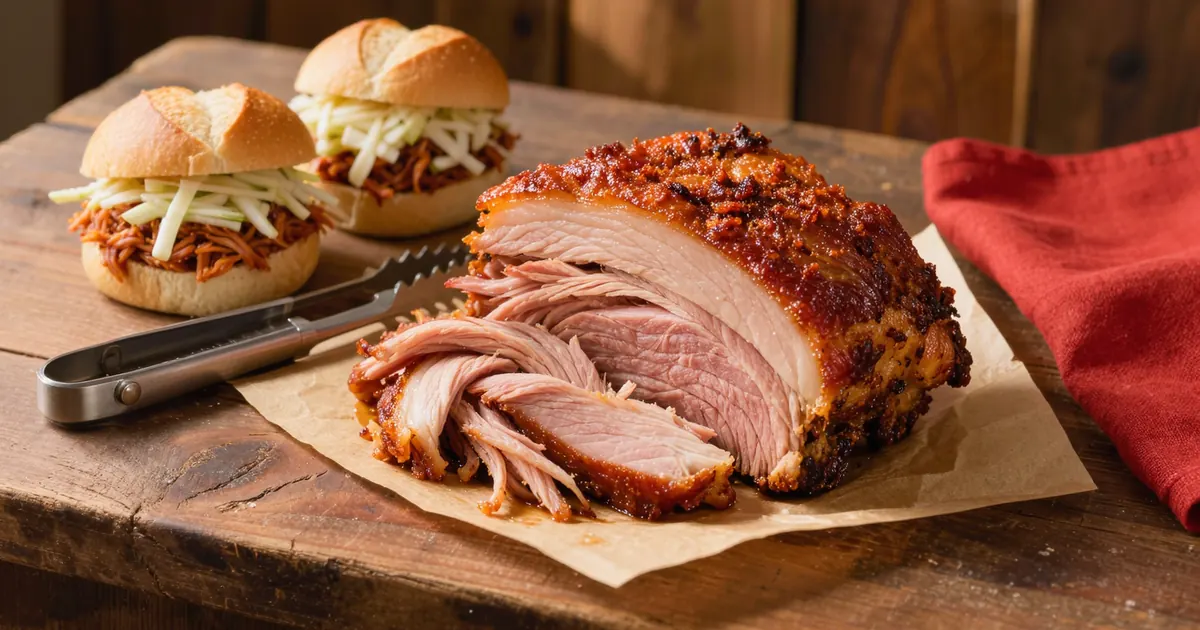
Pork butt vs pork shoulder: two sentences settle it
A pork butt is the upper half of the pig's shoulder — there is no butt in the butt. The name survives from the wooden barrels, called butts, that New England packers once shipped the cut in. That's the entire controversy. Recipes calling for Boston butt, pork butt, or shoulder all want the same bone-in muscle, so if you've been typing how much pork shoulder per person for pulled pork into a search bar, the answer is the one below: 12 oz raw bone-in per adult for sandwich service, a full pound for plates. One footnote — the lower shoulder, sold as picnic, runs leaner and stringier. When the case gives you a choice, take the butt.
How many pounds of pulled pork per person
Two baselines, because pulled pork lives two lives. Sandwich service assumes a sandwich and a half per adult with 4 oz of meat in each. Plated service assumes the pork anchors the plate next to one or two sides.
| Guests (adults) | Cooked (sandwiches) | Raw to buy | What to grab |
|---|---|---|---|
| 10 | 3.8 lb | 7.5 lb | one 7.5-lb butt |
| 20 | 7.5 lb | 15 lb | two 7.5-lb butts |
| 30 | 11.3 lb | 22.5 lb | three 7.5-lb butts |
| 50 | 18.8 lb | 37.5 lb | five 7.5-lb butts |
| 100 | 37.5 lb | 75 lb | nine 8.5-lb butts |
Computed by the Party Portions engine — party-portions.com
Plating it instead? The portion grows to half a pound cooked, and the raw column doubles it as usual.
| Guests (adults) | Cooked (plated) | Raw to buy |
|---|---|---|
| 10 | 5 lb | 10 lb |
| 20 | 10 lb | 20 lb |
| 30 | 15 lb | 30 lb |
| 50 | 25 lb | 50 lb |
| 100 | 50 lb | 100 lb |
Computed by the Party Portions engine — party-portions.com
Both tables assume adults. Kids count half, big eaters count one and a half, and a buffet line nudges everything up about 10% — the calculator blends all of it without making you do the algebra.
How much pulled pork per person: sandwich math vs plate math
A standard sandwich carries 4 oz of cooked pork, so a cooked pound makes four sandwiches. You'll find blogs insisting a pound only makes three — they're building sandwiches with 5 oz of meat or more, which is a choice, not a standard. Know which sandwich you're building before you trust anyone's chart, including mine.
Guests average a sandwich and a half, so how much pulled pork per person for sandwiches comes to 6 oz cooked — 12 oz raw. Plates are a different job. Without a bun doing quiet work, the meat anchors everything, and the portion rises to 8 oz cooked. That gap is exactly why 50 guests need 18.8 lb cooked on a sandwich menu but 25 lb plated. Menu first, then math.
How much pulled pork per person for sliders?
Half a sandwich portion. A slider bun holds about 2 oz of meat, and guests take two when sliders are an appetizer. If sliders are dinner, plan three per adult and you're right back at standard sandwich weight — the format changed, the pork didn't. Running carnitas instead? Tacos work on the same small-portion logic, 2 oz of meat each and three tacos per adult; the taco bar calculator has a full carnitas mode with tortillas, cheese, and salsa included.
How much pork butt per person
Raw weight is where pulled pork punishes optimists. A bone-in butt yields about 50% of its raw weight as pulled meat — bone, fat cap, and moisture take the rest — so the rule is the same one I use for brisket: double the cooked target. That's 1 lb of raw bone-in butt per plated adult, or 12 oz for sandwich service. Boneless butt yields closer to 60%, meaning you can buy roughly a sixth less of it, though at my suppliers the boneless premium usually eats the savings. The 50% law isn't unique to pork, either — a plated adult costs a full raw pound of brisket too, and the brisket calculator does that doubling for the other smoker classic.
Buy the bigger butt anyway. Pulled pork freezes beautifully for 3–4 months (USDA FSIS), and per pound the 9-lb butt beats two 5-lb ones on both price and bark-to-meat ratio. When the math says 7 lb, I buy 9 and portion the extra into freezer bags with its own juices. Plan the freezer bag, not the panic.
Smoking a mixed spread — pork plus chicken, sausage, or ribs? Nobody takes a full portion of each meat. The meat per person calculator splits the shares so you don't buy three full menus for one party.
Reheating pulled pork without drying it out
Pulled pork reheats better than almost anything you can smoke, if you keep the liquid. When I pull a butt, every drop from the wrap and the pan goes back into the meat or into a jar beside it. Reheat covered and low — a splash of that liquid or plain stock underneath — until the pork hits 165°F (USDA FSIS). Steam does the reviving; a dry oven does the opposite.
On the serving line, hold it at 140°F or above (USDA FSIS) — a slow cooker on low with liquid handles a backyard party fine. Room temperature gets 2 hours, 1 hour above 90°F (USDA FSIS), then whatever is out comes off the table. Leftovers keep 3–4 days in the fridge or 3–4 months frozen, and get reheated to 165°F again (USDA FSIS). Day-two pork on a bun with fresh slaw is genuinely better than most day-one plates.
A real order sheet: 50 guests, 75 sandwiches
Last October I fed 50 adults at a retirement party on a ranch road outside Dripping Springs — sandwich service, slaw, beans, rice. Fifty adults at a sandwich and a half each is 75 sandwiches. At 4 oz apiece, that's 18.8 lb of cooked pork, which means 37.5 lb raw bone-in — five 7.5-lb butts on the order sheet. Both smokers ran that morning, and four hostesses later told me they'd have bought twice the meat. They'd have frozen half of it, too.
Steal this order sheet. The link loads the retirement party's exact inputs — swap in your own guest count and menu from there.
Load the 50-guest partyThe sides were their own math, not a guess. Potato salad for 20 runs 7.5 lb — run the slaw-and-salad line properly — and rice for 50 is 16.7 dry cups, about 6.8 lb of dry rice, full stop. I have never once watched a party run out of rice, so check the rice number before you double it. When the whole spread needs sizing from one guest list, plan the whole menu in one pass.
Frequently Asked Questions
How much pulled pork for 50 sandwiches?
Fifty sandwiches at the standard 4 oz each is 12.5 lb of cooked pulled pork, which means 25 lb of raw bone-in pork butt at 50% yield — three 8.5-lb butts covers it with a little grace. Mind the difference between 50 sandwiches and 50 people, though: guests average a sandwich and a half, so 50 people actually eat about 75 sandwiches. If your headcount is 50 and sandwiches are the menu, you want 18.8 lb cooked and 37.5 lb raw — five 7.5-lb butts. The calculator above works in either direction; give it people and it runs the sandwich math internally.
How much pulled pork for 50 people?
It depends on the menu, and the gap is bigger than most hosts expect. Plated with a side or two: 25 lb cooked, 50 lb raw bone-in. Sandwich service: 18.8 lb cooked, 37.5 lb raw — five 7.5-lb butts. A sandwich carries 4 oz of meat while a plated portion carries 8, and the bun does quiet work. For a mixed crowd, count each kid as half an adult and each big eater as one and a half, then re-run it — the calculator above does this automatically. And cook it all either way: pulled pork freezes for 3–4 months (USDA FSIS), so the downside of extra is lunch, not loss.
How many people does one pork butt feed?
An 8-lb bone-in butt cooks down to about 4 lb of pulled pork. That's 16 sandwiches at 4 oz each — enough for 10 or 11 adults at a sandwich and a half apiece, or 8 adults on plates at half a pound each. This is the arithmetic behind every row in my tables: raw weight, halved by trim and cook, divided into portions. It also explains why one butt never feeds the 25 people some packaging suggests. If your party is bigger than a dozen, you're buying multiple butts, and two 7.5-pounders cook more predictably than one giant anyway.
Should I buy bone-in or boneless pork butt?
Bone-in, most days. A bone-in butt yields about 50% of its raw weight as finished pork; boneless runs closer to 60% because you're not paying for the bone or the deepest fat seams. That means you can buy roughly a sixth less boneless for the same cooked result — but compare per-pound prices before deciding, because the boneless premium often erases the yield advantage. I buy bone-in for a simpler reason: the blade bone sliding out clean is the most honest doneness test in barbecue. Whichever you choose, tell the calculator and it adjusts the raw weight for you.
Can I make pulled pork the day before?
Yes — for a crowd I recommend it. Pull the pork while it's hot, mix its strained juices back through, cool it quickly in shallow pans, and refrigerate; it keeps 3–4 days (USDA FSIS). Party day, reheat it covered and low with a splash of the reserved liquid or stock until it reaches 165°F (USDA FSIS), then hold it at 140°F or above on the line. Cooking a day ahead takes the schedule risk out of a 10-hour smoke, and the flavor doesn't suffer — day-two pork with fresh slaw beats a day-of butt that finished two hours late.
How long does pulled pork keep in the fridge or freezer?
Fridge: 3–4 days. Freezer: 3–4 months. Reheat to 165°F either way (USDA FSIS). The quality trick is freezing the pork in meal-sized bags with its own juices — flat bags thaw fast and the liquid keeps the reheat moist instead of stringy. Get leftovers into the fridge within the 2-hour window after serving (1 hour if it's above 90°F out), because the safety clock runs while the party does. Frozen right, pulled pork is the best planned-leftover meat there is, which is exactly why I round my orders up instead of down.