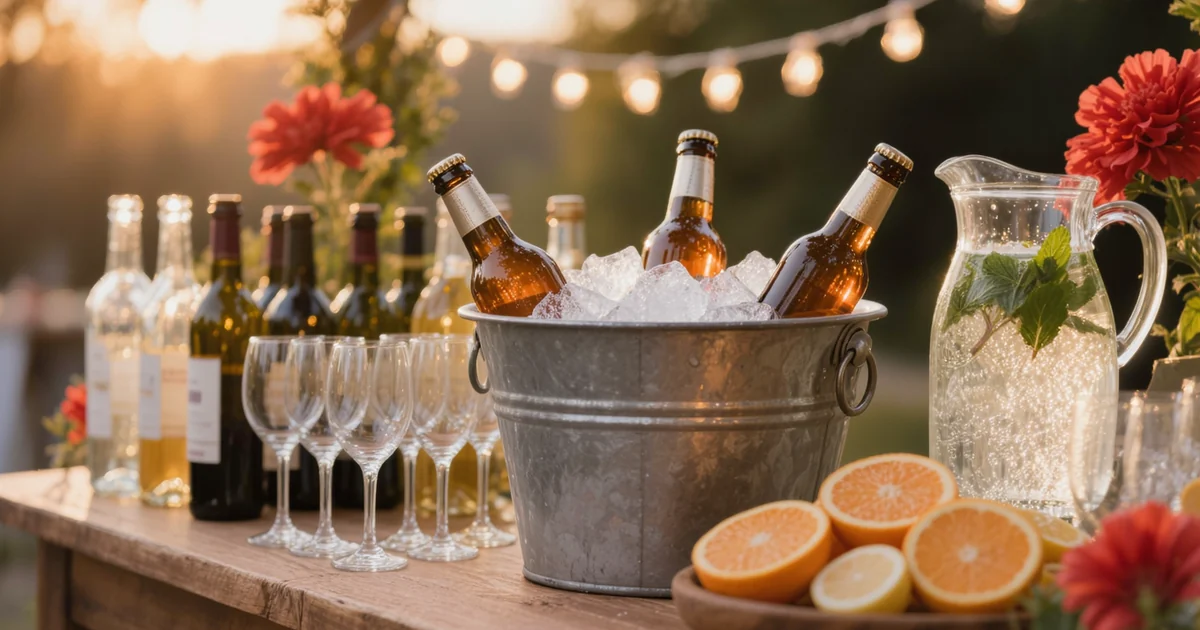
Last October I catered a 120-guest wedding in Wimberley — live oaks, string lights, a first dance to a song I've now heard at eleven weddings. The couple had budgeted “a few cases of wine and some beer.” Five hours of reception had other plans. Here's what the engine on this page put on the truck, and what actually got poured:
- 72 bottles of wine (750 ml — red, white, and one sparkling case for the toast)
- 180 beers (bottles and cans, two or three styles)
- 12 bottles of liquor (750 ml — vodka, bourbon, and tequila lead)
- 18 L of mixers (tonic, soda, citrus)
- 120 zero-proof drinks (sparkling water, sodas, one real NA option)
- 180 lb of ice
That's 720 drinks of capacity. Nobody drank 720 drinks — that's not what the number means. A bar list is a purchase plan: what has to be on hand so hour five isn't warm beer and apologies. This page plans what you buy. What any one guest does with their evening is their own business.
The bar is also the piece couples most often guess at after getting the food right. If you're still working down the list, plan the whole menu first — the bar takes twenty minutes once the headcount is settled.
Load the Wimberley wedding. 120 drinking guests, five hours, full bar — the exact list above, ready to adjust to your own numbers.
Open the worked exampleThe pace behind every bar list: two, then one an hour
Caterers size bars on a convention: two drinks per guest for the first hour, one per hour after that. I want to be precise about what that is — a purchasing convention, not a law of nature and not a prescription. It models the shape of a reception: the cocktail-hour rush, then the long settle through dinner, dancing, and cake. Buy to it and the bar stays stocked. That's all it claims.
The arithmetic for Wimberley: five hours means 2 + 1 + 1 + 1 + 1 — six drinks of capacity per guest, times 120 guests, is 720. From there, the list is one split and three conversions:
- A 750 ml bottle of wine pours 5 glasses.
- A 750 ml bottle of liquor pours about 16 drinks.
- Beer counts itself.
- Staff one bartender per 50–75 guests — two covered Wimberley comfortably.
How much alcohol for a wedding?
For a five-hour reception on the consensus split — 50% wine, 25% beer, 25% liquor — the shopping list scales like this:
| Drinking guests | Drinks (4 hrs) | Drinks (5 hrs) | Wine 750s (5 hrs) | Beer (5 hrs) | Liquor 750s (5 hrs) |
|---|---|---|---|---|---|
| 50 | 250 | 300 | 30 | 75 | 5 |
| 75 | 375 | 450 | 45 | 113 | 8 |
| 100 | 500 | 600 | 60 | 150 | 10 |
| 150 | 750 | 900 | 90 | 225 | 15 |
Computed by the Party Portions engine — party-portions.com
So how much alcohol for a wedding of 100 people? Over five hours: 600 drinks of capacity — 60 bottles of wine, 150 beers, and ten 750s of liquor, plus mixers, ice, and the zero-proof line. One note on the input: the table runs on drinking guests, so subtract kids and adults who won't be drinking before you look up your row.
The first-hour rush is also why cocktail-hour food earns its keep — a bar rush lands softer on a fed crowd. Shrimp cocktail for 50 alongside other passed apps is 11.3 lb of 16/20 (plan the cocktail hour).
The split the internet argues about
That table uses the consensus split — half wine, a quarter beer, a quarter liquor — and I'll say the disagreement out loud: The Knot publishes it flipped, liquor at half and wine at a quarter. I've broken down the bar at somewhere north of a thousand receptions, and wine wins weddings walking away. The toast is wine. Dinner is wine. Your aunt's third trip to the bar is wine. If your crowd is genuinely a cocktail crowd, slide the mix — but I'd start where the empty bottles actually end up.
Beer and wine only: most weddings' real answer
Drop the liquor line entirely and the split becomes 60% beer, 40% wine. This is my quiet recommendation for most receptions: cheaper by the case, faster lines because nobody is building anything, and no shots at midnight. For 50 drinking guests over four hours, that's 250 drinks of capacity — 150 beers and 100 glasses of wine, which is 20 bottles. The calculator's beer-and-wine mode runs this split for any headcount and any hours.
The full bar is wedding-industry theater. Beer, two wines, and one batched signature cocktail serves 95 percent of receptions better than a twelve-bottle spirits rail — it costs about a third less, it halves the bar line, and no guest in history has left a reception muttering about the Campari selection.
A drink calculator for party planning — same engine, drop the tulle
A wedding is a party with better lighting. Everything above works as a drink calculator for party hosts of any kind: set drinking guests, set hours, pick a bar style. The pacing convention holds for graduations, retirements, and backyard fortieths — only the hours change, and most parties run four, not five. Feeding the same crowd is the other half of the job; a graduation taco bar for 60 takes 29 lb of ground beef (run the taco numbers).
An alcohol calculator for party sizes the charts skip
Printed charts stop at round numbers; parties don't. An alcohol calculator for party planning earns its keep at 37 guests and three and a half hours, where no chart has a row — the engine just runs the same pace math on your real numbers. It also works as a non alcoholic drink calculator for party hosts: the zero-proof line is on every list this engine produces — about one drink per guest at Wimberley — as a line item, not an afterthought.
Signature drinks and the wedding alcohol calculator
If you want a wedding alcohol calculator with signature drinks, keep the math boring: batch one cocktail, and shift half the liquor line into it. Wimberley's 12 liquor bottles would become six for the batched drink and six for a short rail — the total doesn't grow, it just gets reallocated. A cocktail batched by the gallon before guests arrive pours as fast as wine, which is the real gift: it gives the couple the personal touch a full rail was pretending to be, without the line the full rail creates.
One batch, not three. Every signature drink past the first adds prep, garnish inventory, and a decision point at the bar — and decision points are where lines come from.
Ice, mixers, water, and the part that's actually hosting
The Wimberley list carried 18 L of mixers and 180 lb of ice — call it a pound and a half per guest for a five-hour bar. Ice is the item hosts skip and then remember forever: it chills the beer tubs, ices the zero-proof, and fills the glasses, and only the last of those is small. Buy it bagged the day of. Nobody's freezer is catering-sized.
The hosting part is cheap and mostly logistics. Water stations around the room beat a sad pitcher parked on the bar. Food pacing does more than any pour policy — the late-night snack exists for a reason, and pizza for the 30 guests still dancing at midnight is about 12 larges (size the late-night snack). Arrange rides before the reception, not during it. And keep the zero-proof line stocked and visible, because 15–20% of guests won't be drinking — and they notice when you noticed.
Frequently Asked Questions
How many bottles of wine for a party of 50?
Twenty bottles, for a beer-and-wine bar over four hours. The math: 50 guests at two drinks the first hour and one each hour after is 250 drinks of capacity. Wine takes 40% of a beer-and-wine split, so 100 glasses; a 750 ml bottle pours 5 glasses, and 100 divided by 5 is 20 bottles. Call it two cases minus four. Running a full bar instead? Wine's share rises to 50% — 125 glasses, or 25 bottles — because it absorbs some of what beer and liquor would have covered.
How much alcohol for a wedding of 100 people?
Plan bar capacity of 600 drinks for a five-hour reception with 100 drinking guests: 60 bottles of wine, 150 beers, and ten 750 ml bottles of liquor on the consensus 50/25/25 split, plus mixers, ice, and a zero-proof line of roughly one drink per guest. That's purchase capacity, not a consumption target — if the crowd runs quiet, sealed cases come home. Ask the store about returns on unopened cases when you buy. And enter 100 drinking guests, not 100 invitations: subtract kids and non-drinkers first.
How many bartenders does a wedding need?
One bartender per 50–75 guests. A 120-guest reception runs comfortably with two; past 150, add a third. The ratio matters more than almost any stocking decision, because guests remember the line, not the inventory. A beer-and-wine bar stretches each bartender further — pouring is faster than building drinks — and a batched signature cocktail helps the same way, since pre-mixed pours move like wine. If the budget forces a choice between a deeper bar and a second bartender, take the bartender.
Is the two-drinks-first-hour rule how much people actually drink?
No — it's a purchasing convention caterers use so the bar never runs dry, and it should be presented as exactly that. Real consumption varies with the crowd, the weather, the music, and the hour. The convention sizes what you buy for the first-hour rush and the long tail after it; it isn't a suggestion printed on anyone's napkin. Buy to the convention, host attentively, and expect leftovers. Leftover sealed wine is a solved problem. An empty bar at nine o'clock is not.
What should the zero-proof side of a wedding bar include?
Sparkling water, a couple of sodas, and at least one real non-alcoholic option — an NA beer, or a zero-proof version of the signature drink — at roughly one drink per guest for the evening. On my 120-guest Wimberley list that meant 120 zero-proof drinks alongside 18 L of mixers. Put them at the bar itself, in the same glassware, not on a card table by the restrooms. The guests who aren't drinking are at every single wedding, and the difference between an afterthought and a line item is the difference they remember.
How much ice does a wedding bar need?
Figure a pound and a half per guest for a five-hour bar — the engine put 180 lb on my 120-guest list. It disappears three ways: chilling the beer and white wine tubs, icing the zero-proof, and filling glasses, and only the glasses are a small number. Buy it bagged on the day, keep a reserve cooler for the tubs, and put someone in charge of restocking at the halfway mark. Melt runs fastest outdoors — a Texas October afternoon eats ice, and a June reception anywhere eats it faster.