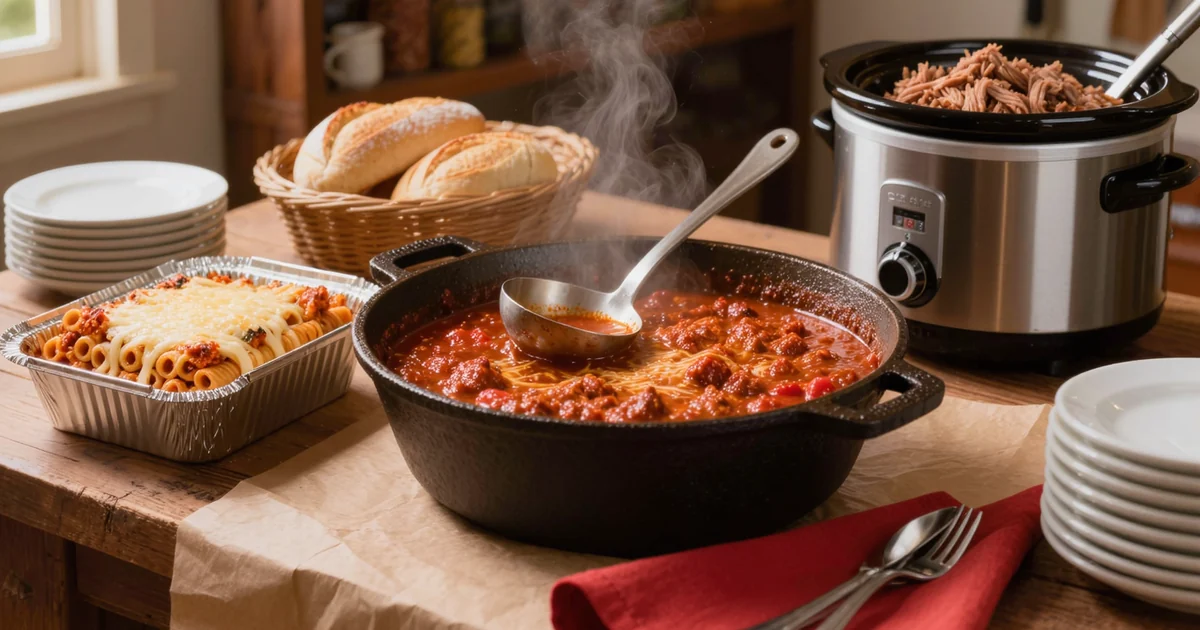
Meals for a crowd: the rule that sorts every dish
Some dishes double. Some collapse. That distinction is the whole page, and it's the only thing I'd genuinely want a host to take away from it.
A pot of chili at four times the size is still chili. It's arguably better chili — a bigger pot holds its heat more evenly, the flavors get more time and more mass to work with, and nothing about the method changes except the size of the spoon. A risotto at four times the size is a wrist injury and a gluey tragedy. Same doubling, opposite outcomes, and the reason isn't difficulty. It's what the dish demands from you at the moment of service.
Here's the sorting rule my crew uses. Braises, bakes and boils scale. They cook by mass and time, they hold, they forgive a twenty-minute delay, and one person can run three of them at once. Anything that needs per-plate timing or constant stirring doesn't. If a dish has a window — a seared scallop, a fried egg, a risotto that's perfect for ninety seconds — then feeding forty people means hitting that window forty separate times. You can't. Not while also greeting people, refilling ice, and hunting for the serving spoon you swear you packed.
There's a third category, and it's the one that fools people: dishes that scale in the pot but not in the pan. Roast chicken is fine at four birds and miserable at twelve, because the limit isn't the method, it's oven air. Same trap with anything breaded and fried — the oil temperature crashes after the second batch and the tenth batch is a different dish from the first. Scaling isn't about the ingredients. It's about whether your equipment can be in four places at once.
The unpopular advice: cook one thing well and buy the rest. The instinct at scale is to make more dishes, because more dishes feels like more hospitality. The professional move is fewer. I'd rather serve one perfect brisket with store-bought slaw and good bread than four homemade things that all arrived at the table lukewarm — and I've served both, so this isn't theory. Nobody has ever complimented my slaw. They compliment the brisket, and they remember whether the food was hot. Pick your one dish, give it your whole attention, and let the grocery store handle everything around it. That's not a compromise. That's how the people who do this for a living actually cook.
What is the easiest meal to make for a large group?
A pot of chili — 2 gallons feeds 20 as the main, 4 gallons feeds 40, about 12 oz a head with cornbread. It scales because it cooks by mass and time, with no per-plate window and no step you can't walk away from. It holds all afternoon and it's better on day two.
Ten mains that scale, with the amounts
1. A pot of chili
The most scalable main there is, and I'm not being cute about it. Chili at 4× is still chili — better, if anything, because a bigger pot holds heat more evenly and gives the thing time to come together. It's the one main here I'd genuinely make 48 hours out: it improves on day two, so you can cook it entirely ahead and reheat to 165°F. Ground meat goes to 160°F (USDA FSIS). What breaks it: nothing. A stockpot on low is the most forgiving object in any kitchen.
Quantities For 20: 2 gal · For 40: 4 gal — about 12 oz a head as the main with cornbread
2. Baked ziti in foil pans
The dish I hand to anyone catering their first party. It assembles cold, it bakes in a foil pan, it holds at 140°F (USDA FSIS) for two hours without punishing you, and it feeds the meat-eaters and the vegetarians out of two different pans without anyone feeling like a concession. Count pans, not recipes — a 9x13 is 8 mains, so 20 people is three pans. What breaks it: one giant roasting pan instead of three 9x13s. That's a dish burnt at the edges and cold in the middle.
Quantities For 20: 3 pans (9x13), about 5 boxes of pasta · For 40: 5 pans, 10 boxes
3. Pulled pork
The best ratio of effort to people fed on this page. One overnight cook, no attention required after midnight, and it holds for hours wrapped in a cooler. Sandwiches stretch it further than plates do: a cooked pound makes four 4-oz sandwiches, and 1.5 sandwiches an adult is the catering default — pulled pork for 20 sandwich-style is 15 lb raw, two 7.5-lb butts. What breaks it: pulling it early. It's done when it shreds, not when the thermometer hits a number you read somewhere.
Quantities For 20: 15 lb raw (two 7.5-lb butts) · For 40: 30 lb raw — sandwich service
4. King ranch casserole
A Texas potluck fixture and a genuinely smart party dish: chicken, tortillas, chiles, cheese, assembled a day ahead and baked in 9x13s. It's the rare casserole that's better with rotisserie chicken than with chicken you poached yourself, which deletes the longest step on the list. Poultry to 165°F (USDA FSIS). What breaks it: a sauce that's too thin. It should set into something you cut, not something you ladle onto a plate and apologize for.
Quantities For 20: 3 pans (9x13), about 9.5 lb of boneless breast · For 40: 5 pans, 19 lb
5. A taco bar
The best crowd food there is and I'll argue it with anyone. It scales linearly, it feeds picky eaters and adventurous ones off the same table, the meat gets stretched by eight other things, and everything except the meat is prep you can do sitting down. Ground beef to 160°F (USDA FSIS). A taco bar for 20 wants 10 lb of raw 80/20 and 66 shells, plus 1.9 lb of cheese and 40 oz of salsa. What breaks it: tortillas warmed too early. Wrap them in a towel inside a covered pan and they'll hold an hour.
Quantities For 20: 10 lb raw beef, 66 shells · For 40: 20 lb, 132 shells — 3 tacos an adult
6. Red beans and rice
Monday food, and the cheapest genuinely good main I know. A pound of dried beans is almost nothing and it feeds a crowd; the sausage is in there for flavor, not for bulk, which is exactly the trick — a little protein doing a great deal of work. It simmers unattended for hours and it's better reheated. Rice for 20 is 6.7 dry cups, which is roughly half what most people cook. What breaks it: worrying about when to salt. It's fine. Cook the beans soft.
Quantities For 20: 4 lb dried beans, 6.7 cups dry rice · For 40: 8 lb, 13.3 cups dry rice
7. Lasagna
Everything I said about ziti, plus an hour of assembly you'll spend standing up. That hour is the only reason ziti outranks it. But lasagna is the dish people photograph, so if the party wants a moment, build the lasagna. It freezes raw, which means you can build it two weeks out on a night you actually have time. What breaks it: cutting it hot. Rest it twenty minutes or you're serving slop with excellent flavor and no structure.
Quantities For 20: 3 pans (9x13) · For 40: 5 pans — a 9x13 cuts 8 main portions
8. Chicken and rice
One pan, two components, and the dish I make when the party is thirty people and I have exactly one oven. Bone-in thighs on top so the fat bastes the rice underneath; boneless breast if you want it lighter. Poultry to 165°F (USDA FSIS). What breaks it: lifting the lid. The rice is cooking in steam it can't spare, and every look costs you dinner.
Quantities For 20: 3 pans (9x13), 9.5 lb boneless breast or 13 lb bone-in · For 40: 5 pans, 19 lb or 26 lb
9. Brisket
The most impressive thing you can put on a table and the most demanding thing here, which is why it's ninth and not first. It scales — I've done 600 plates in the rain at a Kerrville fire department fundraiser and ran out of nothing — but it scales on time, not on effort. Half a pound cooked per adult means a full pound raw, because trim and smoke take about half the weight: brisket for 20 is 20 lb raw, two 10-lb packers. What breaks it: starting late. There is no recovering an hour.
Quantities For 20: 20 lb raw (two 10-lb packers) · For 40: 40 lb raw — half a pound cooked a head
10. A big pot of soup
Underrated for a crowd, and perfect for the cold half of the year. A gumbo, a potato soup, a chicken and dumpling — it's a braise in disguise, it holds at 140°F (USDA FSIS) all afternoon, and a ladle is the fastest serving utensil ever invented. Serve it in mugs rather than bowls if people are standing; it changes the whole event. What breaks it: a dairy-heavy soup held too long or reheated hard. It splits. Add the cream at the end, off the heat.
Quantities For 20: 2.5 gal · For 40: 5 gal — about 2 cups a head as the main
Cheap meals for a crowd: the dishes that stretch
I'm not going to publish prices. Grocery costs swing by region and by month, and a number I quote today is wrong by Christmas — so any page handing you a confident cost per head is either guessing or stale. What I can tell you is which dishes stretch, because that's structural, and structure doesn't go out of date.
The principle behind every one of them: cheap meals for a crowd are the ones where a little protein does a lot of work and something starchy does the rest. Beans, rice, pasta and tortillas are the stretchers. A pound of dried beans feeds more people than a pound of anything else in the store. A shredded shoulder goes further than a sliced one, because pulling distributes the meat and a bun carries the rest of the bite. That's why 20 people at a pulled pork sandwich party need 15 lb raw, while the same 20 people at a plated pulled pork dinner need 20 lb. Same meat, same guests, five pounds of difference — purely from how it's served.
The second lever runs opposite to instinct: more dishes on the table means smaller portions of each. Our engine drops every side portion to 90% the moment you're serving four or more, because that's what actually happens on a plate. A taco bar is both levers working at once, and I have the order sheet to prove it.
Last May I did a graduation party for 60 outside Dripping Springs — 46 adults, 10 kids, 4 big eaters. Kids count as half in my math and big eaters as one and a half, so the engine ran that mix and called for 29 lb of raw 80/20, 199 tortillas, 5.6 lb of shredded cheese, 3.8 lb of shredded lettuce, 120 oz of salsa, 60 oz of sour cream, 120 oz of guacamole and 120 oz of beans. Sixty people. Under thirty pounds of meat. That's the stretch working — the beans, the tortillas and the six bowls of toppings are doing half the feeding, and nobody left that party hungry.
Load that party in one click. The graduation mix — 46 adults, 10 kids, 4 big eaters, guac and beans on. Swap in your own list from there.
Load the 60-guest taco barNow run the same sixty people as a steak dinner and the arithmetic tells the story without a single price attached: you'd be buying roughly 40 twelve-ounce ribeyes. One of those is a party you cook. The other is a party you finance. Nothing about that comparison depends on what beef costs this week, which is exactly why I trust it and don't trust a cost-per-head chart.
Easy meals for a crowd: what to buy for 20 and for 40
Here's the engine's answer for the mains and the things that go around them, at the two headcounts that come up most. Same numbers the calculators run — no rounding done by hand, no convention I couldn't source.
| Dish | For 20 | For 40 |
|---|---|---|
| Pulled pork (sandwiches, raw to buy) | 15 lb | 30 lb |
| Chicken (boneless breast, raw) | 9.5 lb | 19 lb |
| Pasta (as the main) | 5 boxes | 10 boxes |
| Pizza (large, 14") | 8 large pizzas | 15 large pizzas |
| Cookout (burgers + dogs) | 48 items | 96 items |
| Rice (as a side) | 6.7 cups dry | 13.3 cups dry |
| Potatoes (mashed) | 10 lb | 20 lb |
| Sides (salad + mac + slaw together) | 13.5 lb | 27 lb |
Computed by the Party Portions engine — party-portions.com
Two rows are worth arguing with. The pizza row isn't a typo: 20 adults need 8 large pizzas but 40 need 15, not 16, because the slices round in your favor exactly once. And the sides row is the total across three dishes combined, not each — sides for 20 is 13.5 lb across salad, mac and slaw, and the same three for 40 is 27 lb. That's the four-or-more adjustment doing its quiet work: a plate only holds so much, so every portion drops to about 90% once the table gets crowded.
What to cook when you can't be in the kitchen
This is the real constraint at most parties and almost nobody plans for it. You are the host. You'll be outside, or at the door, or looking for the corkscrew. The menu has to survive your absence.
Three tools do that work. Slow cookers are the obvious one, and their genuine value isn't cooking — it's holding. I finish shredded meat on the stove or in the oven where it cooks properly, then move it to a slow cooker on Low to hold at 140°F or above (USDA FSIS) for the length of the party. Two 6-quart cookers hold enough pulled pork for 20 comfortably. Foil pans are the second: freezer to oven to table to trash, they stack, and a casserole that failed is one pan rather than the whole dinner. A cooler is the third and the one everybody forgets — a cooked brisket or a pot of beans wrapped and rested in a closed dry cooler stays above 140°F for hours, and it frees the oven for something else.
The scheduling version of the same idea: nothing on your menu should need you in the last thirty minutes. That's when guests arrive, and that's when you are the least capable person in the building. Chili, done and holding. Ziti, out and tented. Bread, already sliced. If a dish needs you at 6:45, replace the dish. I have never once regretted moving work earlier, and I've regretted the opposite about a hundred times.
One warning on the slow cooker, because it's the tool people misuse most. A cooker set to Warm with a full crock of cold leftovers isn't holding — it's incubating. Reheat to 165°F (USDA FSIS) on the stove or in the oven first, then move it across to hold. The cooker keeps hot food hot. It was never designed to make cold food hot, and the gap between those two sentences is where people get sick.
How do you keep food warm for a party?
140°F or above (USDA FSIS) is the line hot food has to hold for the whole party. A slow cooker on Low, covered foil pans in a low oven, or a chafer will each hold it there without you in the room. Anything sitting out unheated gets 2 hours, then it comes off the table.
Five numbers that keep a big-batch meal safe
Five numbers, and they're the ones I make new crew recite before they're allowed near a chafing dish.
160°F for ground meat (USDA FSIS) — chili, taco meat, meatballs, anything ground, and it does not matter what color it looks inside. 165°F for poultry (USDA FSIS), which covers the king ranch, the chicken and rice, and every shredded-chicken anything. 140°F or above for hot holding (USDA FSIS) — the number your chafers, cookers and cooler have to beat for the entire service, not just at the start of it. 2 hours is how long perishable food can sit out, dropping to 1 hour above 90°F (USDA FSIS), which describes most of a Texas summer. And 3–4 days in the fridge for what's left, or 3–4 months frozen, reheated to 165°F (USDA FSIS).
The 2-hour rule is the one broken at every party I've ever attended as a guest. The fix isn't vigilance, because you'll be busy — the fix is pans. Put out half, keep half hot or cold, swap at the hour mark. Then the food on the table is never old, and the leftovers are genuinely worth keeping, which matters, because leftovers are half the reason to cook a big-batch main in the first place.
Once the main is settled, the rest of the menu is more arithmetic of exactly the same kind. The plan the whole menu tool runs your guest list through every dish at once instead of making you do this eight separate times. The casserole guide carries the pan math three of these mains depend on — a 9x13 feeds 8 as a main, 12 as a side — and if the same crowd needs feeding at 8 AM, breakfast for 20 is three casserole pans and 3 lb of bacon, timing sheet included.
Frequently Asked Questions
What are the easiest meals to make for a crowd of 50?
Chili, baked ziti, pulled pork, a taco bar, or a big pot of soup — and pick exactly one. All five cook by mass and time rather than by per-plate timing, all five hold at 140°F or above (USDA FSIS) for a couple of hours, and all five are better the day after they're made, so you can cook ahead and reheat to 165°F. For 50 people I'd take pulled pork on sandwiches: one overnight cook, no attention needed after midnight, and it holds wrapped in a cooler for hours. Then buy the slaw, buy the buns, buy the pickles and the chips. One cooked thing done properly beats four rushed ones, every single time, and it isn't close.
Which dishes do not scale up for a crowd?
Anything with a service window: risotto, seared scallops, fried eggs to order, an omelet station, pasta finished per plate, and anything breaded and deep-fried in batches. They all fail for the same reason — the dish is perfect for about ninety seconds, and you'd need to hit that window forty separate times while also being the host. Roast chicken is the sneaky one. Four birds is fine; twelve is miserable, because the limit isn't the method, it's oven air, and a crowded oven steams instead of roasting. Frying is the same trap: the oil temperature crashes after the second batch and the tenth batch is a different dish. Scaling is an equipment question, not a difficulty question.
How much chili do I need for 40 people?
About 4 gallons if chili is the main event with cornbread — roughly 12 oz a head, which is a full bowl and a small refill. Cut that to about 2.5 gallons if the chili is one of several dishes, because portions shrink the moment a plate has competition on it. Cook it in two stockpots rather than one enormous one: two pots come up to temperature faster, hold more evenly, and give you a spare if one scorches. Ground meat goes to 160°F (USDA FSIS). Make it the day before — chili is genuinely better on day two — refrigerate it, reheat to 165°F, and hold it at 140°F or above (USDA FSIS) through the party.
Is it cheaper to cook for a crowd or to cater it?
I cater for a living and I'll still say it depends on what you're spending, because it isn't only money. I won't hand you a cost per head: grocery prices swing by region and by month, and any number published here is stale by Christmas. What doesn't change is the structure. Cooking is cheaper in money and expensive in your attention — you will spend the party in the kitchen. Catering is the reverse. The middle path is the one I actually recommend to friends: cook one thing that stretches, like a shoulder or a pot of beans or a taco bar where 60 people eat 29 lb of meat, and buy everything around it. That's most of the savings for a fraction of the labor.
How far ahead can I cook a big meal?
Braises, chilis, soups and sauces go two days ahead and are better for it. Casseroles: assemble a day ahead unbaked, or freeze them raw two weeks out. Smoked meats: cook the day before, keep them whole and unsliced, and reheat gently in their own juices. Cut vegetables, dressings and toppings: the day before. What can't go early is bread, anything fried, anything crisp, and salads that are already dressed. The safety line runs through all of it — cooked food keeps 3-4 days in the fridge or 3-4 months in the freezer, and every bit of it gets reheated to 165°F (USDA FSIS). Cooking ahead isn't cheating. For a crowd it's the only version that works.
How do I keep everything hot when it is all done at different times?
Stop trying to finish everything at once and start holding things properly. Hot holding is 140°F or above (USDA FSIS), and three tools get you there: chafing dishes with fresh fuel, slow cookers set to Low rather than Warm, and a closed dry cooler for anything wrapped, which holds a brisket or a pot of beans above temperature for hours. Finish the forgiving dishes early and hold them. Finish the fragile ones last — bread, anything crisp, anything green. Then watch the clock rather than the food: perishables can't sit out more than 2 hours, or 1 hour above 90°F (USDA FSIS). Put out half a pan at a time and swap at the hour.