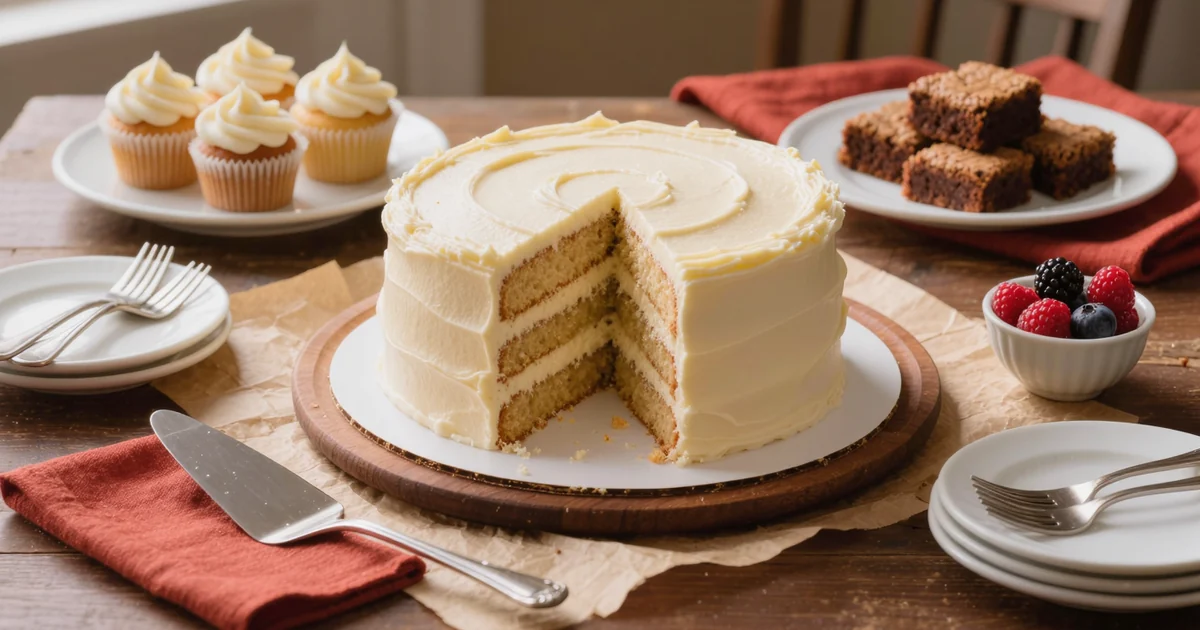
Wilton's chart says an 8-inch round serves 20. Mayfair Bakery says 8 to 12. Both of them are telling you the truth.
That's not a paradox, and neither one is lying to sell you something. Wilton's number assumes a precisely-cut finger slice: 1 inch by 2 inches, on a cake 4 inches tall. Picture that. It's a domino. It's the piece you get at a wedding, cut by someone who does this professionally, off a cake built tall so the slices can be narrow. Mayfair is describing what happens when a human being at a birthday party picks up a knife and cuts a wedge.
Nobody cuts a domino at a birthday party. In 1,500 events I have watched exactly zero uncles approach a cake and say "let me get the ruler." Cut normal wedges and you get roughly half the chart — about 55% of Wilton's number, which is how an 8-inch round becomes 11 servings instead of 20. This calculator sizes on that honest figure and shows you both, so you see the gap here instead of at the party. If cake is one line on a longer menu, the party food calculator plans the rest from the same guest list.
How much cake per person? One slice — until the table changes the math
One slice each. If cake is the only dessert, that's your whole answer: 50 guests, 50 slices.
Build a dessert table around it and the number drops. Plan cake for about 70% of the headcount — not because people want less cake, but because a third of the room is standing there with a brownie instead, and they were never going to take a slice too. The Knot goes further, putting it under 50% when the table genuinely feeds everyone: a real spread of five or six things, not a cake with garnish. I sit at 70%, because most "dessert tables" I get hired for are a cake plus a few supporting players. The calculator will follow you either way.
| Guests | Cake only (1 slice each) | With a dessert table (~70%) | Small pieces | Cupcakes |
|---|---|---|---|---|
| 20 | 20 slices | 14 slices | 70 | 20 |
| 30 | 30 slices | 21 slices | 105 | 30 |
| 50 | 50 slices | 35 slices | 175 | 50 |
| 75 | 75 slices | 53 slices | 263 | 75 |
| 100 | 100 slices | 70 slices | 350 | 100 |
Computed by the Party Portions engine — party-portions.com
Read the slices column as servings, not as chart numbers — they're real wedges. That's the difference between this table and the one on the back of the box, and it's about a factor of two.
The slice nobody cuts: Wilton's chart versus your knife
Here's every common round, both ways. The Wilton columns are the official chart — finger slices on a 4-inch two-layer cake. The last column is what a host cutting wedges actually gets, and it's the one this calculator uses.
| Round | Wilton party slices | Wilton wedding slices | Real wedges (what you'll cut) |
|---|---|---|---|
| 6 inch | 12 | 12 | 7 |
| 8 inch | 20 | 24 | 11 |
| 9 inch | 24 | 32 | 13 |
| 10 inch | 28 | 38 | 15 |
| 12 inch | 40 | 56 | 22 |
Computed by the Party Portions engine — party-portions.com
The geometry explains the gap, and Wilton publishes it themselves. A wedding slice is 1 × 2 × 4 inches — 8 cubic inches of cake. A party slice is 1.5 × 2 × 4 — 12 cubic inches. That's 50% more cake per person before anyone has done anything wrong, and it's the whole difference between the two Wilton columns.
Then there's the rule underneath everything, also Wilton's own: a cake under 3 inches tall yields half. Every serving number on that chart assumes 4 inches of height, and most home layer cakes aren't 4 inches tall. If yours is two thin layers at 2½ inches, you halve the chart before you start — which lands you at the "real wedges" column by Wilton's own arithmetic, not mine.
The chart isn't wrong. It's answering a question you're not asking. Wilton's 8-inch round really does serve 20 — if you cut 1×2-inch fingers off a 4-inch-tall cake with a ruler and a hot knife. That's a catering procedure, not a birthday party. Your brother-in-law is going to cut wedges, and wedges give you about 11. So when someone tells you an 8-inch round feeds 20 and you're planning for 18 guests, understand what you've agreed to: either a professional cuts that cake, or seven people don't get any. Size on the honest number. If a pastry chef turns up with a ruler, you have leftovers — that's the direction I want to be wrong in.
How many servings in a sheet cake?
Fewer than you've been told, and the label on the box is the least reliable part of the answer.
Start with the correction, because it's the one that costs people. Wilton's chart says a 9×13 serves 36 — but that number is for a two-layer cake, 4 inches tall. The quarter sheet you actually buy at a grocery bakery is a single layer, about 2 inches tall, and it serves 12 to 29 depending on the cut. Anyone quoting 36 for a quarter sheet is off by roughly double. This isn't even a disagreement with Wilton: it's their own "under 3 inches yields half" rule applied to their own number. Half of 36 is 18, right in the middle of that band.
| Sheet (single layer, ~2 inches) | Real servings |
|---|---|
| 9×13 ("quarter") | 12–29 |
| 12×18 ("half") | 36–54 |
| 18×24 ("full") | 72–108 |
Now the part that catches even careful people. There is no industry standard for "quarter," "half," and "full." None. A full sheet is 16×24 at one bakery, 18×24 at the next, 18×26 at the one after that — and a quarter of a different full sheet is a different cake. The words are marketing, not measurements.
So order in inches. Always. Ask for the pan dimensions and the height, then count servings yourself off the table above. Run the areas and you'll see the stakes: a 16×24 full sheet is 384 square inches, an 18×26 is 468 — 22% more cake for the identical word on the invoice.
How many cupcakes per person?
One, if there's a cake and the cupcakes are supporting it. Beyond that it depends entirely on their job at the party.
If cupcakes are the dessert — no cake at all, which is a genuinely good call for an outdoor party — plan 1.5 to 2 per guest. People take one, circulate, and come back. Minis run 3 to 4 each, because a mini isn't a dessert, it's a bite, and everyone knows it. For 50 guests, that's 50 standard cupcakes alongside a cake, or closer to 90 if cupcakes carry the whole event.
The quiet argument for cupcakes at a big party: no knife, no server, no line, and no uncle. Nobody has to cut anything, so nobody can cut it wrong, and your serving count is the number you baked.
What else goes on a dessert table
Three to four small pieces per person, plus the cake. Cookies, bars, brownies, tarts, dipped strawberries — anything picked up with two fingers. For 50 guests that's 175 pieces alongside 35 slices. If there's no cake and the table is the entire dessert, go to 4 to 6 each, since the pieces are doing all the work.
A hundred and seventy-five sounds enormous until you divide it: five things, 35 of each. Five recipes, not fifty. And every one can be made ahead, which is the real argument for a dessert table over a cake — a cake is a deadline, a table of small things is a week of quiet evenings. Plan plates and forks at about 1.3 per guest, because people set a plate down, lose it, and take another. Same as they do with coffee cups.
Worked example: a dessert table for 50 in Wimberley
An anniversary party this spring. Fifty guests, outdoors in May. The family wanted a "real cake moment" plus a table, and their first plan was a 12-inch round, because a chart told them it served 40. It doesn't. A 12-inch round cut in wedges is 22 servings, and they'd have been 13 slices short in front of their own parents.
What we built instead: cake for 35 — the 70% figure, because the table was carrying real weight — which came to two 9×13 single-layer sheets at about 20 real servings each. Then 175 small pieces across five things: lemon bars, brownies, pecan shortbread, dipped strawberries, and a tray of my mother's cinnamon cookies. Sixty-five plates and 65 forks.
We put the cake at the end of the table, not the start, so people filled a plate before they reached the slice. Thirty-three slices went. Two came back to the kitchen, which is exactly the margin I want.
Load my exact anniversary numbers. 50 guests, full dessert table — then switch to cake-only and watch the slice count jump.
Open the prefilled calculatorThe table needs things on it, and 175 pieces for 50 guests is five recipes rather than a nightmare — here's what I actually make for a crowd. Cake wants coffee beside it, and 50 guests at a morning pour is 1 lb of grounds and one 60-cup urn — size the urn here. And if the dessert table is the last stop at a wedding, the bar it follows is a much bigger number: 720 drinks for a 120-guest reception — run the bar math.
Frequently Asked Questions
How much cake do I need per guest?
One slice per guest if cake is the only dessert — 50 guests, 50 slices. Build a dessert table around it and plan cake for about 70% of the room, because a third of your guests will take a brownie instead and were never going to take a slice too. The Knot puts it under 50% when the table genuinely feeds everyone. The bigger trap isn't the headcount, it's the slice: Wilton's chart assumes a 1x2-inch finger slice off a 4-inch-tall cake, and nobody cuts that at a party. Cut normal wedges and you get roughly 55% of the chart. That's why an 8-inch round is 11 servings here and 20 on the box.
How many people does a sheet cake feed?
A single-layer 9x13 quarter sheet serves 12 to 29 real slices, a 12x18 half sheet serves 36 to 54, and an 18x24 full sheet serves 72 to 108. If you've seen 36 quoted for a 9x13, that figure is for a two-layer cake 4 inches tall — not the single-layer, roughly 2-inch cake a grocery bakery hands you. It's off by about double, and Wilton's own rule confirms it: a cake under 3 inches tall yields half, and half of 36 is 18. One more warning. There's no industry standard for quarter, half, and full — a full sheet is 16x24, 18x24, or 18x26 depending on the shop. Always order in inches.
How many cupcakes should I make per guest?
One per guest when there's a cake and the cupcakes are supporting it. If cupcakes are the whole dessert, plan 1.5 to 2 each — people take one, walk around, and come back. Minis run 3 to 4 per person, because a mini is a bite and everybody treats it like one. For 50 guests that's 50 standard cupcakes alongside a cake, or closer to 90 if cupcakes are carrying the party alone. The quiet argument for cupcakes at a big event is that nobody has to cut anything. No knife, no server, no line, and no relative improvising with a ruler — the number you baked is the number you serve.
How do I plan a dessert table for 50 guests?
For a dessert table for 50, plan cake for about 35 people plus 175 small pieces. The math: 50 guests at the 70% cake factor is 35 slices, which is two single-layer 9x13 sheets at roughly 20 real servings each, or a 12-inch round (22 wedges) plus something else. Then 3 to 4 small pieces per person gives you 175 — cookies, bars, brownies, dipped fruit. That divides into five recipes at 35 each, not fifty. If there's no cake at all and the table is the entire dessert, go to 4 to 6 pieces each. Add 65 plates and 65 forks, about 1.3 per guest, because people put a plate down and lose it.
How many servings is an 8-inch round cake?
It serves 20 by Wilton's chart and 8 to 12 by a working bakery like Mayfair, and both are honest. Wilton is counting precisely-cut finger slices — 1 inch by 2 inches, on a cake 4 inches tall — which is a professional catering cut. The bakery is counting wedges, which is how actual humans cut cake at actual parties. Our calculator lands at 11, right inside the bakery's band, because we size on wedges. So the practical answer: an 8-inch round feeds about 11 guests. If you're planning for 18 and someone told you it serves 20, either hire the person with the ruler or buy more cake.
How many desserts besides cake do I need?
Three to four small pieces per person on top of the cake — for 50 guests, that's 175. If the table is the whole dessert and there's no cake, go to 4 to 6 each, since the pieces are doing all the work. The number sounds enormous and isn't: 175 pieces is five recipes at 35 apiece. That's the real argument for a dessert table over a single cake. A cake is a deadline that lands the day of the party; a table of cookies, bars, and brownies is a few quiet evenings of make-ahead. Put the cake at the far end of the table, too — people fill a plate first and take a smaller slice, and your cake goes further.