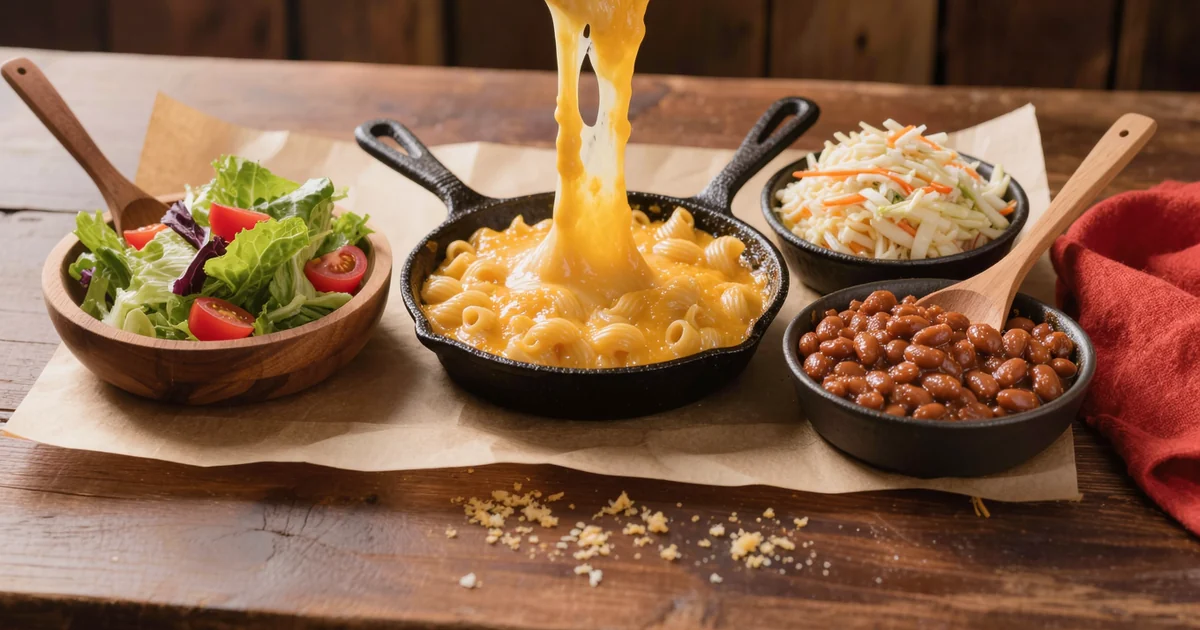
Every side you add makes every other side smaller. No chart tells you that, and it's the single reason side-dish math goes wrong.
Think about how a buffet works. One side on the table? Everybody takes a real scoop, because it's that or nothing. Four sides? People take a spoonful of each, because they want to try everything and their plate is only so big. Same appetite, same room — and now every bowl needs to be smaller. A chart that hands you a flat half-cup of coleslaw has quietly assumed a number of dishes and never told you which.
So this calculator asks which sides you're making before it tells you how much. One side gets a big scoop — 125% of standard. Two dishes, 110%. Three, dead-on standard. Four, and everyone's down to a spoonful of each: 90%. That adjustment is in the engine. It isn't in anybody else's. If sides are one part of a bigger spread, you can plan the whole menu off one guest list.
How many sides per person? The count is the variable
Three is the number I build almost every menu on — it's where a plate stops being a sampler and starts being a meal.
Here's what the count does to one dish. Coleslaw's standard portion is 3.5 oz. Serve it as your only side and it's really 4.4 oz, because there's nothing else to fill a plate with. Serve it alongside salad, mac, and beans and it's 3.2 oz. Nobody eats more because you cooked more variety. They eat it in smaller pieces.
Which is why "how many sides" has to come before "how much." Pick the dishes first. The quantities follow.
How much salad per person when it's not the only side
Two ounces of greens — roughly a cup, loosely packed — as one side among several. Smaller than people expect, which is why I end more events hauling home a garbage bag of dressed lettuce than anything else on the table.
The honest range is 1.5 to 2.5 oz. Take the low end when the salad is a courtesy — the green thing on a brisket plate that half the room walks past. Take 2.5 when it's a real composed salad, the dish with a name. Two ounces sits in the middle, and it's what the calculator runs.
One note that matters more than the ounces: dress at the table, not in the kitchen. Two ounces of undressed greens holds for hours. Two ounces of dressed greens is a wet paper bag in forty minutes, and then the portion was never the problem.
How much mac and cheese per person, and the USDA recipe behind it
5.3 ounces per adult as one side among several. That figure isn't a caterer's guess — it's the portion in the USDA's own adult quantity recipe for macaroni and cheese, which scales to 16½ pounds for 50 servings. Check it yourself: 5.3 oz × 50 = 265 oz = 16.6 lb.
Mac is the heaviest side on this page for a reason. It's the one people go back for. If your crowd skews toward kids, or the mac is the emotional centerpiece of the table, the working range is 4 to 6 oz.
The table below is all four sides at once — the full spread, at the 90% four-dish portion. That's why every figure runs about a tenth under the per-person numbers in this section. The shrink is baked right into it.
| Guests | Salad | Mac & cheese | Coleslaw | Baked beans | All four total |
|---|---|---|---|---|---|
| 10 | 1.1 lb | 3 lb | 2 lb | 2.3 lb | 8.3 lb |
| 20 | 2.3 lb | 6 lb | 3.9 lb | 4.5 lb | 16.7 lb |
| 30 | 3.4 lb | 8.9 lb | 5.9 lb | 6.8 lb | 25 lb |
| 50 | 5.6 lb | 14.9 lb | 9.8 lb | 11.3 lb | 41.6 lb |
| 100 | 11.3 lb | 29.8 lb | 19.7 lb | 22.5 lb | 83.3 lb |
Computed by the Party Portions engine — party-portions.com
Making only two of these? Don't read across and stop — the numbers go up, not down. Two dishes means 110% portions. Count kids as half an adult and big eaters as one and a half.
How much coleslaw per person?
3.5 ounces — about half a cup — as one side among several. The range is 3 to 4 oz, and the low end is fair next to a heavy mac.
Slaw is the one side that improves with a head start. Cut and dress it the night before and the cabbage softens into itself; hour eighteen beats minute five. It's also the cheapest insurance on a barbecue table — a cabbage costs almost nothing and cuts the fat on a plate of brisket. That's why slaw sits next to smoked meat all over Texas, including in my own trailer.
How much baked beans per person?
4 ounces — half a cup — as one of several sides. The band is 3 to 5 oz.
Beans behave differently from the rest of this page. They hold hot for hours, they scale to 100 guests without a single new decision, and they're the only side I'll happily make two days ahead. My aunts' smokers are named Rosa and Delia; the bean pot has no name, but it's been to more events than either of them. For 30 guests across a four-side spread, that's 6.8 lb — one deep hotel pan, no drama.
Three sides is the ceiling. A fourth doesn't feed anyone extra. Look at what it does: at 30 guests, three sides is 20.3 lb of food. Add the beans and you're cooking 25 lb — a 23% jump for the exact same appetite, spread across an extra dish. Nobody at that party eats more than they would have. You just split one plate four ways instead of three, cook an extra pan, wash an extra bowl, and go home with four half-full containers to find fridge space for. I've watched it happen at 1,500 events, and the fourth bowl is always the one still full at the end. Cook three sides well. That isn't a shortcut — it's the better party.
Two charts, double the numbers, and both are right
Search any side dish and you'll find two families of answers that disagree by roughly 2×. Here's the resolution: they're describing two different meals.
The institutional charts — extension services, school and cafeteria quantity recipes — portion at half-cup scoops. That's not stinginess. In their world, a person in gloves stands behind the pan and puts a measured scoop on your plate. Nobody chooses their own portion, so the number is exact and it holds. Caterer and party charts run 1.5 to 2× that, because a buffet is a self-serve free-for-all. Your guests hold the spoon. They take what looks good, they misjudge, they come back. Both families are telling the truth about their own service; they're just never in the same room.
We publish the party figure, because you're running a buffet, not a cafeteria line. If you're plating in the kitchen and carrying plates out, size down toward the institutional end and you'll be right.
Mac and cheese is the exception, and it runs backwards. Our 5.3 oz comes from USDA's adult quantity recipe — an institutional source — and it's more generous than the 4 oz typical catering runs when there's a big spread. The government portions mac and cheese like it means it. I've never once regretted following them on that dish.
Make it ahead, hold it at 140°F
Sides are where make-ahead earns its keep, because none of this needs to be hot off the stove the moment your meat is resting. Slaw and beans go a day or two out — both are better for it. Mac assembles the day before, refrigerated unbaked, and goes in the oven the morning of. Salad gets no head start: wash and cut ahead, store it dry, dress it when the line opens.
Then the rules, which are short. Hot sides hold at 140°F or above (USDA FSIS) — a chafer, a warming oven, or a slow cooker on low all get there, and mac and beans hold for hours without suffering. Nothing perishable sits out more than 2 hours, or 1 hour above 90°F (USDA FSIS). In a Hill Country August that's a 1-hour clock on the cold sides, and I run it hard: small bowls refilled from an ice chest, never one heroic bowl sweating in the sun. Leftovers keep 3–4 days in the fridge (USDA FSIS), which is exactly why the fourth side you didn't need is still in a container on Thursday.
Worked example: three sides for 30 at a Hill Country reception
A reception outside Wimberley this spring. Thirty guests, brisket off Rosa, and the couple wanted "all the classic sides" — which, translated, meant five dishes and a panic. We cut it to three: green salad, mac and cheese, coleslaw.
The ticket at three dishes, standard portions: 3.8 lb of salad greens, 9.9 lb of mac and cheese, 6.6 lb of coleslaw. That's 20.3 lb of sides, about 10.8 oz a head. Two hotel pans and a big bowl. The mac went in the oven at 3 p.m., the slaw was made the night before, and the salad got dressed when the line opened at 5.
Now the part that proves the whole page. Add baked beans as a fourth and the calculator drops every dish to 90% — salad 3.4 lb, mac 8.9, slaw 5.9, beans 6.8 — and the total climbs to 25 lb. Same 30 people. Same appetite. Almost five pounds more food, one more pan, one more bowl to wash, and a bean container in somebody's fridge until Thursday. We didn't make the beans. Nobody asked where they were.
Load my exact reception numbers. 30 guests, salad + mac + slaw — then add or drop a dish and watch every portion move.
Open the prefilled calculatorFour sides worth knowing live on their own pages, because their math is nothing like this one's. Potato salad is the classic fifth dish and it eats a shopping list whole — 11.5 lb for 30 guests — so run the potato numbers before you commit. A pasta side is 2 oz dry a head, or 4 boxes for 30 — size the pasta here. Rice is 10 dry cups for the same 30, and the rice math is the one I most often talk people down from. And sides exist to sit next to something: a cookout for 30 is 36 burgers and 36 dogs off the grill — count the patties and packs before you count the slaw.
Frequently Asked Questions
How much salad do I need for a party?
Two ounces of greens per person — about one loosely packed cup — when the salad is one side among several. The working range is 1.5 to 2.5 oz: go low when it's a courtesy salad next to heavy barbecue, go high when it's a real composed salad people came for. For 30 guests as part of a four-side spread, that's 3.4 lb of greens; at three sides it's 3.8 lb, because fewer dishes means bigger scoops. The most common mistake isn't the weight, it's the timing. Dress the greens at the table, not in the kitchen — dressed salad collapses in about forty minutes, and then no portion size on earth saves it.
How much mac and cheese for 30 people?
5.3 ounces per adult as one of several sides — the portion in the USDA's own adult quantity recipe for macaroni and cheese, which works out to 16½ lb for 50 servings. The practical range is 4 to 6 oz. Nudge up for a crowd with kids, or when the mac is the dish people came for; nudge down when the table is crowded with other options. For 30 guests across four sides, plan 8.9 lb; across three, 9.9 lb. Here's the oddity worth knowing: on this one dish the government's number is more generous than typical catering practice, which runs 4 oz when there's a big spread. I follow the USDA figure and have never regretted it.
How much coleslaw do I need per guest?
3.5 ounces — about half a cup — as one side among several, with a fair range of 3 to 4 oz. That's 5.9 lb for 30 guests on a four-side table. Slaw is the one dish here that genuinely improves with a head start: cut and dress it the night before and the cabbage softens into itself overnight. It's also the cheapest thing you can put next to smoked meat, and it cuts the fat on a brisket plate, which is why it appears on nearly every barbecue table in Texas including mine. Serving it alongside a heavy mac and cheese? Take the 3 oz end and give the extra room to something else.
How many side dishes should I serve at a party?
Three, and I'd call that a ceiling rather than a target. The count is the variable nobody talks about: one side means everyone takes a big scoop of it (125% of standard), two means 110%, three is standard, and four drops everyone to a spoonful of each (90%). The engine on this page makes that adjustment automatically. The reason to stop at three is arithmetic, not taste. At 30 guests, three sides is 20.3 lb of food; four is 25 lb — 23% more cooking for the exact same appetite in the room. Nobody eats more because you offered more variety. You just end up with four half-full bowls instead of three empty ones.
How many baked beans for a crowd?
4 ounces — half a cup — as one of several sides, in a band of 3 to 5 oz. For 30 guests on a four-side table that's 6.8 lb, which is one deep hotel pan. Beans are the most forgiving dish on this page. They hold hot for hours without suffering, they scale to 100 guests with no new decisions, and they're the only side I'll happily make two days ahead, because the flavor improves. Hold them at 140°F or above (USDA FSIS) in a chafer or a slow cooker on low, and refrigerate leftovers within 2 hours, or 1 hour if you're above 90°F (USDA FSIS). They keep 3–4 days.
Which party sides can I make ahead?
Almost everything except the salad. Coleslaw and baked beans are better a day or two ahead — the slaw softens, the beans deepen. Mac and cheese assembles the day before, sits in the fridge unbaked, and goes into the oven the morning of. Greens are the exception: wash and cut them ahead, keep them dry and cold, and dress them only when the buffet opens. Once the food is out, hot sides hold at 140°F or above and nothing perishable sits out past 2 hours — 1 hour above 90°F (USDA FSIS). Leftovers keep 3–4 days refrigerated (USDA FSIS). My rule for outdoor Texas parties: small bowls refilled from an ice chest, never one big bowl sweating in the sun.