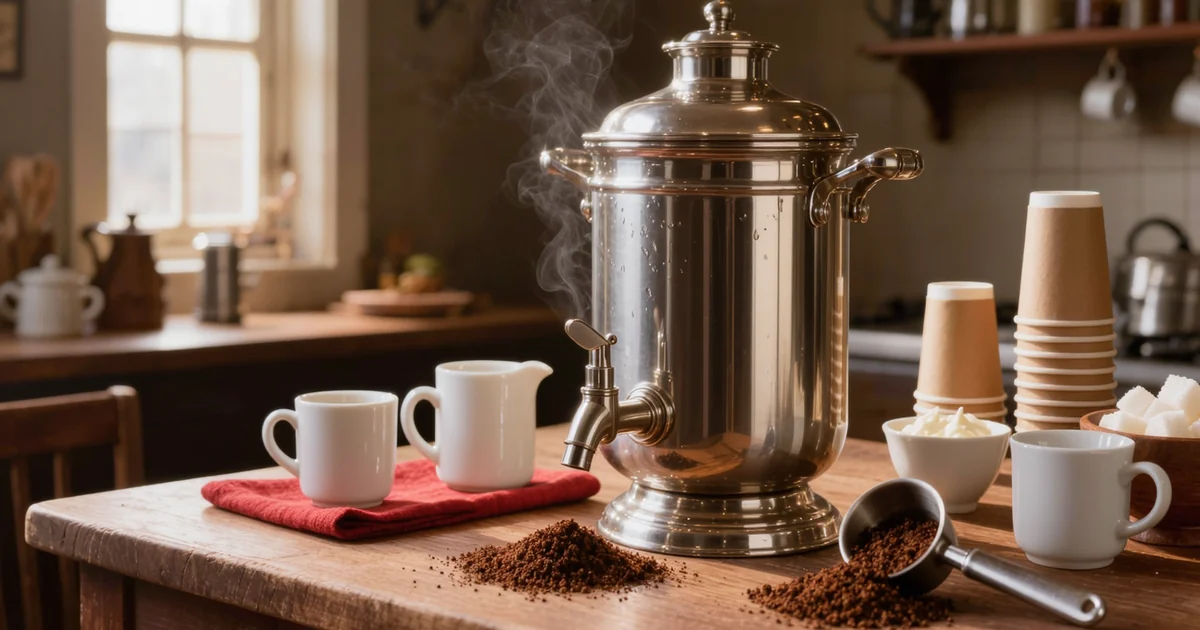
The mistake isn't the ratio. Almost nobody gets the ratio wrong — the bag tells you, and half the urns I rent have a chart printed on the lid. The mistake is assuming everyone drinks it.
I've watched it at 1,500 events. The host counts 50 guests, reads one cup per person, buys for 50 cups. Then 38 people take coffee — the rest are on juice, or nothing, because it's ten in the morning and they had a cup at home. The extra goes down a hotel sink at noon.
So here's the figure the charts leave out: not everyone takes a cup. Morning or brunch, about 75% of the room does. Afternoon settles near 60%. Evening runs 50% — by then they've moved to wine. Those take rates move real money. At 75 guests, it's the difference between a 60-cup urn and a 100-cup urn. At 120, it's one urn versus two. If coffee is one line on a longer menu, the party food calculator plans the rest from the same guest list.
How much coffee for 50 people, cup by cup
One pound of grounds. Two-point-four gallons of water. Thirty-eight cups. One 60-cup urn. That's a morning event for 50 — here's every step, so you can check me.
Fifty guests at a 75% take rate is 38 drinkers; round up, always. One cup each makes 38 cups. A gallon is 16 eight-ounce cups, so 38 cups is 2.4 gallons. A pound brews 2 to 3 gallons depending on how strong you pull it — call it 2.5 in the middle — and 2.4 gallons lands at almost exactly one pound. Thirty-eight cups drops inside a 60-cup urn with room to spare.
| Guests | Morning (75% take one) | Cups | Grounds lb | Water gal | Urn |
|---|---|---|---|---|---|
| 20 | 15 drinkers | 15 | 0.4 lb | 0.9 | One 30-cup urn covers it |
| 30 | 23 drinkers | 23 | 0.6 lb | 1.4 | One 30-cup urn covers it |
| 50 | 38 drinkers | 38 | 1 lb | 2.4 | One 60-cup urn covers it |
| 75 | 57 drinkers | 57 | 1.4 lb | 3.6 | One 60-cup urn covers it |
| 100 | 75 drinkers | 75 | 1.9 lb | 4.7 | One 100-cup urn covers it |
Computed by the Party Portions engine — party-portions.com
Read that last column twice. A hundred guests still comes down to one urn and under two pounds. Every second urn I've watched a host rent came home full and cold.
How many cups in a gallon of coffee?
Sixteen, at the 8-ounce pour every catering chart measures by. That's arithmetic: 128 ounces in a gallon, divided by 8.
But look at the cups you're setting out. Plenty of rentals and disposables run 6 ounces, and at that pour a gallon stretches to about 21 cups. Which sounds like free coffee. It isn't — the same gallon just serves more people a smaller drink, and the ones who wanted a real cup come back for a second. Plan at 8 ounces and let small cups be a bonus.
How much coffee per person? One cup, and one in five takes decaf
One cup per person who drinks it. Not per guest — per drinker, which is the whole point of the take rate above. Every catering guide lands on one cup each, and in 20 years I've never needed to argue with it.
The split that does matter: about 1 in 5 takes decaf. Caterer convention rather than a law of nature, but it's held across every service I've run. For a 50-guest morning, 38 cups means roughly 8 decaf — 0.8 lb regular, 0.2 lb decaf.
And decaf isn't worth a second urn. A small bag brewed in an ordinary drip machine, labeled with a strip of tape, covers that fifth of the room for the price of a pot. What I see instead is two full-size urns, and the decaf one goes back three-quarters full every time.
One pound brews two to three gallons — the range is the strength
A pound of ground coffee makes 2 to 3 gallons. Not one number. A range, and the range is you.
At the standard 1:16 ratio — one part grounds to sixteen parts water — a pound gets you about 2 gallons. Pull it at the lighter strength big urns are usually run at, and the same pound stretches to 3. That's a 50% swing on your shopping list from nothing but taste. The calculator sizes on the 2.5-gallon midpoint, which is why 2.4 gallons for 50 reads as 1 pound.
Prefer scoops to pounds? The urn charts run another unit: about 2 cups of grounds per 25 cups of water. Our brunch comes to roughly 3 cups. Just don't brew strong after buying for weak.
Buy the urn's worth, not the guest list's worth. Coffee is the one thing on this site where running out is free to prevent. Grounds keep. An unopened half-pound sits in your pantry and gets drunk next week, and it costs less than one guest standing at an empty spigot at 9 a.m. with nothing to hold. So when the calculator says 1 pound, buy the pound — if it only comes in 12-ounce or 2-pound bags, size up without guilt. This is the exact opposite of my advice on every other page, where I'll fight you over half a pound of brisket. I mean it here. Buy a little extra coffee. Never buy a little extra urn.
Urn sizes, and the clock nobody plans for
Rental urns come in three sizes: 30, 60, and 100 cups. That's the whole menu at most rental yards and every grocery party counter I've used. Match the urn to your cup count — 38 cups takes the 60 — and stop thinking about it.
The part nobody plans is the clock. An urn is not a drip machine. A 60-cup urn is 3.75 gallons of water that has to come up to temperature before a drop reaches a cup, on its own schedule regardless of yours. Every model differs, so the real answer on brew time is the sheet that came with your urn.
But the rule that's never failed me needs no number: start it before the guests arrive. Not when they arrive. Before. The urn goes on while my crew is still taping down butcher paper — there's no version of a party where 40 people watch a chrome cylinder decide to be ready. Fill to the line, not the top, and find the outlet before you pick the table.
What coffee for a crowd needs besides coffee
Cream, sugar, and cups — and the cups are where hosts undercount. Plan half an ounce of half-and-half per cup, one sugar packet per cup, and about 15% more cups than servings, because people set a cup down and take a fresh one. Nobody has ever re-found their cup at a party. Our 38-cup brunch: 0.6 quarts of half-and-half, 38 sugar packets, 44 cups.
Now the safety part, and I'll be precise, because this gets quoted at me wrong constantly. Coffee is water and roasted seeds; it carries no safety clock. The dairy beside the urn is the item with the rule. Half-and-half on a buffet is perishable food, and perishable food never sits out more than 2 hours, or 1 hour above 90°F (USDA FSIS). The 140°F hot-holding line (USDA FSIS) people cite at me about coffee is a rule for perishable food held hot — the cream's category, not the coffee's. Cream belongs on ice, not in a chafer. Small pitchers, refilled from the fridge, swapped on the clock.
Worked example: a Saturday-morning wedding brunch for 50
This spring I ran the day-after brunch for a wedding outside Dripping Springs. Fifty guests, 10 a.m., a barn with one working outlet. The couple's plan, copied off a chart, was two 60-cup urns and three pounds of coffee.
What we brought: one 60-cup urn, one pound of coffee, a small drip pot for decaf. Fifty guests at 75% is 38 drinkers, 38 cups, 2.4 gallons, 1 pound of grounds — 0.8 regular, 0.2 decaf. Half a quart of half-and-half on ice, 38 sugar packets, 44 cups. The urn went on at 9:15 while we were still setting out plates.
We poured 36 cups. Two people wanted tea. The urn held hot through the last toast, and the second urn they almost rented would have sat empty in that barn for three hours.
Load my exact brunch numbers. 50 guests, morning pour — then swap in your own head count and time of day.
Open the prefilled calculatorCoffee rarely travels alone. The morning after a reception you poured 720 drinks at, the bar math for a 120-guest wedding is a different animal — and that brunch wants real food, so what to cook for a crowd at breakfast is the next list. For an office pour, 20 people at a desk lunch is 20 sandwiches and 4.4 lb of deli meat — size the platter here. And if there's cake at the end, 50 guests at a dessert table means cutting for about 35 — run the cake numbers.
Frequently Asked Questions
How much coffee do I need for 50 people?
One pound of ground coffee, 2.4 gallons of water, and one 60-cup urn. The math: 50 guests at a morning event means about 38 people actually take a cup — the 75% take rate — and one cup each is 38 cups. Sixteen 8-oz cups make a gallon, so that's 2.4 gallons, and a pound brews 2 to 3 gallons depending on strength. Split it roughly 0.8 lb regular and 0.2 lb decaf. Add about 0.6 quarts of half-and-half, 38 sugar packets, and 44 cups, because guests lose track of theirs. Pouring in the afternoon instead? The same 50 guests drop to 30 cups and 0.8 lb.
How many cups of coffee does a gallon make?
Sixteen, at the standard 8-ounce pour: a gallon is 128 fluid ounces, and 128 divided by 8 is 16. If your cups are the 6-ounce size a lot of rentals and disposables use, the same gallon pours about 21 cups. Plan your gallons at the 8-ounce number anyway — the 6-ounce figure only holds if nobody comes back for a refill, and people always come back. To shop, run it backwards: count your drinkers, give each one cup, divide by 16. Thirty-eight cups is 2.4 gallons. A hundred guests at a morning event is 75 cups, or 4.7 gallons.
How many gallons does a pound of coffee brew?
Two to three gallons, and the difference is how strong you brew. At the specialty standard of 1:16 — one part grounds to sixteen parts water — a pound makes about 2 gallons. Run it at the lighter strength most big urns are set for and it stretches to 3. This calculator sizes on the 2.5-gallon midpoint, which is why 50 morning guests come out at 1 pound rather than 0.8 or 1.2. If you measure in scoops instead, the urn charts use another unit entirely: about 2 cups of grounds per 25 cups of water. Pick your strength before you shop, and never buy for weak while planning to brew strong.
What size coffee urn do I need for a party?
Match the urn to your cup count, not your guest count. Rental urns come in three sizes — 30, 60, and 100 cups — and the take rate decides which. A 30-cup urn covers a morning event up to about 40 guests. The 60 handles 50 to 75. The 100 takes you to roughly 130. One urn is almost always enough: a 100-guest morning is 75 cups, which one 100-cup urn pours without complaint. Before you rent a second, remember that every second urn I've seen at a party went home cold and full. Rent the right single urn and put the savings into better coffee.
Can I brew the coffee before guests arrive?
Yes — brew it early and let the urn hold it. That's what an urn is built to do, and it's why the rule in my kitchen is that the urn goes on before guests arrive, never during. A 60-cup urn is 3.75 gallons of water that has to come up to temperature first, and no room full of people wants to watch that happen. Check your urn's own instructions for brew time, because every model runs a different clock. What you cannot make ahead is the dairy: half-and-half is perishable, so it follows the 2-hour rule — never out more than 2 hours, or 1 hour above 90°F (USDA FSIS). Pour small pitchers, keep the rest cold, swap them.
Do I need to make decaf too?
About 1 in 5 takes decaf — for a 50-guest brunch, roughly 8 of your 38 cups. But don't give it an urn. A small bag brewed in an ordinary drip pot and labeled with a strip of tape covers that fifth of the room for a few dollars. Two matching full-size urns is the most common overbuy I see at morning events, and the decaf one goes back three-quarters full every time. The same logic runs through this whole page: an afternoon crowd drops to 60% and an evening crowd to 50%, because by evening they've switched to wine. Buy a little extra coffee if it helps you sleep. Never buy a little extra urn.