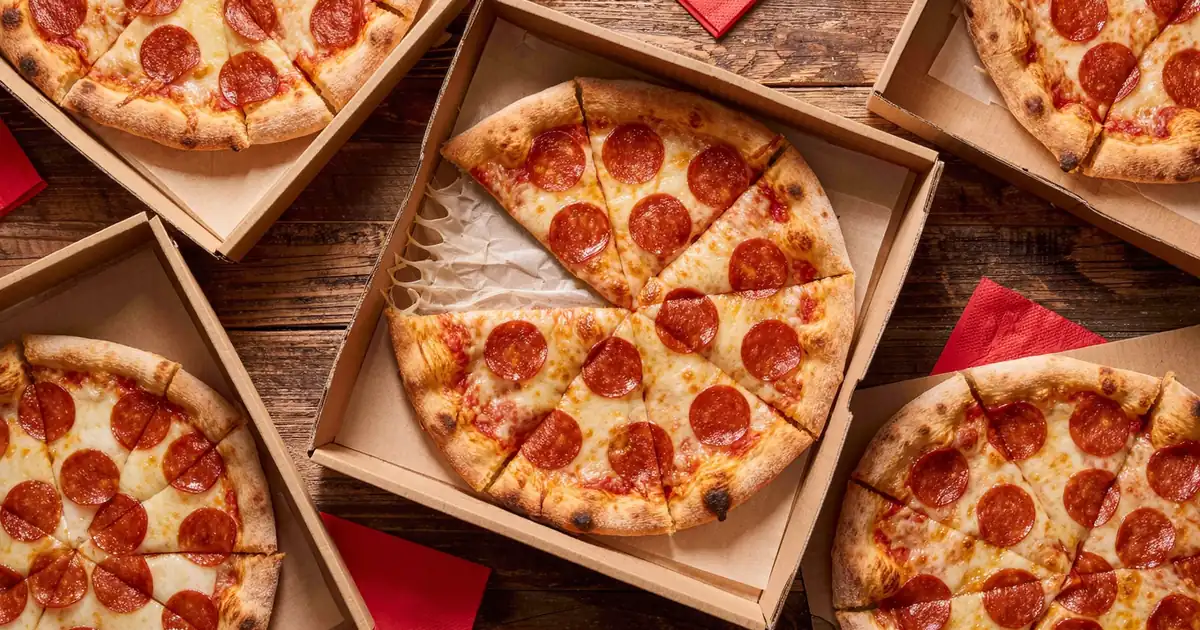
Start with the 3/8 rule, because it's most of the answer: multiply your guests by 3 slices each, divide by 8 slices per large, round up. Twenty adults × 3 = 60 slices. Sixty ÷ 8 = 7.5. Order eight. That one line settles the majority of pizza orders ever placed, and it's the spine of the calculator above.
Everything after the rule is adjustment. Kids eat about 2 slices, not 3. A crowd that spent the afternoon in a pool eats more; a crowd grazing a buffet eats less. I cater brisket and 600-plate fundraisers for a living, but I order pizza like everyone else — crew nights, kid birthdays, the office parties clients tack onto a quote — and the 3/8 rule with honest adjustments has never left my people hungry or my fridge buried.
Pizza also anchors bigger menus well. If you're adding wings, a salad bar, or a dessert table, plan the whole menu and let every dish shrink accordingly — the fastest way to overspend is calculating each dish as if it's the only one.
How many pizzas do I need?
Guests × 3 ÷ 8, rounded up. Always up. A 7.5-pizza answer is an 8-pizza order, because the half pizza you "save" by rounding down is precisely the moment the slowest walker in the office reaches an empty box. Rounding up costs you a couple of slices of leftovers. Rounding down costs you a guest standing there holding a plate.
People even type the question with the math attached — how many pizzas for 20 people 3 slices each is one of the most-searched pizza phrasings there is — and it answers itself: 60 slices, 8 larges. The reason a calculator still earns its spot is that real guest lists are never 20 clean adults. They're 17 adults, 6 kids, two teenagers who eat like farmhands, and a third of everyone arriving late. That mix is what the tool above sorts out without you juggling multipliers.
How do you size a group pizza order?
Group pizza orders — the office lunch, the team after the tournament, the crew feeding twelve trades on a job site — fail for one reason, and it isn't the math. It's the poll. Somebody asks the group what they want, collects fourteen opinions, and orders to the loudest three. Skip it. Count heads, run the 3/8 rule, apply the 40/30/30 topping split below, and add one box only if the group skews teenage or post-game. For a recurring group order — the Friday crew lunch, the weekly league night — track what came back last time and trim next week's order by that much; two weeks of boxes tells you more about your group than any poll will.
One more group-order habit worth stealing: for crowds past 30, stagger the delivery. Half the pizzas at the start, half forty minutes in — the second wave lands hot, and the early birds can't strip-mine the pepperoni before the late shift walks in.
How many slices in a large pizza?
Eight. That's the convention for a 14-inch large, and it's what this page's math assumes. Some chains cut 10 slimmer slices from the same pie, and a tavern-style shop may cut squares. Don't redo your math for any of it — slice count is a cutting convention, not a food quantity. A large cut into 10 doesn't feed more people; it feeds the same people with one extra trip to the box. Order on the 8-slice math and let the shop cut however it likes.
Pizza for 5 to 100 people: the lookup table
Read it straight across: pizza for 30 people is 12 larges, and pizza for 15 is 6. The last column adds 8 kids at 2 slices each, because "plus some kids" is how real guest lists arrive.
| Adults | Slices | Large pizzas | With 8 kids added |
|---|---|---|---|
| 5 | 15 | 2 | 4 |
| 10 | 30 | 4 | 6 |
| 15 | 45 | 6 | 8 |
| 20 | 60 | 8 | 10 |
| 30 | 90 | 12 | 14 |
| 45 | 135 | 17 | 19 |
| 50 | 150 | 19 | 21 |
| 100 | 300 | 38 | 40 |
Computed by the Party Portions engine — party-portions.com
Two things the table can't see: your crowd's appetite and the rest of your menu. Teenagers after a tournament are a "hungry" setting, not a footnote. And pizza sharing the table with other mains drops everyone to about two slices — the calculator's light setting exists for exactly that night. Feeding the same headcount on a different theme entirely? Twenty-five pounds of ground beef runs a 50-person taco bar — longer shopping list, but the build-your-own line is its own entertainment.
Large vs XL: the per-slice value math
An XL runs 12 slices to a large's 8 — half again the pizza in one box. The geometry backs it up: a 16-inch XL is roughly 200 square inches of pizza against a 14-inch large's 154, about 30% more food, and at typical menu prices the upcharge is far smaller than 30%. Two mediums technically match the XL's 12 slices (six each, most places), but I've rarely seen the two-medium "deal" actually win on price — you're paying twice for dough-stretching, boxes, and oven space.
So when the group is big and the oven is someone else's: fewer, larger pizzas. The calculator's size setting re-runs the whole count for medium, large, or XL, so you can compare the order line by line before you call it in. The one caution: XLs don't fit some home fridges, and leftover pizza that can't be refrigerated isn't a bonus — it's a countdown.
Toppings: the 40/30/30 split nobody argues with
Order 40% pepperoni, 30% cheese, 30% veggie or specialty. That split has survived contact with every American crowd I've fed: pepperoni goes first, cheese covers the kids and the cautious, veggie covers everyone the first two don't. For a 10-pizza order that's 4 pepperoni, 3 cheese, 3 veggie. Resist running a group poll — you'll end up with one pineapple-jalapeño compromise that eight people vetoed and one person half-eats. The goal isn't personalization. It's nobody opening four boxes and finding nothing.
Leftovers by design
Cold pizza is a feature, and I plan for it on purpose. When a client asks me to trim an order to zero-leftover precision, I talk them out of it, because the failure mode of "exactly enough" is "not enough" the second two extra people walk in. The safe-handling rules are simple: boxes shouldn't sit out more than 2 hours — 1 hour above 90°F — and refrigerated leftovers keep 3–4 days, reheated to 165°F if you want them hot (USDA FSIS). Day-two pizza straight from the fridge needs no defense from me.
Stop ordering one pizza per person "just in case." I've watched offices do this for years, and the result is always the same: a leaning tower of untouched boxes and someone quietly asking if anyone wants to take four home. The 3/8 rule with an honest hunger setting beats fear-ordering every time — and day-two pizza only counts as a win when you planned it, not when it's a receipt for math you didn't do.
An office party for 45, ordered right
A software company outside Austin had us run their launch party — 45 people, and I flagged 4 of them as big eaters because I'd watched them orbit the brisket table at an earlier event. So: 41 adults plus 4 big eaters, counted at one-and-a-half appetites each. The engine's answer was 18 larges — 7 pepperoni, 5 cheese, 6 veggie/specialty. That's the 3/8 rule doing its quiet work: 47 effective adults, 141 slices, 17.6 pizzas, rounded up to 18. Every box was opened. Two came home. Nobody hovered by an empty one.
One more note, for the wedding planners who find this page: pizza at 11 PM saves bar budgets. A 120-guest bar pours about 720 drinks over five hours — the wedding alcohol calculator shows the full bottle math — and a late-night pizza drop slows that final hour's pour while sending guests out grinning. Cheapest goodwill in the industry.
Load the 45-person office party. Same guest mix, same settings — then swap in your own crowd and get your order.
Open the office-party exampleFrequently Asked Questions
How many pizzas for 20 people?
Eight large pizzas. Twenty adults at 3 slices each is 60 slices, and 60 ÷ 8 slices per large is 7.5 — you round up, always. Add 8 kids at 2 slices each and the count becomes 76 slices, which pushes the order to 10 larges. If the twenty skew hungry — teenagers, a game day, a pool afternoon — use the hunger setting in the calculator above instead of padding the order by feel. And keep the 40/30/30 topping split: for eight pizzas, that's roughly three pepperoni, and either three cheese and two veggie or two cheese and three veggie, depending on your crowd.
How many pizzas for 20 people with other food?
Fewer than the table says. When pizza shares the menu with wings, salad, or a taco spread, plan closer to two slices per adult instead of three — for 20 people that's 40 slices, or 5 larges instead of 8. That's exactly what the calculator's light hunger setting models. The mistake I see constantly is ordering the full-meal pizza count and full portions of every side, which is how a 20-person party ends up with food for 35. Pick the star of the menu, portion it fully, and let everything else drop to supporting-cast amounts.
What is the 3/8 pizza rule?
The 3/8 pizza rule is the caterer's shorthand for pizza orders: multiply guests by 3 slices each, then divide by 8 slices per large pizza, and round up. Twenty guests × 3 = 60 slices; 60 ÷ 8 = 7.5; order 8. It works because 3 slices is an honest adult portion at a casual party and 8 slices is the standard cut of a 14-inch large. Bend it knowingly: kids count at 2 slices, big eaters at closer to 4 or 5, and a menu with other mains drops everyone toward 2. The rule gets you the number — the bends get you the right number.
Can I use this as a kids birthday party pizza calculator?
Yes — enter the children as kids and it becomes a kids birthday party pizza calculator: they're counted at 2 slices each instead of 3. Ten adults plus eight kids comes to 6 large pizzas, straight from the lookup table above. Skew the toppings hard toward cheese and pepperoni; the 40/30/30 split is for grown-up rooms, and a veggie-heavy order at a seven-year-old's party is how you take home veggie pizza. One practical trick from a few hundred family events: have the shop cut the kids' pizzas into smaller slices, because a whole large slice mostly becomes a dropped large slice.
How long does leftover pizza keep?
USDA FSIS gives leftover pizza the same window as any cooked food: 3–4 days in the refrigerator, 3–4 months in the freezer, and reheat to 165°F if you're warming it up. The counter is the real deadline — boxes shouldn't sit out more than 2 hours, or 1 hour above 90°F (USDA FSIS), so break down the pizza table when the party shifts to cake, not when it ends. Slide leftover slices into zip bags rather than storing whole boxes; they cool faster, fit the fridge, and day-two pizza was half the reason you rounded up in the first place.
Is an XL pizza a better deal than a large?
Usually, yes — check the per-slice price on your shop's menu. An XL is typically cut into 12 slices against a large's 8, and a 16-inch XL is about 200 square inches of pizza versus 154 for a 14-inch large: roughly 30% more food for an upcharge that's almost always smaller than that. Two mediums match the XL's slice count but rarely beat it on price, since you're paying twice for dough, box, and oven time. For big groups, fewer and larger wins. The calculator's size setting recalculates the full order for medium, large, or XL so you can compare before ordering.