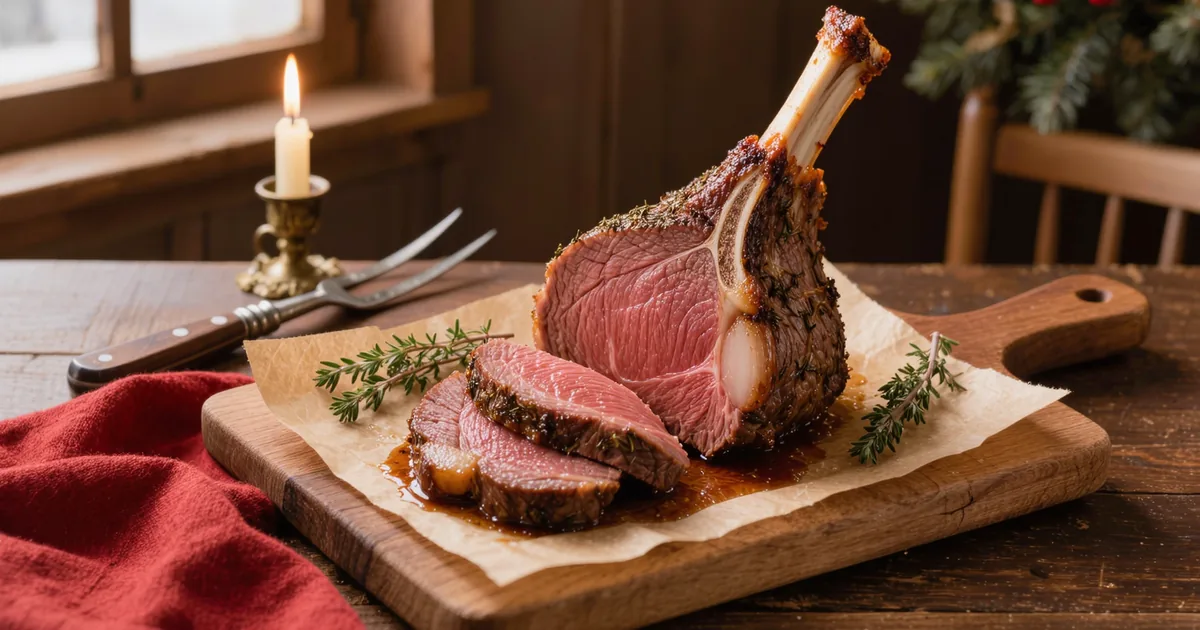
Prime rib is the rare roast with two sizing rules that check each other's work. Rule one: a pound of bone-in roast per adult. Rule two: one rib for every two people. A rib section weighs right around two pounds, so both rules hand you the same answer from different directions — ten adults, ten pounds, five ribs. That agreement is why butchers still quote the rib rule out loud. When the pound math and the rib math shake hands, you can stop second-guessing the order.
The calculator above runs that arithmetic with the fiddly parts included: kids count as half portions, big eaters as one and a half, and the dinner-time field works backward to tell you when the roast goes into the oven. It's one tool in our party food calculator family, and every table on this page is the same engine's output. I've carved prime rib through twenty-two Decembers of client dinners, and the rib rule has never once left me short.
How many pounds of prime rib per person: the 4-to-16 table
One pound of bone-in roast per adult. The table multiplies that rule out and rounds to whole ribs, because butchers cut by the rib, not by the decimal.
| Adults | Bone-in roast | Rib count |
|---|---|---|
| 4 | 4 lb | 2 ribs |
| 6 | 6 lb | 3 ribs |
| 8 | 8 lb | 4 ribs |
| 10 | 10 lb | 5 ribs |
| 12 | 12 lb | 6 ribs |
| 16 | 16 lb | 8 ribs |
Computed by the Party Portions engine — party-portions.com
Mixed crowd? Kids count as half portions, and your linebacker cousin counts as one and a half. Ten adults, four kids, and two big eaters figure as fifteen effective adults — which rounds up to an eight-rib roast. The calculator does that rounding for you, and it rounds up on purpose. Short is the only unforgivable roast.
What size prime rib for 6 adults?
Six pounds bone-in, cut as a three-rib roast. The two sizing rules agree on it: one pound per adult makes 6 pounds, and one rib for every two guests makes 3 ribs. Don't round down to two ribs — that's a four-person roast — and only round up past three if leftover sandwiches are the plan.
How many ribs are in a whole prime rib?
Seven ribs — a whole prime rib runs from rib 6 through rib 12 of the steer. At about two pounds a rib, that's a fourteen-pound roast, and by the one-rib-per-two rule it feeds about fourteen people. Most holiday tables don't need the whole thing; butchers will cut any section you ask for.
Ten guests, five ribs, one answer. The calculator folds in kids, big eaters, leftovers, and your dinner hour.
Size my roastHow much prime rib per person with bone — and without
Bone-in, one pound per person. Boneless, three-quarters. The difference isn't generosity; it's anatomy.
About 30 percent of a bone-in roast never reaches a plate — the bone itself plus roasting shrink. A pound of raw bone-in carves out to roughly eleven ounces of beef, a proper steakhouse slice with sandwich insurance. Boneless loses around 20 percent, all of it moisture, so twelve raw ounces serves out at about nine and a half. Either way, everyone lands comfortably past the eight-ounce cooked portion the engine targets.
Which to buy? Bone-in for holidays: the presentation does half my job, the bones flavor tomorrow's stock, and carving at the table quiets a room. Boneless when the oven is small, the timeline is tight, or the person carving is nervous with a knife. There's no wrong answer, just different math — and the calculator switches between the two with one toggle.
Asking your butcher for "prime rib" doesn't get you USDA Prime. Prime rib is a cut name — the standing rib roast — not a grade, and most roasts sold under that sign grade out as Choice. So order a Choice standing rib on purpose, dry-brine it overnight with kosher salt, and it will out-eat mislabeled hope at $10 less a pound. If you want true Prime-grade beef, ask for the grade by name and expect to pay for the marbling. For most holiday tables, I'd put that money into a bigger Choice roast instead.
Prime rib vs tenderloin: which roast to buy
Half a pound per person for tenderloin, against a full pound for bone-in prime rib. A whole tenderloin carries no bone and almost no waste, so its buying rule is half the prime rib figure — the beef tenderloin calculator runs that math, trim loss included.
Per dollar, the two are closer than the meat case suggests. Tenderloin costs more per pound — sometimes startlingly more — but you're buying eight ounces per guest instead of sixteen. Price both by the plate, not the pound: pounds per person times price per pound. Some Decembers, the tenderloin plate quietly wins.
The eating is different, too. Tenderloin is buttery, lean, and mild, and it roasts in a fraction of the time; prime rib brings fat, crust, and a louder beef flavor that carries a holiday. And if your crowd would rather have individual steaks altogether, ten standard appetites take seven 12-ounce ribeyes — the steak per person calculator sorts cuts and appetites. For the whole-roast question, though, this is the one comparison worth sitting with before you order.
Is prime rib the same as ribeye?
Same muscle, different cut. Prime rib is the whole standing rib roast, cooked in one piece and carved at the table; a ribeye is an individual steak sliced from that same rib section before cooking, seared one plate at a time. If steaks suit your crowd better, the steak per person calculator sizes that order instead.
Resting math: the USDA number and the steakhouse number
USDA FSIS calls whole beef cuts safe at 145°F with at least a 3-minute rest (USDA FSIS). That's the food-safety standard, and I give it to every client straight, every time.
Steakhouse prime rib runs on a different number: medium-rare at about 130°F, which means pulling the roast from the oven near 120°F and letting carryover heat coast it the rest of the way while it rests. USDA doesn't endorse that — it's a personal preference, the same one nearly everybody who orders prime rib at a restaurant is expressing. Both numbers are true. Decide which one is yours before the roast goes in, not while the thermometer is climbing.
Rest a big roast 30 minutes, loosely tented. The temperature keeps rising through the first stretch, the juices settle, and carving goes from ragged to clean. However you cook it, the buffet clock still applies: never leave it sitting out past 2 hours — 1 hour if it's above 90°F (USDA FSIS).
The reverse-sear back-calculator
Low and slow, then loud. At 250°F, a prime rib wants 30 to 35 minutes per pound, followed by a 30-minute rest, finished with a short blast in the hottest oven you can manage to set the crust. That's the reverse sear, and it's the schedule the calculator assumes when you give it a dinner time — it works backward from the hour you want to carve.
The order of operations is the quiet genius. Because the rest happens before the sear, the roast hits the table hot and crusted, with no flood of juice when the knife goes in. The slow oven also cooks edge to edge — no gray band, no negotiating over who gets the middle slice.
Afterward, leftovers go into the fridge within that same 2-hour window, keep 3 to 4 days there or 3 to 4 months frozen, and reheat to 165°F (USDA FSIS). Prime rib sandwiches are half the reason to round up a rib in the first place.
Christmas for 10: the worked example
Ten adults, one roast: the five-rib answer
The right prime rib size for 10 adults is a five-rib roast, about ten pounds bone-in. Here's how that played at a client Christmas: dinner was called for 6 PM, so the engine set the oven time at about 12:15 PM — ten pounds at 250°F, pulled near 120°F, a 30-minute tented rest while the oven roared up to searing heat, crust set, carving at six sharp. Nobody waited, and nothing sat out.
Here's that exact plan, preloaded — change the guest count or the dinner hour and the whole timeline recalculates.
Round out the plate while you're at it. Prime rib for 10 wants 5 lb of mashed potatoes, and the same ten guests take ten cooked cups of rice — 3.3 cups dry — if the menu leans that way (rice per person calculator). If the December budget vote swings the other direction, ten adults need about 6.5 pounds of bone-in ham (ham size calculator), or a 10-pound turkey with no leftovers — 12.5 pounds if sandwich week matters (turkey size calculator).
Frequently Asked Questions
How many ribs for 8 adults?
Four ribs. One rib feeds two people, so 8 adults divided by 2 makes a 4-rib roast — about 8 pounds bone-in, since a rib section weighs right around 2 pounds. Notice the pound rule lands in the same place: 8 adults at 1 pound each is 8 pounds. When both rules agree, buy with confidence. If two of your eight are serious eaters, or you've been promised leftover sandwiches, step up to a 5-rib roast. A rib too many has never ruined a holiday; a rib too few gets remembered for years.
How many pounds prime rib for 10 adults?
Ten pounds bone-in — a 5-rib roast. The rule is 1 pound of bone-in prime rib per adult and one rib for every two guests, so 10 adults means 10 pounds and 5 ribs by both counts. Going boneless? Plan 7.5 pounds at three-quarters of a pound per adult. Kids count as half portions, so 10 adults plus 4 kids figures like 12 adults. Add weight only if you genuinely want leftovers — these portions already run steakhouse-generous. And if four of your ten are teenagers, count them as full adults; they've earned it.
How much prime rib per person boneless — is that enough?
Three-quarters of a pound of raw boneless roast per adult. The bone-in figure is a full pound because roughly 30 percent of a bone-in roast is bone plus roasting shrink; boneless loses only about 20 percent, all of it moisture. Twelve raw ounces carves out to roughly nine and a half ounces on the plate — a generous restaurant slice. Boneless also carves faster and fits smaller ovens. You give up the bones for stock and some of the show, but none of the eating.
Do I need USDA Prime grade for prime rib?
No. Prime rib names the cut — a standing rib roast — not the USDA grade, and most roasts sold under that sign grade out as Choice. A Choice standing rib, dry-brined overnight with kosher salt, roasts up deeply seasoned and plenty marbled for this cut. If you want true Prime-grade beef, ask for the grade explicitly and expect a real premium. For a holiday table of ten, I'd rather put that premium toward an extra rib of Choice. Nobody has ever sent one back.
How do I thaw a frozen prime rib safely?
In the refrigerator at 40°F or below, allowing about 24 hours for every 4 to 5 pounds (USDA FSIS). A 10-pound roast wants two full days, and two and a half is safer. In a pinch, submerge it in cold water for 30 minutes per pound, changing the water every 30 minutes, and cook it immediately afterward (USDA FSIS). Plan the thaw when you buy the roast, not the night before — a half-frozen prime rib throws off every minute of the reverse-sear timeline.
How long does leftover prime rib keep?
Refrigerate it within 2 hours of leaving the oven — within 1 hour if it's sitting anywhere above 90°F (USDA FSIS). Leftover prime rib keeps 3 to 4 days in the fridge and 3 to 4 months in the freezer, and leftovers reheat to 165°F (USDA FSIS). Keep the remaining roast in one whole piece rather than pre-slicing; whole pieces hold their moisture, and you slice only what the sandwiches need. For a warm second act, reheat slices gently in a little beef broth until they hit that 165°F mark instead of running them dry in a microwave.