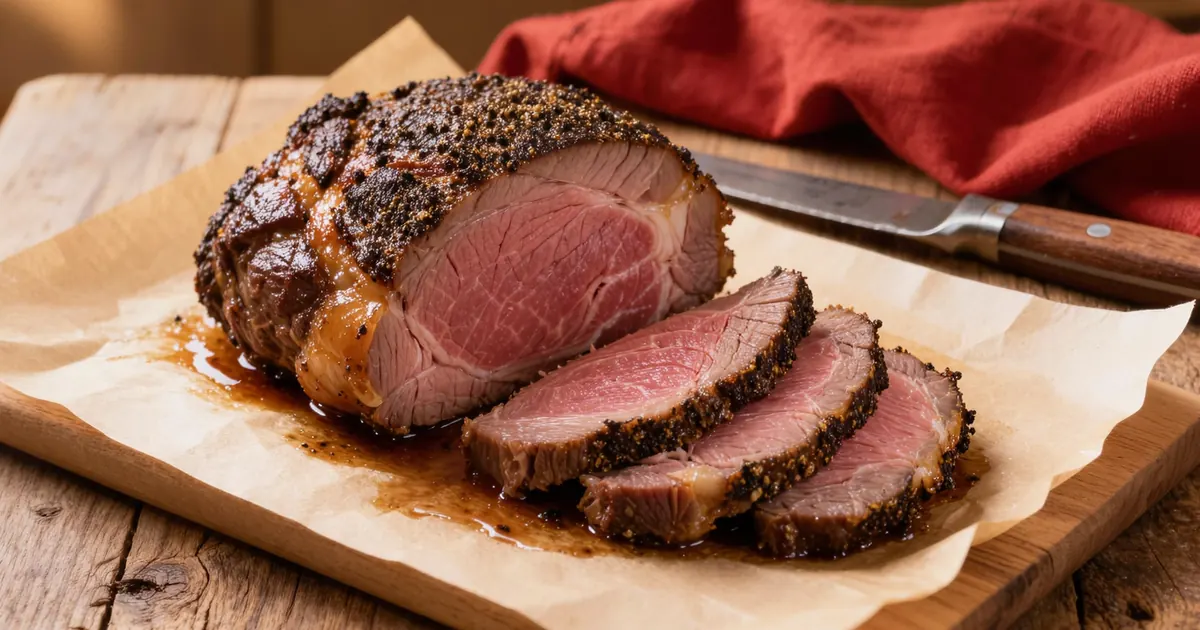
How much brisket per person — and the cooked-weight trap
Every barbecue blog on the internet quotes the same rule: half a pound per person. Almost none of them mention that it's a cooked weight. That single omission is the number-one reason brisket runs out at parties. I've watched it happen at events I didn't cater, standing in line with an empty bun like everyone else.
The correction that saves the party: a 12-lb raw packer feeds about 12 people, not 24. You'll trim 20–30% of the raw weight away as fat before the brisket ever sees smoke, and the long cook shrinks what's left. Net yield is roughly 50%. Whatever cooked number you plan, buy double raw. Every time.
Half the searches that land here ask how much brisket per person cooked; the other half ask how much brisket per person uncooked. Same question, two points in time. Plan 8 oz cooked per adult for a plated dinner with a side or two, and put 16 oz raw per adult on the shopping list. The half pound itself is a caterer's convention, not a law — pile on a heavy side spread and people eat less of the star, which is why the calculator has a sides setting instead of a single flat rule.
How many pounds of brisket per person: the quick table
This is my baseline — plated service, one or two sides, adults only, no leftover plan. It's the table I make new crew members recite before I let them near an order sheet.
| Guests (adults) | Cooked brisket | Raw to buy | What to grab |
|---|---|---|---|
| 10 | 5 lb | 10 lb | one 10-lb packer |
| 20 | 10 lb | 20 lb | two 10-lb packers |
| 30 | 15 lb | 30 lb | two 15-lb packers |
| 50 | 25 lb | 50 lb | four 12.5-lb packers |
| 100 | 50 lb | 100 lb | seven 14.5-lb packers |
Computed by the Party Portions engine — party-portions.com
If all you want is how much cooked brisket for 20 people, it's 10 pounds. Nobody sells brisket cooked, so the store list says 20. You also don't need a separate brisket for 20 people calculator — the tool above re-runs this exact math the moment you add kids (they count half), big eaters (they count one and a half), a buffet line, or a leftover plan.
How many pounds of brisket for 20, 50, or 100 people?
Straight answers, plated service: 20 people take 20 lb raw (10 lb cooked — two 10-lb packers). Fifty people take 50 lb raw (25 lb cooked — four packers in the 12-to-13-lb range). A hundred people take 100 lb raw, 50 cooked, which is seven packers and a smoker that earns its keep. The rule underneath never changes: one raw pound per adult, because half of it leaves as trim and smoke. Feeding a buffet line instead of plates, add 10% — self-serve hands are generous hands — so the 50-person buffet buys 55 lb, not 50.
Serving sandwiches instead of plates? I build chopped brisket sandwiches exactly like my pulled pork ones: 4 oz of meat each, a sandwich and a half per adult, so a cooked pound makes four. The same 4-oz logic runs the pork page too — one 7.5-lb bone-in butt covers sandwiches for 10 people — and if you're pricing both meats against each other, the pulled pork calculator settles it fast.
Packer, flat, or point: buying the right brisket
Packer vs flat: which should you buy?
A whole packer is the entire brisket, two muscles in one: the lean flat and the fatty point. Buy packers for parties. They cost less per usable pound, the point stays juicy under a long hold, and the trimmings make sausage or burnt ends. A flat alone looks convenient — uniform, pre-trimmed, tidy slices — but you're paying the butcher for that trimming, so flats cost noticeably more per usable pound. For a small dinner of six where presentation matters, fine, buy the flat. For twenty hungry people, the packer vs flat question answers itself.
How much does a brisket weigh?
Packers run 10–16 lb raw at most warehouse clubs and butcher counters. That range is why my table says two 10-lb packers for 20 guests instead of one mythical 20-pounder — briskets that size are rare, and two smaller ones cook faster and more evenly anyway. When your math lands between real-world sizes, round up to the next brisket that actually exists in the case. And if you're spreading the smoker across brisket, ribs, and sausage, nobody eats a full portion of each — the meat per person calculator splits a mixed spread so you don't triple-buy.
Slicing, holding, and the two lines USDA draws
Brisket forgives a long hold better than any meat I cook. Wrap the finished packer in butcher paper, add a towel, and rest it in a closed dry cooler — the faux cambro. The line that matters is 140°F: USDA calls 140°F or above safe hot holding (USDA FSIS), and a wrapped packer straight off the smoker stays north of that for hours. After a long hold, probe it before you slice. Trust the thermometer, not the clock.
Once it's sliced and on the table, a different clock starts. Perishable food shouldn't sit out more than 2 hours — 1 hour when it's above 90°F (USDA FSIS), which describes most Texas afternoons I work. So slice what the line needs and keep the rest wrapped. Sliced brisket also dries out in minutes, which means slicing to order isn't chef theater; it's moisture management.
Leftovers go into the fridge within that window and keep 3–4 days, or 3–4 months frozen, reheated to 165°F (USDA FSIS). Day-two brisket chops into exceptional tacos — 2 oz of meat per taco, three tacos an adult — and the taco bar calculator turns a leftover point into a second party.
Work backward from dinner time
Here's the question nobody asks until 10 PM the night before: when do I light the fire? Count backward. A 13-lb packer at smoker temperature runs 1 to 1.5 hours per pound, plus at least an hour of rest before slicing. Want to eat at 6 PM? Fire at about 5 AM. That sounds brutal, and it is, but the arithmetic is the arithmetic.
The early start is also your insurance policy. A brisket that finishes at 2 PM holds happily in the cooler until dinner — see the 140°F rule above. A brisket that finishes at 7:30 PM holds up the toasts, and no one remembers the flowers at a wedding where the food ran late. Enter your dinner time in the calculator and it back-computes the fire-up hour for your exact weight, rest included.
A worked example: 40 guests at a backyard wedding
Last May I catered a backyard wedding outside Wimberley: 32 adults, 8 kids, buffet service, light sides. Kids count as half an adult in my math, so the engine sees 36 effective adults. Buffets run about 10% heavier than plated service, because people serving themselves are generous people. So: 36 × 0.5 lb × 1.1 = 19.8 lb cooked, which at 50% yield means roughly 40 lb raw. I bought three 13.5-lb packers — 40.5 lb, a hair over the plan. By nine that night the hair was gone.
Reproduce that order in one click. This link loads the wedding's exact inputs — swap in your own headcount from there.
Load the 40-guest weddingThe sides deserved the same arithmetic as the meat. Brisket for 20 needs about 7.5 lb of potato salad — run the numbers — and rice for 20 is 6.7 dry cups, not the stockpot most hosts cook. I have never once watched a party run out of rice, so check the rice math before you double it to be safe. And when you're ready to plan every dish from one guest list, the party food calculator covers the whole menu the same way this page covers the packer.
Frequently Asked Questions
How much brisket for 20 people?
Ten pounds cooked, which means 20 pounds raw — two 10-lb packers. That's the plated answer for 20 adults with a side or two: half a pound cooked each, doubled to raw because trim and smoke take roughly half the weight. Feeding from a buffet? Add about 10% to the cooked target. Kids in the twenty? Count each as half an adult and the total drops. If you searched how much cooked brisket for 20 people, the number is 10 lb — but nobody sells brisket cooked, so the shopping list says 20. The calculator above re-runs the whole thing the second your headcount changes.
How much brisket per person for sandwiches?
Plan 4 oz of chopped brisket per sandwich and a sandwich and a half per adult — 6 oz cooked, or 12 oz raw, per person. I build brisket sandwiches exactly like my pulled pork line, and the portion holds. A cooked pound makes four sandwiches, so 20 adults need about 7.5 lb cooked (15 lb raw) for 30 sandwiches. Sandwiches are the most forgiving way to feed brisket to a crowd: chopped point stays moist far longer than slices, and a smaller packer stretches over more people. Switch the calculator's serving style to sandwiches and it redoes the math — buns not included.
Is the half-pound brisket rule cooked or raw weight?
Cooked. Always cooked — and that's the detail most charts bury. The half-pound convention describes what lands on the plate, not what you carry out of the store. A raw packer loses 20–30% of its weight when you trim the fat cap, then the cook evaporates more, and the net lands near 50%. So the raw shopping rule is a full pound per adult for a plated dinner. If a chart doesn't say whether its number is cooked or raw, assume cooked and double it before you shop. Wrong in that direction, you get leftovers. Wrong in the other, somebody's plate stays empty.
When should I start smoking brisket for a 6 PM dinner?
For a 6 PM dinner, light the smoker at about 5 AM. A 13-lb packer runs 1 to 1.5 hours per pound, plus at least an hour of rest before slicing — call it thirteen hours door to door if the cook behaves. Brisket rarely behaves, which is exactly why the early start matters: a packer that finishes at 2 PM holds beautifully, wrapped in a dry cooler, until dinner. One that finishes at 7:30 PM holds up the toasts instead. Give the calculator your dinner time and it back-computes the fire-up hour for your exact weight.
How long can brisket hold before serving?
Hours, if you hold it right. Wrap the cooked brisket in butcher paper, add a towel layer, and rest it in a closed dry cooler — the faux cambro. The line that matters is USDA's hot-holding floor of 140°F (USDA FSIS): a whole packer wrapped straight off the smoker stays above it for a surprisingly long time, but always probe before serving after a long hold. Once brisket is sliced and sitting out, the rules change — perishable food shouldn't stand at room temperature over 2 hours, or 1 hour above 90°F (USDA FSIS). Slice what the line needs; keep the rest wrapped.
How long does leftover brisket last?
Refrigerate leftover brisket within the 2-hour window and it keeps 3–4 days; frozen, 3–4 months (USDA FSIS). Reheat to 165°F either way. Two habits make leftovers worth eating. First, slice only what you serve — whole chunks stay moist, sliced meat dries out fast. Second, pack the meat with its drippings, in a vacuum bag or a tight container with the juices poured over. Reheated gently in that liquid, day-three brisket makes better tacos than most day-one brisket makes plates: 2 oz per taco, three tacos an adult, and a leftover point feeds another dozen people.