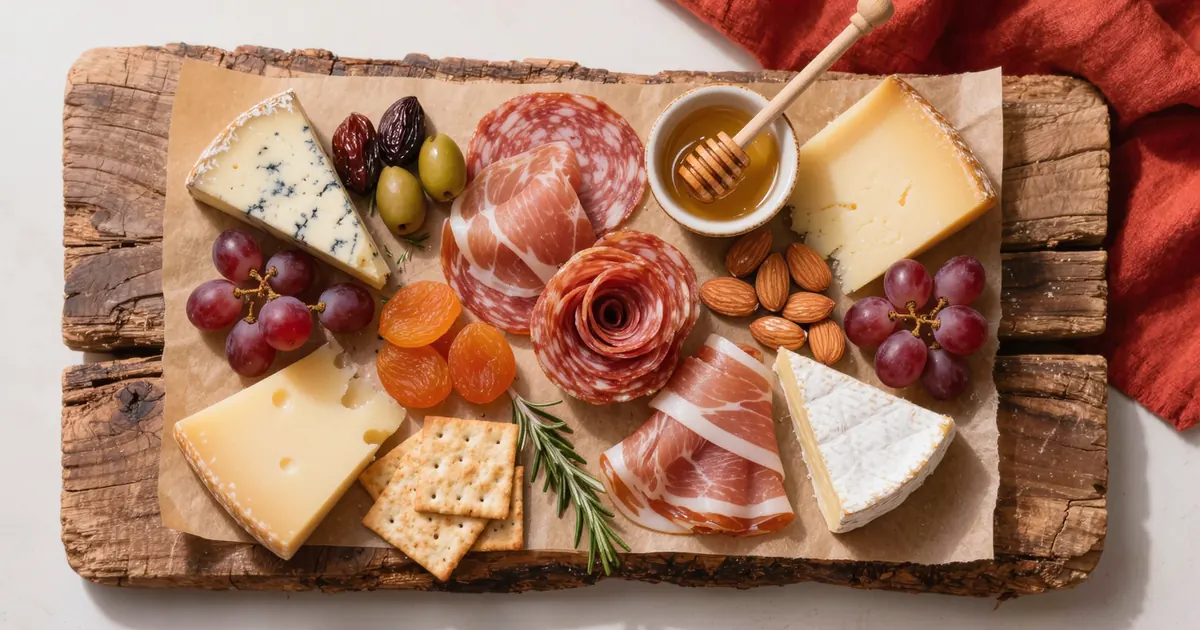
A board that opens a party and a board that is the party are not the same groceries. They are not close. One is two ounces of meat a head; the other is five. The internet blends the two into a single mushy number somewhere in the middle, and that average serves nobody — you end up with either a sad plank of six salami slices, or eleven pounds of orphaned Manchego going home in a cooler.
I have built both. The 2-ounce board sits beside the passed apps and the bar, gets grazed on the way past, and vanishes politely before dinner is called. The 5-ounce board is the dinner. Nothing else is coming, and forty people will stand around it for three hours. Same photograph on Pinterest. Completely different order.
How much charcuterie per person: the two-board split
Two ounces of cured meat plus two ounces of cheese per adult when the board is one appetizer among several. Five ounces of each when the board is the meal. That is the whole decision, and every number further down this page hangs off it.
The board-as-the-meal figure is the one that is hard to source, and Wisconsin Cheese is the only industry body I have found that addresses it head on — they say five ounces of each per person. It sounds enormous written down. It is not. Take away the entrée and people eat like there is no entrée, because there isn't one.
Check your guest mix before multiplying. Kids count as half a portion, big eaters as one and a half — so 20 adults, 6 kids, and 2 known grazers plan like 26 effective adults. Same guest-mix math that runs every tool in the party food calculator.
How much cheese per person?
One to three ounces per person as an appetizer — call it two — and three to five ounces when cheese is carrying the meal. That is a real range, not a hedge, and it moves with the rest of your table: two ounces is right when there are meatballs and a shrimp platter competing, three when the board is the only thing standing between guests and the bar.
Now, the thing the blogs garble. You have read "one to one and a half ounces per person" a hundred times, usually credited, eventually, to Shelburne Farms. That figure is per cheese. Not per board. Not total. It answers "how much of each wedge do I put out," and somewhere along the chain of people rewriting each other it got flattened into a total, which is exactly why the recycled numbers never add up — plug 1.5 oz in as a total and a board for 20 comes out under two pounds, meat included. That board would be gone in nine minutes.
Read it correctly and it agrees with everyone else: 1 to 1.5 oz per cheese, times three or four cheeses, lands you right back at the 3 to 5 oz an appetizer board actually needs of cheese and meat together.
How much meat and cheese per person, scaled to the room
Here is how much meat and cheese per person works out once you multiply it by an actual guest list. Left columns are the appetizer board, right columns are the board doing the job of dinner.
| Guests | App: meat / cheese | Main: meat / cheese | Cheese kinds |
|---|---|---|---|
| 10 | 1.3 / 1.3 lb | 3.1 / 3.1 lb | 3 |
| 20 | 2.5 / 2.5 lb | 6.3 / 6.3 lb | 4 |
| 30 | 3.8 / 3.8 lb | 9.4 / 9.4 lb | 4 |
| 50 | 6.3 / 6.3 lb | 15.6 / 15.6 lb | 5 |
| 100 | 12.5 / 12.5 lb | 31.3 / 31.3 lb | 5 |
Computed by the Party Portions engine — party-portions.com
Look at the last column before you look at anything else. It barely moves. Ten guests get three cheeses; a hundred guests get five. That is not a rounding artifact — it is the single most misunderstood thing about buying for a board, and it gets its own section.
A board rarely travels alone, either. If shrimp is joining it, a cocktail platter for 20 runs 4.5 lb of peeled 16/20 (run the shrimp numbers). And a board and a bar are the same party: 100 drinking guests over five hours pour about 600 drinks, which is 60 bottles of wine and 150 beers (size the bar).
The variety ceiling nobody will say out loud
The "one cheese per five guests" rule is invented. It is all over Pinterest, it is in a dozen listicles, and it has no source — no cheesemonger, no extension service, no industry body. Nobody will own it. And it breaks on contact with arithmetic: 50 guests would mean ten cheeses, which flatly contradicts the ceiling every actual cheesemonger gives, which is three to five. Past five, the tastes get lost — guests stop tasting and start sampling, and nobody remembers a single one of them. Buy three cheeses for a small board, five for a big one, and spend the difference on more of each.
Three to five is a flat ceiling, not a ratio. It does not scale with the guest list, because it was never about the guest list — it is about a human palate, and palates do not multiply when you invite more of them. What scales is the weight of each wedge. Fifty guests do not need ten cheeses; they need five cheeses that are twice as big as the ones you would put out for twenty-five.
There is a selfish reason to like this, too. Five good cheeses bought in generous wedges cost less than ten mediocre ones bought in nervous slivers, and the board looks better — abundance reads as five confident piles, never as ten polite shingles.
Building the board: hard, soft, blue, and salami roses
Spread the cheeses across styles rather than across countries. One hard and aged (a cheddar, a Manchego, a two-year Gouda), one soft and bloomy (brie, camembert, a fresh chèvre), one blue, and — if you are at four or five — a wildcard that starts conversations. Nobody at your party wants three cheddars with three different flags on them.
Meat is simpler than cheese and gets treated as an afterthought, which is backwards, because meat is the half that disappears first. Two or three kinds is plenty: something sliced thin and silky (prosciutto, coppa), something firm and peppery (a dry salami, soppressata), and if you want a third, something spreadable.
Now the part that matters more than any of it: do not lay the slices flat. Flat slices look mean. They look counted — and they are being counted, by every guest who does not want to be the person who took too much. Fold salami into roses, pinch prosciutto into loose ribbons, let the pile have some air in it. Same three pounds of meat. Twice the board. I have watched the identical order look stingy on Saturday and lavish on Sunday, and the only variable was whether my hands were tired.
Take the cheese out of the fridge an hour before service, cut the first few pieces off each wedge so nobody has to be the one who breaks it, and leave the knives where they belong.
Where the published numbers stop
Here is something no other page on this topic will tell you: there is no published catering convention for accompaniments, or for board size by guest count. None. I went looking properly — extension services, industry bodies, culinary references, the sources I re-verify every January. There is nothing. Every crackers-per-person figure and every "you need an 18-inch board for 12 guests" chart in circulation traces back to a retailer selling boards or a blog citing another blog citing a third.
So the accompaniment numbers in the calculator above are labeled house guidance. They are mine, off my own event sheets, across twenty years and roughly 1,500 parties: 1.5 oz of crackers, 2 oz of fruit, 0.5 oz of nuts, and 1 oz of olives per adult. They work. I use them tomorrow and I would use them for your party. They are not a standard, and I am not going to dress them up as one by inventing a citation for something nobody ever published.
Same goes for board size. Buy the board that holds the food, not the food that fits the board. If the slab is too small, use two — or use three and put them in different rooms, which does more for the flow of a party than any single centerpiece ever has.
A board sits out. That is the format. Mind the clock.
Every other page on this site can be coy about the two-hour rule. This one can't, because sitting out is the entire point of a grazing board. So, plainly: perishable food should never be out more than 2 hours, or 1 hour above 90°F (USDA FSIS). Soft cheese and cured meat are perishable food. An outdoor board in a Texas July is on a one-hour clock, and no amount of shade changes that.
The fix isn't a shorter party, it's a second board. Build two half boards, put one out at the top of the party, and swap in the fresh one at the ninety-minute mark while the first goes back to the fridge. Guests read it as a host who cares. It is really a host who read the label.
What comes off the board goes into the fridge within that same window and keeps 3–4 days (USDA FSIS). Hard cheese that never left the cold and never got warm is a different story — it will outlive us all — but anything that spent an evening on a slab gets treated like leftovers, because that is what it is.
An anniversary party for 50, worked out
Last October I did a fortieth-anniversary party outside Dripping Springs: 50 adults, dinner coming later, and a board that had to hold the room for the first ninety minutes without spoiling anyone's appetite. Appetizer tier, straight down the middle of the chart above — 6.3 lb of cured meat and 6.3 lb of cheese, in 5 kinds. Not ten. Five, cut big.
Around it, on house guidance: 4.7 lb of crackers and sliced baguette, 6.3 lb of fruit, 1.6 lb of nuts, 3.1 lb of olives. We built it on two slabs — one by the bar, one by the door — and swapped both at the ninety-minute mark. What came back was maybe a pound and a half of cheese and a handful of apricots. Dinner still landed at seven to a hungry room, which is the actual test of an appetizer board, and one nobody grades you on.
See that anniversary order in one tap. This link loads 50 adults on the appetizer tier straight into the calculator.
Load the board for 50If the board is one line on a longer menu, keep going: a sandwich platter for the same crowd at an office lunch runs 20 sandwiches and 4.4 lb of deli meat for 20 people (plan the platter).
Frequently Asked Questions
How much charcuterie do I need per person?
Two ounces of cured meat plus two ounces of cheese per adult when the board is one appetizer among several, and five ounces of each when the board is the meal. Those are the only two numbers you need, and picking between them matters more than any other decision you will make. Wisconsin Cheese, the one industry body that addresses the board-as-a-meal case directly, gives the five-ounces-of-each figure. Count kids as half a portion and big grazers at one and a half. For 20 adults that is 2.5 lb of meat and 2.5 lb of cheese as an appetizer, or 6.3 lb of each if no dinner is coming.
What do I buy for a charcuterie board for 20?
For a charcuterie board for 20 as an appetizer, buy 2.5 lb of cured meat and 2.5 lb of cheese — 5 lb of board food total — split across about 4 cheeses and 2 to 3 meats. If that board is the whole meal, it jumps to 6.3 lb of meat and 6.3 lb of cheese. Four cheeses, not four per table and not one per five guests: four, cut generously. On house guidance I would add roughly 1.9 lb of crackers, 2.5 lb of fruit, 0.6 lb of nuts and 1.3 lb of olives around it. Build it on two smaller slabs rather than one big one and put them in different parts of the room.
How much cheese do I need per person for a board?
One to three ounces as an appetizer, about two in practice, and three to five ounces when cheese is doing the work of a meal. The famous one-to-one-and-a-half-ounce figure from Shelburne Farms is per cheese, not a total for the board — that single misreading is why so many charts on this subject come out impossibly small. Read it right and everything reconciles: 1 to 1.5 oz of each of your three or four cheeses is the same board as 3 to 5 oz of cheese per person. Two ounces each is my default whenever there is a bar and other appetizers competing for attention.
How many different cheeses should be on a board?
Three for a small board, five for a big one — and that is a ceiling, not a ratio. The one-cheese-per-five-guests rule you have seen everywhere has no source behind it, and it collapses the moment you scale it: fifty guests would mean ten cheeses, which contradicts every cheesemonger alive. Past about five kinds, guests stop tasting and start sampling, and they remember none of it. What should grow with your guest count is the size of each wedge, not the number of wedges. Five confident piles beat ten polite shingles at any guest count.
How long can a charcuterie board sit out?
Two hours, and only one hour if it is above 90°F — that is the USDA FSIS rule, and a grazing board is the one format built to test it. Soft cheeses and cured meats are perishable. Rather than shorten the party, build two half boards and swap the fresh one in at about the ninety-minute mark while the first goes back to the refrigerator. Anything that came off the board keeps 3 to 4 days in the fridge (USDA FSIS). A board that sat out through a whole evening gets treated as leftovers, not as groceries you can put back.
How many crackers and how much fruit per person?
Honestly? Nobody knows, and I would rather say so. There is no published catering convention for crackers, fruit, nuts, olives, or board size by guest count — not from an extension service, not from an industry body, not from any culinary reference. Every figure circulating traces back to retail or blog content. Our numbers are house guidance from my own event sheets: 1.5 oz of crackers, 2 oz of fruit, 0.5 oz of nuts and 1 oz of olives per adult. They have never failed me across about 1,500 events. They are still my numbers, not a standard, and that distinction is worth more to you than a confident-sounding chart.